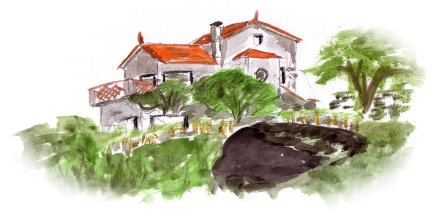
These are posts from our old "Tabua Blog", which we kept until it was destroyed by some kind of malicious code attack back in around 2009. The posts are presented in 'reverse' order, meaning the oldest are at the top, so as to give more of a sense of the historical narrative (if it isn't pretentious to call it that). Japanese and English entries are interspersed in order of original posting. Among first few entries are some that record our last few months in Tokyo before moving out, as well as trips to Portugal to finalise the purchase of our house.
In the beginning....
...after so many years in Tokyo, we had this idea that Portugal might be the ideal place to live. In a way we feel forced out -- with an exhaust outlet for a new monster expressway tunnel about to spew NOX over our home here in the centre of the smoke. But whatever the reason, it started with that little thought. And then we came back from a visit to Portugal in May 2004 with a promissary contract on a house in Tabua -- a small town somewhere near the centre of the country. This web log may, if we can find time to keep it up, become a record of what transpires as we try to shift our focus and our life from this Asian metropolis to a house renovation project in the countryside of Portugal.
はじまり
カナダのモントリオールに5年近く留学して帰国してから早くも15年。いつかまた、異国に住むぞと思い続けていました。東京での生活はそれなりに面白かったけれども、やはり、日本は私にとっては住み難い。
パートナーのスティーブもそろそろヨーロッパに帰りたいと言いだして、ヨーロッパへの移住が何となく現実味を帯びてきたのが2年ほど前。それまで、そのうち英国かヨーロッパのどこかに移住しようと冗談半分に話はしていましたが、実現するなどとは考えていませんでした。移住するならばどこにしようか...? 英国は物価が高いし、家なんてとてもではないけれども購入できない。どこかで自給自足に近い暮らしをして、世界化してしまった現代の経済機構から抜け出したい。そのためには耕す土地も必要だ。
以前私が何度か訪ねたことがあるポルトガルならば、物価はまだ安いし、いつもどんより曇っている英国よりも季候はいい。それに、二人とも話すことができないポルトガル語が母語の国だから、英国に行くよりは二人にとって公正でもある、等々。
2003年11月に初めて二人でポルトガルを訪れました。簡単に住みたい場所が見つかると思っていたわけではありません。住みたい家や場所を見つけることが難しいのならば、どこかに家かアパートを借りて、数週間もしくは数ヶ月住み着いて探す必要があるかも知れない、と考えていました。2004年5月、状況は急展開。タブアという小さな街の郊外に気に入った家が見つかり、覚書を取り交わして帰国。9月に再度、ポルトガルを訪れ、購入手続きを済ませました。そして、2005年2月10日の深夜、重量制限ぎりぎり(以上)の荷物を持って、スティーブと私はリスボン空港に降り立ちました。
Various Photos
Tuna! On sale at the early morning fish market at Numazu port, Shizuoka prefecture.

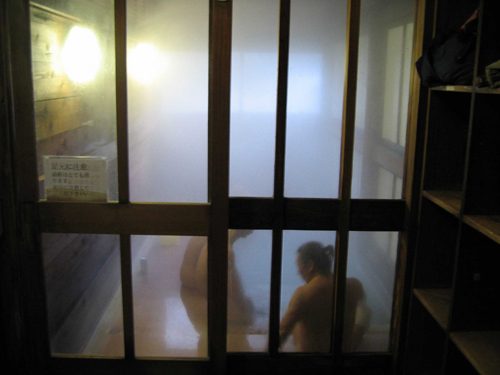
From a skiing trip last season to Zao Onsen, in Yamagaga prefecture. This is one of the free council-run baths in this hot spring resort.
Brushes used to stencil dyes onto silk at a workshop near us here in Shinjuku, Tokyo -- originally a working factory but now a museum.

This one was also taken back in the colder weather. Steamed buns for sale on the street in Yokohama Chinatown. One of my favourite winter snacks!

About Tabua
We came across Tabua quite by accident. It just happens to be where the estate agent Imobitabua have their offices.
We'd seen their property lists prior to our second property-hunting trip to Portugal in May this year. They seemed to have quite a selection of places available, and we had driven through the area before, so we decided to take a look. The house we chose was, if I recall correctly, the first they showed us.
Actually, the house is in the tiny village of Oliveira de Fazemao, a couple of kilometres away from Tabua. Tabua itself is not that remarkable; a small town, with some nice cafes and OK restaurants. But it certainly doesn't have the charm of some other nearby towns and villages with their cobbled streets and winding lanes. It's more businesslike than that, and seems to have good shops (including a reasonable supermarket), library, etc.
The area is very rural. Tabua is right on the edge of the Dao wine region, so there are grapes everywhere. Also olives. But it is also quite hilly so there seem to be few large farms. Nearby is the Mondego River which, as our Portuguese teacher keeps reminding us, is the only major river in the country that does not rise in Spain.
Mount Fuji
A view of Mount Fuji from the seafront at Numazu, in Shizuoka prefecture. We came here for a weekend in late July.

First Pictures
I've posted a few photos to give an overview of the house. Click on the "More" link to see them...

Aerial view showing the house and garden. The boundary is marked by a wall around most of the circumference; you can clearly see the line of grape vines growing atop the wall. Off to the right is a steep wooded valley with a small stream at the bottom. (This photo was taken in 1964, but almost nothing has changed since! The garden is a bit greener, though...)

This is a view from the south east corner. The main (nearer) part of the house is granite and about 100 years old. The more modern section (including the garage) is mostly concrete and added much later. The ground floor consists completely of storage areas at the moment; there is no internal access to the lower part of the granite building.
From down the hill. You can see how much of a gradient the house is on. In fact, on our map, the 285m contour line runs right through the house!

View from across the valley. Note the huge granite boulder immediately outside our boundary. All the other houses in our tiny village are beyond our house in this view.
Leaving for Portugal Tomorrow
Tomorrow we fly to Portugal to finalise the house purchase. We are both really looking forward to it, although undoubtedly we'll have some problems with Portuguese bureaucracy as we go through all the legal procedures.
The owner will be in Tabua from September 17th, which is a little later than we expected. Sometime after that we should be able to do the final transfer of the deeds, and then the keys will be ours. Meantime, he has assured us that we can enter the house (his mother-in-law next door can give us the keys), which means we can take a closer look and begin discussing details with the architect, Paulo. Thus far, Paulo has been a little slow at responding by email and we haven't been able to make as much progress as I'd hoped. Of course, Portugal hosting Euro 2004 earlier in the summer didn't help... the whole country seemed to shut down for a month. Then there were the Olympics?
Anyway, with luck he'll be able to come up with some suitable plans within a reasonable time, and these will have to go to the town administration for approval. Apparently it can take 3 months to get a response, so we want to get them in as soon as possible.
So, the priorities on this trip are simply to complete the transfer and make enough progress with Paulo that he can finish up without us being present. We'll see if we get that far!
Completion Date
We have a contract completion date! So on September 21, if all goes well, the house should be ours. On that day, we have to pay the balance of the purchase cost, as well as all the taxes and transfer fees. It's all done in front of a public notary and in the presence of our lawyer.
Meantime, we are meeting the architect at the house this Wednesday. There's lots to discuss -- not least why the current registration documents record a house (for habitation) of 58 square metres ground area, and two storage buildings of 42 and 132 square metres. The 132 square metre building does not exist at all -- and if it did, would be huge!
We don't know if this is a good thing (ie allowing us to build a large garage/workshop if we wanted to) or a bad thing (meaning we have to pay higher taxes), nor even whether it will have to be put right before we take over the property. We hope to find out today!
It's Ours
We completed the contract -- after a slight delay to sort out document problems -- in front of a public notary on September 23rd, so the house is now ours.
That didn't stop the owner using the alembic (still) in the garage to produce his local grappa in the days that followed! In fact, when we left Tabua on September 26th he was still beavering away at the task, while at the same time removing his huge collection of junk from the house and storage areas. But all that is alright, as we can't do anything with our new property until we return in January to start renovation work. Meantime, the owner is keeping a set of keys -- which will give the architect access over the next month or so.
Onsen Near Tabua
During our recent trip, we spent many happy hours driving around "our" new area. Of the many interesting things we found, perhaps most intriguing was the hot spring town of S. Gemil.
In the middle of the town, we looked down from a bridge over the river to see an almost-Japanese sight -- a pool at the river's edge, bubbling with hot water rising from the gravel bed. An open-air hot spring bath, or "rotenburo" (?I?V???C), just like the ones we love so much in Japan! Well, almost... In this case, it is less than knee deep, and looks very under-used. After moving to Tabua, we might come over one night with a shovel to dig it out to suitable depth for bathing....

Typhoon

Saturday evening, October 9th, outside Yokohama Station. We were a little surprised to be met by a cascade of water down the stairs into an underground shopping area as we attempted to reach street level. This is the sight that greeted us when we did find a reasonably dry exit -- floating cars and a Starbucks knee-deep in water!
Garden Plan
Here's a rough plan of the site that I made during our September trip. It shows the grapes (black dots) as well as the various other trees on the land. Most we identified, a few we couldn't.
Garden Plan

Total area of the plot is about 1,600 square metres. There are 200 vines, three orange trees, a few olives, and one large cherry. The dark lines on the plan are low granite retaining walls. The numbers are counts of grape vines, not lengths!!
Climate
So what's the weather/climate like in and around Tabua?
Haven't a clue really. We've spent at most a month in the area -- so the other 11 months are bit of a mystery! Still, I think we can expect it to be reasonably warm, perhaps quite hot in August. Olives and oranges grow in our garden, so we assume it won't get that cold during the winter -- though the neighbours have told us many times that it gets quite frosty. The nearby mountains get snow; there's skiing. According to people we've met, the winters can be a little damp and windy. So it will be a real contrast with Tokyo, where our winters are cold but bright and clear, while the summers are hot and humid.
Anyway, to check the current weather in the nearby city of Coimbra, try here at Weather Underground. We think Tabua is generally a little cooler and less humid than Coimbra -- we are a couple of hundred meters higher in elevation.
January 2005 Status
Well, here we are and it's January already. Here's an update of where we've got to.
First, we have a date for leaving Japan: February 10. It'll soon be time to finalise the tickets, so it's now unlikely to change. We are also ready to ship our belongings -- that should be happening this Friday, January 21.
Our architect, Paulo, has completed the plans and submitted them to the council for approval. Though they aren't perfect -- we still want to make some small changes -- we are quite pleased. I'm going to put the ground and first floor plans in here...


And just for good measure, he's an E-W section through the house...

Finally, it looks like we have an apartment to move into as soon as we arrive. It'll be in the centre of Tabua, and by the standards we've got used to in Tokyo very large. This means that visitors will be very welcome even before the house becomes habitable...
House Elevations
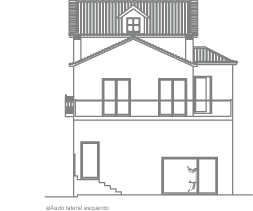
Here are a couple of elevations from Paulo, our architect.
First, from the south. This is the "road" side, so the main view -- except that it's almost impossible to get a good view from the lane because it's so narrow and has a steep rocky bank on the other side...

And this is from the east. This, in fact, is the elevation that most people will see as it's the view from the approach up the hill.
We Made It!
Well, we finally made the big move to Tabua. We arrived at our cold and dark house at 4am on February 11 after a long journey from Tokyo (via Amsterdam). Unfortunately, we found the kind neighbour had locked all our bedding into a room for safekeeping and taken away the key -- so our much anticipated slumber turned into a frozen wait for dawn!
Next morning we went to our agent, who was supposed to have set up everything for our temporary apartment. But there were problems here too -- some fiscal registration issue meant we could not sign the contract, and therefore could not have water/gas/electricity connected. We are still in the process of resolving these problems -- and in the meantime are living in our house. Or perhaps "camping" would be more descriptive of the situation. We have water and electricity, but no heat or hot water. Not completely comfortable given the weather (below freezing at night, but nice and warm once the sun comes up).
As a result of this, we have not even begun the process of getting a phone line and ADSL connection for the Internet. When this will happen is anybody's guess at the moment.
But we have been keeping occupied. Megumi has somehow taken it upon herself to prune the grape vines -- all 200 of them. About a third done so far. As for me, I've been doing odd things -- including harvesting some of the oranges, of which we seem to have about a tonne on our three trees. We've been drinking quite a lot of freshly squeezed juice!
Well, that's all for now. I hope to upload a few photos soon.... Perhaps in the next few days or so.
A few photos
OK. So here are a few photos from the past week or so...
We are still living without hot water, and certainly without an Internet connection, so it is taking a bit of time to get things together...

Ours is the white house in the centre. Behind, you may just be able to make out a little snow on the mountains. That is Portugal?Ls only ski slope!

Our first crop -- a bowl of oranges! The three orange trees must have a ton of fruit on them. Unfortunately it is going to waste -- much ruined already by frost. (Marmalade, anyone?)

Our second day here; one of the local shepherds brought her sheep to a neighbouring garden. We are planning a lawn, and sheep may be cheaper than a lawnmower...

This is the ski slope in close-up. With a Sunday afternoon free, we went for a look. The snow is artificial (no precipitation here for the past four months!) We guess that in a normal year there is more snow and back-country skiing should be possible...
Still Waiting for Phone/Internet
Here we are, almost three weeks after arriving. We do finally have water, electricity, hot water, and a washing machine at our temporary apartment. But a fixed phone line and the Internet have yet to happen, so we are still relying on 30 minute sessions (free) at the local library. Until we get this resolved, I would expect blog entries to be few and far between! But as soon as we are connected, I'll upload some more photos of this area -- and of the snow covered mountains we can now see clearly after some bad weather last week.
Finally!
Well, it's the first of April and it may be an April fool, but it looks like we finally have our ADSL Internet connection. It's been a long saga. What should have taken "5-8 days" got held up first by an error on the line (according to Portugal Telecom). I must have spent many hours on the phone to them ("Push 1 to speak to a customer services representative, 2 for....", etc., etc.), and somehow managed to keep my calm! Finally, the day before yesterday, the ADSL link was made -- but we couldn't complete the sign-in process because of some registration error or network problem. I finally talked to the engineering supervisor this morning -- after the call-center employee said it would take another working day (ie Monday) to fix -- and he seems to have made it happen. Of course no one told us we were ready to go -- I just tried it on the off-chance, and here we are -- up and running. So expect more regular postings to this blog from now on....
House Latest
It's over a month since my last update here because of the difficulties we've had getting an Internet connection. But now we've cleared that hurdle, I can bring things up to date.
The basic situation is that we are still waiting for approval of our plans from the local authority. However, as much of the work we want to do is renovation, this shouldn't necessarily prevent progress. At this stage, though, we are still talking to builders and trying to obtain estimates for the work. We've seen the work of two builders recommended by the architect, and both seem competent. They have done some nice renovations. We are hoping to get quotes this coming week, and are expecting them to be way more than we can afford; the idea is to then cut down the work -- leaving some parts of the house unfinished -- until we reach an affordable price. Builders seem quite open to that kind of negotiation.
At the same time, though, we are hearing of difficulties with builders from people we meet around here. There seem to be problems with cheating (like quoting for fully insulated walls, but then stuffing a little insulation around door and window frames to make it look as if it has been done...), as well as simply with getting the work done at all (delays of years seem common). We are hoping that our architext Paulo has weeded out builders who might operate like that, but we really don't know.
Anyway, we will wait for these quotes. If we are not happy with them, we are thinking of contracting the work in smaller parcels -- perhaps the walls and roof first, windows and doors separately, etc., etc. That way each contracted step is smaller and if the builder just doesn't show up -- or keeps promising to come "next week" -- we can soon find someone else to do the work (or take it over ourselves).
For the moment, though, we are still expecting to get as much work as we can afford done by one builder. We are hoping to start sometime this month, and it seems that a typical project is finished in one work season (ie by the autumn or early winter). Here's hoping....
Meantime, we ARE progressing with the garden. I'll start a separate category for that... Coming soon!
ポルトガル便り 1
皆さん、お元気ですか? ポルトガルに来て一ヶ月やっと少し落ち着きました。ポルトガルは気候がいいから(だけではないけど)と思って移住を決めたのに、今年は40年ぶりの寒波だとかで、2月一杯、毎日霜が降りるような寒さ。東京の方がよっぽど暖かかった。何で今年に限って...。
住み始めると同じ村のポルトガル人だけではなく、ポルトガルに住み着いた外国人とも知り合いになります。去年初めてタブア辺りに来た時よりは、かなり人数も増えたような感じがするのですが、まだあまり見かけません。特に東洋人は少ないので、私は地元ポルトガル人の子ども達から異星人を見るような目で見つめられます。
さて、最初に家を建て直すことから始めなければならないのですが、建築許可がまだ降りないだけではなく、建築業者も決まっていないために、家そのものはまだ、まったく手つかず。雷集中には何とか数人の建築業者に会って、見積もりを取ってどの建築業者を使うのか、決めたいと思っています。
現在は村から2キロほど離れたタブアという街にアパートを借りて住んでいます。まあ日本でいう「高級」マンションなのだろうけれども、作りはまあまあ。いろいろと問題がありました。
ポルトガル人は時間を気にしないから、何でも時間がかかる、と何度も聞かされてきました。これって、ポルトガル人はそういうものなのだ、と全面的に受け入れるべき? それとも、いや、私には私の限界というものがある、とある程度以上は我慢せずに強く主張すべき? 私はやはり、ある程度以上は我慢できない。
ポルトガルに今回来る数ヶ月前から借りるアパートの家主には2月に入ったらアパートを借りたいと思っているとメールを出してOKを取り付けていたのに、いざ来てみたら水道、ガス、電気がどれもつながっていない(!)ということが判明。購入後5年間、これまで誰も住んだことがないという状態。電気やガスがなくても、水さえあれば何とかなるのだろうけれども、水道メーターがついていないのではお手上げ。
一方でこれから建て直す家の方は、去年9月に来たときに一応布団や羽毛の掛け布団などを持ってきていたので取りあえず、泊まることはできる。水も井戸があるし、電気も前の持ち主(アパートの家主と同じ人)がまだ切っていなかったので、電気も使える。ということで、アパートに水道メーターが着いて水が使えるようになるまでは家で暮らすことになりました。
家で暮らす、とは言っても、暖房器具があるわけではなく、使えるのは2階の居間と寝室だけ。取りあえずは羽布団があるのでベッド中は寒くないけれど、暖房器具がないので夜は寒くて仕方がない。ガスボンベで使うガスコンロを購入してお湯を沸かしたり簡単な調理はできるようになったけど、シャワーもない。朝起きると、霜で一面真っ白だし、入口のドアも上部が開いているので(スチール製のドアでガラスが入っているわけではない)風が強いと2階まで吹き上げてくるし、それでなくともドアの立て付けが悪いのですきま風があちこちから入ってくるような状態で、最初の数日間は夜も8時頃になると寒くて寒くて歯の根もあわず、9時頃にはとにかくベッドに入って暖まろうという感じでした。朝も、早く目が覚めても寒くてベッドから出られず、十分に太陽が上がる頃までベッドに入っているという状態。そして震えながら服を着て、車でタブアの行きつけのカフェに行って(店の中は暖かい)、暖かくなるまでコーヒーを飲みながら粘る。
Permission Granted!
Well, we have heard from Paulo that the local authority has granted planning permission for our building work. This is good news, particularly as there were no conditions attached! Apparently, we also have a quote from one of our builders -- senhor George. It's slightly higher than what I expected, for the whole job -- but not way out of order. The problem now is to negotiate down to something we can afford for work that is meaningful; our aim is for at least part of the house to be livable. It remains to be seen whether that's possible.
Last week we aired our various concerns about builders with Paulo. He seems pretty confident we'll have no major problems with either of the builders he's selected. Maybe he's right -- we'll just have to see. At least it is looking likely that we will be able to parcel out a large part of the work to one company in one piece; this will be much easier than trying to manage lots of separate contracts....
Bicycle Madness
My bicycle arrived as part of our shipment from Japan. (Did I mention earlier that our stuff arrived on March 30th?) And on Saturday, we went off to Seia (near the Serra de Estrela mountains) to pick up one for Megumi. She'd spotted the bike she wanted last week, but in the end decided to upgrade to something else. It's a Portuguese-made mountain bike, but with Japanese (Shimano) components of course. Quite a nice machine.
Anyway, both of us now having bikes, we decided to use them yesterday (Sunday). We rode up to the house, then on to the house of some friends in a village called Sinde, not more than 3-4 km away. It was a lovely ride, and then a very nice mostly-downhill ride back into Tabua. Meg hauled her bike up to this third-floor apartment (no lift). I left mine behind our car in the garage -- locked of course.
A couple of hours later, around 7pm, one of the neighbours came ringing our doorbell. She doesn't speak English, but I understood enough to know that something was going on with my bicycle. I went down to the garage to find the rest of her family -- husband and two daughters -- there with a young lad. My bike had bits hanging off it! They were desperately trying to make me understand -- and eventually I did -- that they'd come in and caught the lad taking off the nice Shimano components!
He denied it, of course. But why else was he in the garage, hands on my bicycle. They asked if I wanted to call the police, and at first I said yes. But it seemed clear they thought it was overkill. The lad kept telling us he'd fix the bike -- he seemed to be an expert! He also said he'd pay for any parts needed -- surely a sign of guilt... Anyway, I decided not to involve the police. In the end, it was clear some parts were needed. He'd damaged one of the gear cables, and somehow a bolt (rear brake arm retainer) had gone missing. We agreed I'd get the parts and invoice him for them!
All this seems quite reliable, as the people told me they knew him; he lives across the square with his mother. All very odd. I'm still not quite sure what was going on; he appeared to have no tools with him, yet clearly some tools had been used to take the parts off. And why would he set about stealing bike parts in daylight, and just outside his own home? Most odd, but we are all convinced he was somehow involved in what was going on...
The Learning Begins!
Neither of us have ever had a garden before, nor attempted to grow anything aside from the odd carrot or herb. Now suddenly we have over a thousand square meters of land and a desire to become mostly self-sufficient in vegetables. Where to begin?
Well, the good news is that the land has been cultivated for many years and has been reasonably well looked after. There are grapes and a number of fruit trees as you can see on the rough garden plan, here. The rest has been used for potatoes, cabbage, kale, beans and other vegetables common around here. That's quite a lot of land, so the first thing we did was set about turning part of it into lawn (or perhaps rough meadow might be a better description). That should reduce the area we have to worry about!
Our bible is a book given to us by my sister Barbara: The Royal Horticultural Society book of Organic Gardening. This publication is an advocate of the no-dig bed system of vegetable production -- and the "no-dig" bit sounded good to us! So in March, we set about gradually creating beds in three areas to allow a three-year rotation system. We fixed on a bed size of 1.2m wide by 4m long, and will try to stick to this as much as the topography allows. So far we have three beds planted or sown, plus one and a half seed beds (not very successful). We are gradually taking the land over from the previous user, our neighbour Alice. She's had kale on much of it through the winter, and after a spring crop it is now coming to the end of its cycle.
We began by planting just small quantities -- we don't want huge gluts of produce! Lettuce, capiscum, tomato, salad kale, and beetroot came as seedlings from the market. We are also attempting to grow rocket, tomatoes, and various herbs from seed. Also some Japanese vegetables -- daikon and gobo (Greater Burdock) so far. These latter are going great guns, while local seeds all seem to be struggling. It seems we may have sown many of them too early. As I've already implied, we have a lot to learn!
ポルトガル便り 2
早いものでもう4月も半ばになってしまいました。暖かくなるとあっと言う間で、桃、梅、桜とほとんど同時に咲いて、日本の桜が満開だと聞く頃、ポルトガルの桜は葉桜になっていました。広場の噴水が凍るような寒い冬の日々は、いったい何だったのだでしょう。
今はアパートに電気、ガス、水道以外にも電話線が入り、ADSLもつながり(一ヶ月もかかった)、冷蔵庫も買い、どうやら文化的な生活ができるようになりました。それでは、前回以降の近況をお知らせします。
2月末。2週間経ってやっとアパートで水が使えるようになった。だが、問題がなかったわけではない。ある日、水道屋の作業員がメーターを取付に来るというのでアパートで待っていたのに誰も来ない。水も出ない。連絡すると一時間前に作業を終了したという。メーターを見に行くと、人が住んでいないアパートのパイプにメーターがついている。作業員は作業だけやると何も言わずに帰ってしまったのだ。今日は金曜日。今、何とかしてもらわないとこの週末も水が使えない。ケータイに電話をかけて呼び戻すと(私達がかけたわけではないポルトガル語を話す不動産屋にかけてもらった)、機嫌の悪そうな二人がやって来た。金曜日の夕方6時である。すでにどこかでワインでも飲んでいたのだろう。私達のアパートのパイプをさして、ここにつけてもらいたいというと、メーターの取付位置が左右逆になるので必要な部品がないから、取り付けられないと言い出す。この時間で必要な部品が手に入るとは思えなかったが、これ以上待つつもりもなかったので、「何が何でも今つけてちょうだい」と彼らが出られないようにアパートのドアの前に立ちふさがって迫った。作業員は翌日朝10時に来ると約束して帰った。そしてもちろん、来なかった。
この週末、オーランド(私達の家の元の持ち主。リスボン在住で、退職したら隣りの妻の実家に住むことになる。借りたアパートは彼の息子のアパート)が村に帰っていた。彼がどういうわけだか町役場の出納係という友人に頼んで、メーターを付け直してくれた。水道局の作業員がどうなったのかは知らない。これまで、水道料の請求書も来ていない。水が使えるのでアパートの掃除をして村の家から布団やガスコンロをアパートに持ち込み、この日からアパートに住み始めた。室温も外気よりは少し暖かいし、すきま風もほとんど入って来ない。暖炉があるので、火をおこすこともできる(後にこの暖炉の設計がよくないことがわかった。風が吹くと煙がすべて部屋の中に逆流してしまうのだ)。何という進歩...。
水が使えるようになったので、温水器と洗濯機を購入する。そして低い水圧が問題であることがわかった。温水器をキッチンに取り付けたのだが、離れた場所にあるシャワーを使うと途中で温水器が止まってお湯が出なくなってしまうのだ。初めて浴びたシャワーは氷のように冷たかった。何度も調整し直して、一応使えるようになった。
3月に入ってやっとアパートの電話がつながり、それからさらに4週間近くかかってADSLが入った。3月末に日本から送った荷物が届き、4月始めに冷蔵庫を購入。やっと生活しているという感じになってきた。
4月に入ってもまだ家の建築業者は決まらず、家の改築はなかなか進まないけれど、庭の手入れの方は進んでいる。3月に入ってから、芝生の種を蒔くために庭の一部を掘り起こして足で踏んで地均しをしたり、苗床を作るために土を耕した。
今年の冬は例年になく寒かっただけではなく、去年は干ばつ状態。一年間で5日くらいしか雨が降らなかった。そのせいで水飲み場の水が涸れ、この時期ですでに森林火災が何度か発生している。庭に井戸があるので家は今のところ特に水の問題はないが、このまま雨が降らずに夏になってしまったら水不足と暑い時期の森林火災が心配だ。
3月半ば、昼間はかなり暖かくなる。スーパーでクロスグリとスグリ(カッシス)の苗木を買ってきて植える。数日前から曇ってきたので、雨が降るのではないかと期待していたがやっと、お湿り程度に雨が降った。市場で買ったレモンの木やトマト、レタス、ピーマンの苗を植え替えて、ハーブの種をまいた。さらに数日後、ジュディからもらった月桂樹を植え、そろそろ時期も終わりに近づいたオレンジを収穫し、ゴボウの種を蒔く。それでも、お湿り程度の雨では土の表面はすぐに乾燥してしまう。
大陸的、というのだろうか。こちらでは数日かけて段々と雲が厚くなってから雨が降る。降り出すと豪雨や雷雨になることも多く、よく停電になる。年に数回、強風(と言うよりは暴風)が吹く。2月末には風で停電。
3月19日、一日中何となく曇っていたが、セイアという町から夜帰る途中、ぽつりぽつりとフロントガラスに雨粒があたった。セイア郊外の森林地帯は森林火災で黒く焦げ、所々でまだ赤い火が見えた。消防署は雨が降ることを期待して、消火活動をしないのだろうか...? 20日の夜、雨。21日の朝起きると雨はすでに止んでいたがアパートの前の広場や道が湿っている。
今日こそは芝生の種を蒔かなければ、次、いつまた雨が降るかわからない。10時頃から種蒔きを始める。午後1時過ぎ、4分の3くらい終わった頃に雨が降りはじめた。昼食後、少し作業を続けたが、段々雨が激しくなったので中断。そのうち横殴りの雨になったので、種が流されてしまうのではないかと心配になった。この日から2週間ほど、雨が降ったり止んだりの天気となる。芝生にとってはタイミングがよかった。夏の水不足を解消するにはほど遠いがレタスなどは元気になった。雑草も元気だ。蒔いたハーブの種も芽を出したようだが、雑草の芽に紛れてどれがどれだかよくわからない。イースターが過ぎた頃、芝生が芽を吹き始めた。
イースターの週末
3月20日はイースターの一週間前で棕櫚の聖日。詳しくは知らないが裁判に連れて行かれるキリストの前に人々が棕櫚の葉を投げたとか言う聖書の話にちなんだ聖日らしい。サン・ジョアオン・ダ・ボア・ヴィスタに行くと、教会の回りに月桂樹の枝を持った人が沢山集まっていた。
一週間後のイースターの週末、村は帰省した家族で賑やかだ。村の人口も4倍くらいに増えている。オーランドとエレナももちろん帰ってきている。二人に昼食に呼ばれる。干し鱈の雑炊。これがイースターの伝統的な食事かどうかは知らないが、ポルトガルの伝統的な食事であることは確かだ。
アリスのカフェに毎日顔を出すおしゃれなオデットとその夫ジョアオンが家でイースターのためにパンを焼いていたので見に行った。ジョアオンは昔リスボンでパン焼き職人だった。スティーブが作るホット・クロス・バムと形はずいぶん違うが、材料はあまり変わらない。ガレージの裏にあるオーブンを薪で暖めている間、アデガ(ワインなどの貯蔵室。大抵家の1階部分にある)や家の中を見せてもらう。築300年以上の石造りの建物を11年前に改築した家である。庭も手入れが行き届いている。彼が全部やるのよ、とオデットが言う。
オデットはフランス語と英語を少し話すが、話している間にポルトガル語と混ざってしまうので、お互いに何の言葉を話しているのかわからなくなる。
イースター当日の昼食に招待された。パンを焼き終わったらオーブンに入れるのだと下ごしらえをした明日の昼食(ラム)を見せてくれた。夕方、アパートに帰ろうとしていると、オーランド達にまた呼び止められて、夕食に誘われる。毎回毎回、悪いかなとは思ったけれど、断るのも悪いような気がする。アリスがチェリソ入りのパンを作っていたので、パンとスープをごちそうになる(もちろんワインも)。
イースター当日。今日から夏時間。午前10半頃から、村に牧師さんが来て、村の家を一軒一軒回ってお祈りと祝福をして回る。私達は見物するためにその時間にあわせて村に行った。牧師が数人の信者(アシスタント?)と一緒に回ってくると、アリスとオーランドとエレナが私達も家の中に招き入れてくれた。ポートワインやチョコレートやチェリソのサンドイッチなどをきれいに並べたテーブルのあるダイニングに牧師と私達も含めて回りにいた村人が囲む。牧師は祈りを唱えて、木の枝を水に浸して水を撒く。十字架に磔にされてたキリストの像にみんな口づけをする。お布施を渡してから、ワインを飲み、サンドイッチなどをつまむ。そして牧師は次の家に行く。私達も次の家に行って、また、祈りを聞き、祝福してもらう。
昼、オデットとジョアオンの家に行くとラムとジャガイモが柔らかく焼き上がっていた。自家製のワインとポルトワイン、デザートも二種類、準備してある。オデットは、ラムに塩を入れすぎちゃった、うまくできなかったわと何度も謝る。確かにちょっと辛かったけど、そんなに悪くはない。オデットは気にして、次はもっとおいしいものを作るわね、と何度も何度も繰り返した。
初めてのお客さん
メールをチェックすると、是月さん一家からメールが入っていた。彼らは自然農場を持っている。聖マタイ農場と言って、有機農法でワインなどを作っている。田舎生活を経験できるファーム・ステイもやっている。「地球の歩き方」で連絡先を見つけて、去年9月に泊まりに行った。この週末にこちらの方面に来るから遊びに行くという。
特に私達は用事もないので、是非どうぞ、と返事を出した。二日後、一家3人揃ってやって来た。中国人はタブアにも数人住んでいる、この辺りで日本人に会うことは先ずない。ポルトガルで知っている日本人は是月さん一家と、私達よりも一足先にポルトガルに来たポルトガル語のクラスメートだけ。この辺りで多いのは英国人とオランダ人だ。
是月さん一家に家を案内して、そのうちに遊びに行く約束をして別れた。
その他
毎月最初の金曜日にタブアから車で15分くらいの郊外にあるカフェ・バーでジンベエ(アフリカのドラム)のジャムセッションがある。ヨガのクラスがあるエスコラダ・デ・ミュジカ(音楽学校)を主催しているドイツ人女性がジンベエのドラマーで、彼女の生徒が集まってジャムセッションをやるのだ。ポルトガル全土から人が集まり始め、夜が更けるにつれて盛り上がる。ポルトガルの田舎とは思えない。4月のセッションは盛り上がった。ドラマーは15人、客は100人位。ポルトガル人は恥ずかしがりやなのだろうか、踊りたくて仕方がないのに、端の方で動いている人が何人もいた。
ファゼマオンの村人以外でも友人は増えている。3年前にここに引っ越してきたジョンとカーラ。家が近いのでアフタヌーンティによく行く。ジョンは英国、カーラはフィンランド出身。ここに来る前、ボートで世界中回っていたという。そしてヨガで知り合ったジュディとディック。ジュディは米国、ディックは英国の出身。ここに来る前、アラスカに一年半ほど住み、そこで中古のスクールバスを購入してニュー・メキシコ州まで運転していったという。そのバスでしばらく生活していた。ポルトガルに来て6年、最初の3年ほどは水も引かれていない家で暮らしながら、自分達でスレートの家を建てた。4歳半と11ヶ月の子供がいる。
家の前にある廃屋が売りに出された。7500ユーロ、日本円で100万円程度。建て直しにお金はかかるけれど、石の壁がしっかりとして広い。多分200平方メートルくらい。農地はないけれども、中庭くらいはできそう。この建物が売りに出されたら買おう、と私達は以前話し合っていたけど、今の家の建て直しの見積もりが出たら、とてもそんな余裕がないことがわかった。廃屋のある土地に家を建てる、一番安い方法は取り壊して新しい家を建てること。忍びない気がする。誰か、買いませんか?
A Builder Is Chosen?
Everyone has told us we need at least three quotes, but we've only had two. But all the same we seem to have settled on a builder to do our renovation work....
The business is run by two brothers. One is friendly and accessible, and we felt after first meeting him that we could develop a good working relationship. The other is, well, quieter and not so communicative -- but he was friendly enough as he showed us around a property they have been working on. Altogether, we were impressed; and pleasantly surprised when their estimate came in almost 20,000 euros less than the rival company. From the cost breakdown, we realized we could probably reach some kind of compromise -- the minimal work we need doing to make the place (semi) habitable for a price we can afford.
Today, we had a meeting with our architect and the (communicative) brother. Without much ado, we managed to go through the work and cut it down to something he seemed to think would be close to our budget. Along the way we discussed bathroom fittings (he's budgeted for good quality stuff), windows (aluminium or wood frames), the round window that Megumi was determined to include (can we afford a granite surround?), and the pros and cons of installing the central heating pipes later. What I expected to be rather difficult negotiations were actually a rather pleasant discussion session. We are going to meet again next week, when we'll get the revised estimate. If it's acceptable, we are assured that a start can be made in the first week of May....
Morning Mist on the Mondego
As our Portuguese "proffesor" kept reminding us last summer, the Mondego is the only major river with a source in Portugal itself (all the others rise in Spain). Here is the Mondego river (or more properly reservoir) at Tabua in the early morning light...

Work Starts Tomorrow?
So, we reached agreement with our selected builders and they are threatening to make a start on the house tomorrow!
Their final quote was more than we can really afford, but we like the quality of their work and decided to somehow find the money. The plan is for them to complete most work on the first floor, but leave the ground floor as just a weatherproof shell. We'll have to work on that later when we have the money.
Garden Poppies
Poppies growing rather wildy in our garden!

The Lawn Takes Shape
About a month after sowing, the grass is beginning to look like a lawn...

There are lots of weeds, and some big bare patches where heavy rain washed away the seed, but at least it gives us hope that we will end up with a decent area of grass. Soon after this photo, we cut the grass for the first time.
Roofless (Ruthless?)
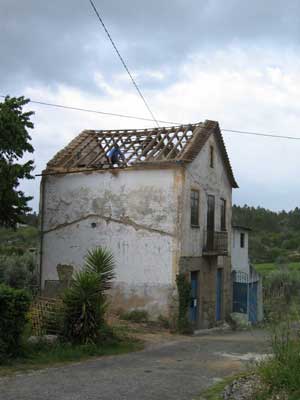
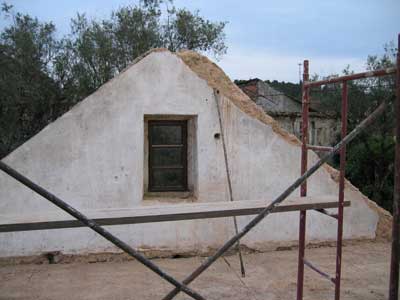
It doesn't take long to pull the roof off a house!
We went up to do some work in the garden first thing yesterday (Monday) morning. It was before 9am when we arrived, but to our surprise the workmen were there already -- and had half the tiles off. We were both feeling a little sad watching the roof gradually came off in front of our very eyes -- we know the house will never look quite the same again, yet it is this original form that originally attracted us to it. I think we'll always wonder whether we could have done something different with it, and perhaps preserved more of its original look...
Anyway, here are the pictures of work so far.

This is what we saw when we arrived on Monday morning....


Our Apartment
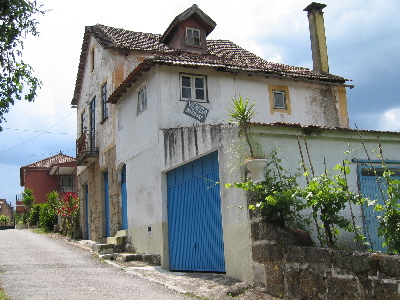
We are in the top floor apartment above the shop with a blue sign.

Garden Successes So Far....
Our work in the garden seems to be paying off, and much of what we have done seems successful. It's the beginning of May now, so I thought I'd just outline what has worked so far!
First, as I've mentioned elsewhere, the lawn is doing fine. It's a patch of grass on the lowest of three terraces making up our land, and the seeded area is about 20 meters by 4 meters. There's also an area of rougher grass -- we are gradually raking it a little flatter and sowing a few seeds over the natural meadow grasses.
As to vegetables, the most successful so far have been bought at local markets as seedlings. The tomatoes seem to be doing fine -- there are about 10 plants of some unknown variety, and they are just beginning to produce flowers. I've also tried a couple of varieties of seed -- I planted out a dozen of these a few days ago, but they remain rather small.
Various lettuce and other salad leaves are doing fine too. I've been buying a few seedlings at a time, a few weeks apart. The other day we had a few leaves plucked from the earliest lettuce. Mixed salad seeds from Tane-no-Mori (a little outfit in Japan specialising in organic seeds) are also doing well now, after a slow start. Rocket I grew from seed, in plastic modules, and later planted out the seedlings. It seems to be doing reasonably well.
Also planted as seedlings were some capiscum (green peppers/piman). These are not looking too good -- they seemed to stop growing a few weeks after planting and haven't really moved since. This contrasts with some beetroot, which are thriving! The only problem is we don't know actually what they are -- animal feed, for human consumption of the root, or for human consumption of the leaves. In fact we don't even know what colour the roots are -- red or white! A week or so ago I planted some red beetroot seeds; just today these show some signs of coming up....
Last week, a neighbour came and helped us plant a bed of potatoes (I don't know what variety) and another bed of onions. Given that we made use of local expertise, I'm reasonably confident these are going to do just fine!
Carrots.... I sowed some seeds a long time ago -- probably six weeks ago. I'd given up hope on them until this week. Now, among the weeds, I see definite carrot-like leaves. Watch this space!
We also have two varieties of Japanese vegetable grown from seed: daikon (giant radish) and gobo (greater burdock). These both require deep soil (the roots are big -- up to 80cm in the case of gobo). I grew them from seed, and they seem quite happy here in Portugal. The only problem is that the local insects seem to like such exotica -- they are showing signs of being eaten.
I've grown some coriander from seed, and they are doing well. Other herbs -- even parsley -- have failed to come up so far. Other herbs we've obtained from friends: mint, lemon balm, laurel, rosemary.
We have also been working on a little soft fruit -- black and red currants, and raspberries from a friend. These all seem to be surviving, even the raspberries (which went through a bad patch a few days after planting).
Indiana Cafe
This is one of the local pubs that we've visited a few times. Once a month, they have an open Djembe (african drum) session on a Friday night, and as our yoga teacher plays we go along. But last Friday night should have been just an ordinary evening when we popped in to meet a friend for a drink. It was ordinary until the drugs squad turned up -- a number of police in quite a few cars, and with a sniffer dog in tow. It seemed an odd time for a drugs raid, but that's what it was. Nothing was found among the dozen or so customers and staff, and after half an hour (with the doors sealed) the police moved on.
But what an odd experience, here in the remote Beira region of Portugal! We've heard that there is a drugs "problem" of sorts in the area, and it may be that there is some drugs related crime. But this flood of police seemed like an over-reaction in such a small town.
The Fruit Trees
We still haven't identified all the trees in the garden, but now that the fruit is beginning to form on many we at least have some clues. Here is a list...
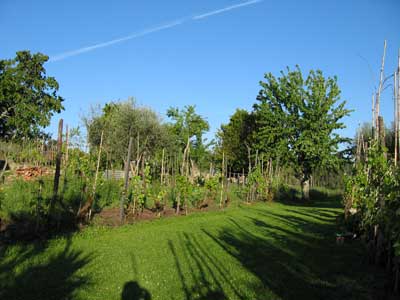
- Grapes, of course. There are approximately 200 vines -- less a few that will be lost as the house is rebuilt.
- Orange: There are three trees, of which two are actually Tangerines.
- Olive: (not a fruit, you say? well where else am I supposed to put them?) There are four or five of these, a couple of them very old.
- Cherry: One huge tree towering over the house, plus one other medium sized (and shading the new lawn).
- Peach: There appear to be at least two (judging by the slightly furry young fruits now growing).
- Plum: One at least, and possibly two. I have no idea what type of plums they would be...
- Apple: One rather old-looking tree. There are a couple of younger apples, but they have grown from seeds. They won't be any good unless/until they are suitably grafted. (A decent productive apple tree is a graft of some kind of rootstock -- there are a number of standard varieties -- and a a fruit variety.)
- Kaki (Japanese persimmon): One tree.
Demolition Continues
If they don't stop soon, there won't be anything left of the house!

Ume-shu
Ume-shu is a wonderfully simple Japanese liqueur made (usually at home) by steeping small green plums and rock sugar in sho-chu (a Japanese spirit similar to Vodka made from rice, barley, sweet potato, or anything else to hand). After maturing for at least 6 months (and sometimes up to decades), a delicious, mature, and slightly tart flavour develops. Great straight, with ice, or in the summer with soda water.
One of the trees in our garden is an ancient plum. The neighbours tell us the fruit is not that great. But this year it is laden with small green fruits -- so much so that a couple of branches have split off under the weight. Not wanting to waste the immature fruit, I thought I might try a local form of ume-shu. So we now have two large bottles of green plums steeping in local "agua dente" (lit. hard water), which is basically a grappa made from the grape skins after pressing out the juice for wine. For sugar, we had to use ordinary granulated white -- but that shouldn't make a great deal of difference. In a year or so, we'll be able to report on the success or otherwise of this Portuguese ume-shu.

At the same time, I found on the net a suggestion that steeping in wine vinegar would produce a concentrated plum juice. So I made one bottle in that style too....
Momo makes it
Our cat "Momo" finally joined us in Tabua a couple of weeks ago.
The trip from Tokyo was not much fun -- for her or for us. She found it particularly traumatic -- a whole string of new experiences, none of them pleasant! In the end, she had to spend the best part of 30 hours cooped up in a small carrier, travelling by taxi (to Shinjuku station in Tokyo), train (the Narita Express out to the airport), plane (11 hours to Amsterdam, then a 5-hour layover, followed by 2-3 hours to Lisbon), then finally rented car to our apartment (3 hours of night driving). From Amsterdam onwards, she was quite distraught and cried continuously until she finally fell asleep somewhere between Lisbon and here. Poor thing!
Our vet had given us a drug to prevent travel sickness and put her to sleep. It seemed to work fine for the first part of the journey; for quite a long period she was quiet as a mouse (or as a sleeping cat). But the second dose just didn't seem to help at all. Still, it's all over now and she seems to be settling into Portuguese apartment living quite well. The most exciting new experience for her is stairs....

Missed Cherries
Megumi spent most of May back in Tokyo, sorting out various papers for her Portuguese residence permit and other chores. I left for Tokyo later -- on May 12. Unfortunately, that was just the time when the black cherries were ripening. As a consequence, of the dozens of kilograms on the tree, I only managed to pick some 5kg. As I was going away, the best I could do was freeze some and make jam from the rest. Too bad, really. They were so good. But at least our builders enjoyed them!

The good news is that we have another cherry tree -- a different variety -- that is ripening as I write. I've already collected some 4kg, and we've probably eaten another couple of kilos straight from the tree as we worked in the garden. This tree is not as large as the black cherry, but still harvesting from the upper branches is problematic. We hope to borrow nets and ropes later today, in the hope of being able to shake some down! Pruning is the long-term answer to the problem; we'll begin work on it once the season is over.

From Demolition to Rebuilding
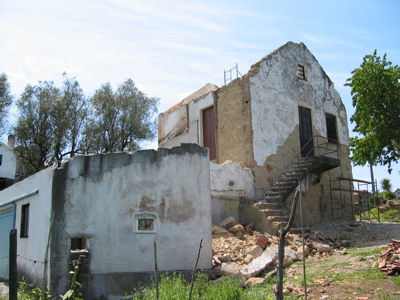
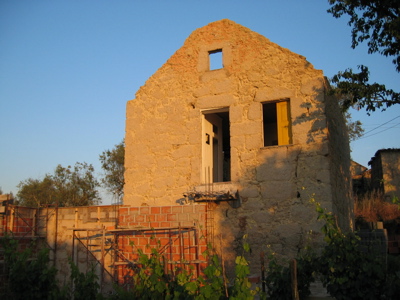
Arriving back from our Tokyo trip, we found the house beginning to rise again from the ruins!
The roof has gone of course. And the upper floor of the extension. The render has been removed from most of the old stone part of the house, so we can now see what it is made of.
May 12th
June 5th

June 8th
Jazz in Tondela
Tondela is a small market town about 30 minutes from Tabua. It doesn't give the appearance of anything grand or particularly cultural. But our Portuguese teacher Ana, herself a saxophonist, told us about a jazz festival there this weekend. We decided to go on Friday evening just to see what was going on
We arrived just before 9pm (having been told the evening's concert began at 10pm). It would have been easy to miss the venue (Culture and Recreation Association of Tondela) or mistake it for a closed and dilapidated school. But in fact, behind the boarded up school on a minor back street was a modern complex with an open-air cafe/restaurant space, chic art shop, and a buzz of people. We had something to eat, then followed the crowds to the stage -- a rather nice outdoor affair. The first band were a local Portuguese quartet (Luis Tapa T4) playing a specially written piece that I would characterize as contemporary/experimental jazz. In the interval, we were entertained by a Dixie jazz group from Belgium. The second band of the night was the Fab Trio, a peculiar but brilliiant mix of bass, percussion, and violin. Though we were pretty tired by this time -- as country types we now tend to go to bed early and rise at the crack -- we spend the whole set on the edge of our seats. It was an excellent, exhilarating performance. And especially good for being outside in the cool (cold?) mountain air.
Without being told about the festival, we would never have found it on our own. We get the feeling that's true of a lot of interesting things going on around here. And in fact perhaps that's true of Tokyo, as well: if you don't know where to look for information, so much could remain hidden. Anyway, we were glad of the hint given to us by Ana, and will look out for the 3rd Jazz in Tondela (Jazzin' Tondela) next year.
Aldina's Bread
Yesterday I had a second chance to see a Portuguese bread oven in use. Aldina bakes every Saturday for the weekly market in Tabua (Sunday mornings). Friends of ours live near her, and suggested I go to watch her bake.
She makes three types of bread: rye, corn, and regular white wheat. After firing the oven once, she fires again for a short time (30 minutes or so) between each batch (about 20-25 loaves of each). I arrived in time to watch the third and final batch.
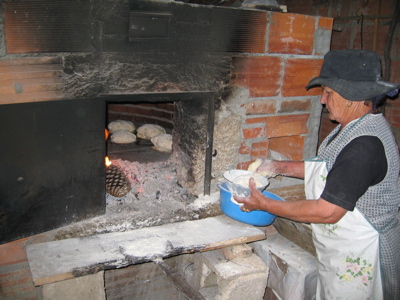
The bread-making process is just about what I would have expected. She retains a little of the fermenting sponge from one week to the next. However, when using this reserved leaven she always adds a few grams of purchased live yeast, so I don't think the yeast can be described as a sourdough. Whether this is necessary or not I can't tell; many recipes note that yeast can be used for a few generations but then has to be discarded, whereas until recently I have been using the same culture for something like 12 years.
That in itself is bit of a story; unfortunately I seem to have "lost" my yeast culture. Though I have dried and revived it many times, the dried flakes I brought to Portugal appear to have died. After such a long time, this is bit of a blow and I'm sad to have lost a familar culture. Still, Aldina was kind enough to give me some of hers, and I'll use that next weekend when we plan to experimentally fire a bread oven at a friend's place for a housewarming party. Whether this culture is anything really special (tasty!) or just the same as the local commercial live yeast that she adds every week I have yet to find out....
Anatomy of a Floor
The floor of our new kitchen and dining area, as well as the balcony, is to be of standard Portuguese construction. It's a little different from what I am used to.
The area to be covered is spanned by T-section reinforced concrete joists. In our case these are going to be cast into the concrete of a "ring beam", a ring of reinforced concrete that will be poured at first-floor height. The joists are spaced at just the right intervals to allow special concrete "breeze" blocks to fit down into them. Once the blocks are in place, the whole lot is covered in concrete to form the floor/ceiling.

Floor joists being placed into position
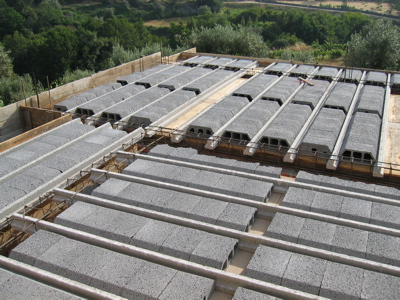
Joists in position with concrete infill blocks also laid
Two Bird Stories
We've had two funny experiences with small birds this week!
First, on Monday, our cat Momo came into the living room of this apartment carrying something in its mouth. It didn't take us long to realize it was a bird -- and still very much alive. This is not unusual; Momo has always treated her trophies very gently and brought them home uninjured. In her past life in Tokyo, she brought in everything from a rat to sparrows, cockroaches, and geckos. The worst damage she's done to a creature was to take off a bit of a gecko's tail... What was unusual this time is the fact that she doesn't (cannot) go outside; she's kept in the apartment all the time. So needless to say, we were a little surprised to find an unharmed sparrow in her mouth! It turns out that the infant had fallen through a skylight into the bathroom!
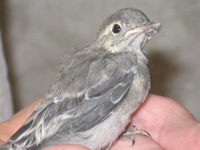
We carefully extracted the bird from her jaws and held on to it for a while. Though shocked, it seemed none the worse for wear -- but was obviously very young and only just flying. In the end, when it seemed to have recovered from its ordeal, I put it back out through the skylight. After a minute or so on the roof, it flew off and we didn't see it again.
Our second story involves a baby swallow. We were walking the few yards back from our yoga class last night, when Megumi looked down and saw something moving on the pavement -- right in front of our post office. Cowering in a pothole was a tiny black bird. At first we thought it was almost dead -- it had been a very hot day, and the pavement was stil quite warm. But although it didn't try to escape Meg's hand, it was clearly alive and reasonably healthy. We decided to bring it home, where we discovered it had one damaged eye -- apparently it couldn't open it (or, we thought, perhaps the eye was missing altogether). So into a box it went!
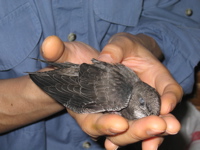
We tried giving it some water, which it drank with gusto. But it wouldn't eat the mashed beans and mashed cat food we tried. In the end, we left it in the box, closed the lid, and put it out of reach of Momo for the night. This morning it was still alive, and even looking quite well. The eye we thought might be missing seemed simply to be closed. (We thought the bird was reasonably mature -- about ready to fly. But this was judging from size alone, and it appears we may have been quite wrong. It could still be quite young, and perhaps the eyes are only just opening properly.)
This morning we picked up some special feed and a syringe from the local pet shop. That cost 8.70 euros! One of the shop staff reckoned it would be another week or so before it was ready to fly -- and reckoned we'd be able to keep it healthy and fed for that time. So there you go -- we now have a tiny bird in the house to worry about! And so no-one forgets its origins, I'm calling it "Pothole", a name Megumi finds rather unattractive for some reason....
Water Crisis?
Water should be no problem on our land -- or so we have been told. Unfortunately. we appear to have run the well almost dry, leaving us with little water to keep the vegetables irrigated.
It looks as if there was some kind of leak in the water system last Sunday night. Or perhaps some kids had opened a valve or something. Anyway, we found an unexplained damp patch in one area of the garden on the same day that the pump started trying to pull up air. The water level had gone down to the level of the inlet pipe. Of course, we might have expected something like this. It's been the dryest period on record, we have builders taking large quantities of water, and we are watering our vegetables daily. Still it is a bit of a shock to find that we are short of water, and may have to choose which parts of the garden survive. Unfortunately, the grass which has taken so much effort to get going may be the first victim, as it's hard to justify such a purely ornamental element in the garden in a drought....

The well is about 2m in diameter. Today we plumbed it with a length of string and a weight (a large spanner). Total depth is about 14-15m, but there is only 1m of water in the bottom! (We had been told that there's always been many metres of depth in the past.) Part way down the well is a concrete platform; our neighbour Alice said, perhaps seriously, it was a great place for a picnic on the hottest days of summer! One of these days we'll venture down for a better look. For the moment, though, we are hoping for a period of rain that might raise the water table a little and refill our well!
モモの引越
モモ(うちのネコ)の預かり知らぬところで、ポルトガルへの引越が決まっていた。引っ越すことは何度も話したが、理解したかどうかはわからない。
私達にしても、ネコ同伴の海外旅行(?)は初めてである。出発の半年以上前から情報を集めるなど準備を始めた。欧州連合(EU)諸国とポルトガルの、ペット輸入に関する法律と手続き、ペット同伴で飛行機に乗った飼い主の体験談、使う航空会社(KLMオランダ航空)の規定に関する情報が知りたかった。
最初に在日ポルトガル大使館に問い合わせたが、そこでつまづいた。情報がない。それでは、とポルトガル政府のサイトを見た。EUの法律に準ずるらしいことはわかったが、確信が持てない(ポルトガル語がよくわからない)。次にEUのサイトへ。2004年に変わったペットの輸入に関する欧州連合の法律、必要書類や手続きの説明がある。
EUにはオランダから入るので、オランダ政府のサイトにもアクセス。オランダ政府とEUの要求事項は同様で、ここで「家庭飼育用として欧州連合に輸入される小動物類の獣医証明書」(正式名称ではありません)がダウンロードできた。ポルトガル政府のサイトからダウンロードした書類と同じ書式である。集めた情報を総合してみると、日本も含めて狂犬病の危険がない国からEUにペットを輸入する場合には、ペットにID用のマイクロチップを埋め込み、狂犬病予防接種証明書を取得すればいいらしいことがわかった。健康診断書が必要という情報もあったが、確認できなかった。
最終目的地であるポルトガルの情報が確認できないので不安は残ったが、EUに入ってしまえば(人間の場合)リスボン空港でパスポートを特にチェックされることはなかった。ポルトガルよりも法律に厳しそうなオランダの要求事項を満たしていれば、先ず問題はないだろう。EUの法律に従って準備を進めることにした。
KLMではキャリーバッグの縦横高がそれぞれ43x31x20センチ以下、キャリーバッグとペットを合わせて4.5キロ以下であれば手荷物としてペットを機内に持ち込むことができる。これより大きくなると貨物扱いで預けなければならず、こちらでケージを用意しなければならない。機内に持ち込んだ場合の輸送費用は1キロにつき6,500円ということだった。
さらにペット同伴で飛行機に乗る飼い主のサイトから実用情報を得た。必要なものやあった方が便利なもの等、様々な情報が載っている。一番役に立ったのはケーキ箱を利用した即席トイレの作り方だった。
ペットの機内持ち込み用にデザインされたキャリーバッグがこのサイトで紹介されていたので、それをを米国から取り寄せた。しっかりしているが重く、モモと一緒に計ると5.3キロになる。800グラムの重量オーバーである。骨格が大きめのモモは太っているわけではないが重い。貨物扱いにはされたくないので5月までに何とか減量させなければならない。
2005年2月半ばにポルトガルに飛ぶ前に、モモにマイクロチップをつけて、狂犬病の予防注射を済ませた。動物病院に行くと震えながらも大人しく診察や注射を受けるモモも、タイ米ほどの大きさのマイクロチップの挿入は痛かったのだろう、「みゃん!」と一声、叫んだ。
5月に一時帰国するまでの約3ヶ月、友人のまりちゃんがマンションに住み込んでモモの世話をしてくれる。モモのダイエットを頼んでポルトガルに行った。
4月の初め頃、まりちゃんから、「モモちゃんの体重、どうしても3.8キロから減りません...」と泣きそうなメールが入っていた。心を鬼にしてダイエットしてくれたようだが、冬に体重を落とすのは難しいのだろうか。
5月に帰国してから私がモモのダイエットを引き継いだ。ドライフードは一日70グラムぐらいが適当なのだが、それを30グラムに減らした。4週間弱で600グラムの減量である。体重が落ちなければ、キャリーバッグを分解して中身を取り出し、チェックインの時だけ、4.5キロ以下にしなければならない。
出発の3週間前にKLMに電話をして、手荷物でネコを一匹輸送する承認を取った。キャリーバッグのサイズと重量も申請しなければならなかったので、制限ぎりぎりで申請。実際には重量オーバーだったが、搭乗時までに何とかすればいいことだ。
モモの体重は減らない。キャリーバッグを分解するしかないか、と思っていた時、東急ハンズで軽量のキャリーバッグを見つけた。早速メーカーに電話をしてキャリーバッグの本体と各付属品の重量を聞いた。これならいける。付属品をつけてモモを入れても4.65キロにしかならない。付属品を取り外せば4.5キロ以下になる。
出発一週間ほど前になって、KLMから新たに健康診断書が要求された。出国48時間以内に、モモが飛行に問題ない健康状態であることを獣医に証明してもらわなくてはならない。最初はこれがEUの検疫で必要なのかと思った。何度も電話をしてやっとそれがKLMの必要書類であることがわかった。
出発の2日前に新しいキャリーバッグにモモを入れて獣医に連れていった。健康状態は良好。健康診断書は問題ない。必要最低限の付属品をつけたキャリーバッグとモモの重量を計ると4.54キロ。40グラムの重量オーバーである。搭乗拒否されることはまずないだろう。
5月29日。モモは今日、一生にたった一回だけ(の予定)、飛行機に乗る。成田からアムステルダムまで約11時間。アムステルダムからリスボンまで約3時間。アムステルダムで4時間半の待ち時間がある。もちろんそれに成田空港までの所要時間約2時間、リスボン空港から家までの約3時間が加わる。約24時間、モモは小さなキャリーバッグの中で過ごさなければならない。
午前4時頃に起きて、4時半に酔い止めをモモに飲ませた。30分で効き始めて11時間くらいは眠っているということだった。モモは机の上に座って、池のコイを眺めている。モモがここでコイを眺められるのも、これが最後である。
5時。タクシーで新宿新南口へ向かう。薬が効き始めてもいい頃なのに、怖いからなのか、モモは空港に着くまで鳴き続けた。
出国に必要な書類はすべて事前に空港の動物検疫所にファクスで送ってあったので、手続きはすぐにすんだ。EUの検疫所に渡す書類の原本と保管用の複写を一部ずつもらい、キャリーバッグには「飛行問題なし」と書かれた健康診断書を結びつけ、酔い止めの薬をさらに2片飲ませた。
そしてチェックインである。書類は万端だがさて、重量は...? 重量計にモモがキャリーバッグごと乗せられる。何と重量計はぴったり4.5キロを指した。思わず「やった!」と小声で叫んでしまった。モモの航空運賃は4キロで計算され、何故か8,300円しか請求されなかった。KLM用にわざわざキャリーバッグにつけた健康診断書はチェックもされなかった。
手荷物の検査ではモモはX線を通らず、キャリーバッグに入ったまま目視検査を受けた。出入国管理では前日に私が手書きで作ったモモのパスポートにスタンプを押してもらった。これでモモは正式に日本から出国したことになる。
鳴き疲れたのか、薬が効いてきたのか、搭乗時にはかなりおとなしくなっていた。飛行中も薬でぼーっとしているのか、あまり反応しない。9時間ほどしてから、トイレに連れていった。キャリーバッグから出すと、しばらく狭いトイレの中で匂いを嗅ぎ回っていたが、組み立てた即席トイレをちゃんと使った。席に戻るとキャリーバッグの中でごそごそしていたが、また静かになった。
アムステルダムに到着して車椅子マークの着いているトイレに3人(私とスティーブとモモ)で入った。モモに水を飲ませ、餌を少し食べさせた。
ここでEUに入るためにモモの検疫を済ませなければならない。だが、入国管理もKLMも空港のインフォメーションも検疫について何も知らない。その上、検疫所は空港内にないという。チェックイン時に機内持ち込み手荷物につけられた「機内持ち込み承認済み」のシールを指して、「もう承認されているじゃないの」と言われた...?
4時間半の待ち時間があると言っても、離陸1時間前には搭乗ゲートに行きたい。国際線ターミナルから国内(含EU)ターミナルに移動した。途中、出入国管理でモモのパスポートにスタンプを押してもらった。係官は「あら、こんなパスポート見るのは初めてよ」とまじまじとパスポートを見ていた。手荷物の検査ではモモを抱いて金属探知器を通り、キャリーバッグはX線検査を受けた。
これで私達はEUに入ってしまった。モモは事実上、ノーチェックである。オランダ政府のホームページには書類がすべて揃っていなければ空港で健康診断を受けなければならない、もしくは送り返される場合もある、と厳しいことが書いてあったけれど何だったのだろうか。モモはリスボンの空港でもチェックされることなく、ポルトガルに入国した。
モモがEUに入ったことを証明するのは彼女のパスポートに押されたスタンプだけである。日本を出国した後、モモは正式には消息不明となっている。
Ginger Beer
My ginger beer has proved quite popular over the years on Tokyo, particularly during the hot, steamy summers. I've just started the process of making some here in Portugal -- in the expectation of some very warm days later this summer!
There's actually not much to it. I start the process in early summer by generating a ginger beer "plant" (as they were called when I was at school; they were often handed around among friends, much to the delight of mothers I'm sure...). Grate some fresh ginger -- about a couple of teaspoons. Add a similar amount of sugar and water. Then throw in any type of yeast you have handy -- I've used a few grains of dried yeast in the past, but more usually just take a speck of my sourdough bread yeast. Within a few hours, the mix should be fizzing away as the yeast does its work. Now, every day feed the mix with another small amount of grated ginger, sugar, and water (a teaspoon of sugar, a couple of teaspoons of ginger, and a similar amouont of water is enough). After a week or so, you should have a fair amount of fizzing liquid. Half to one litre is about the right amount.
When you are ready, boil up a couple of litres of water. Turn off the heat and add anywhere from 500g to 1kg of sugar to taste; I like to use brown cane sugar for its flavour. You could also add some lemon juice if you like. Stir to dissolve the sugar, then wait for the mix to cool a bit. You now need a container that will hold about five litres -- in the past I used a glass bottle usually used in Japan to make ume-shu. Add a litre or so of cold water (I do this to protect the glass in case the sugar water is still quite warm). Pour in the sugar water, then strain the yeast mixture into the container. (A piece of muslin is useful for this.) Squeeze as much juice out as you can, leaving only the ginger fibres behind. Now make the mix up to five litres of so using lukewarm water. Out a lid on the container, and wait until fermentation begins!
The remaining ginger fibres, which still contain some yeast, are the ginger beer "plant". Take half of it, add the usual amounts of ginger, sugar, and water, then continue as before adding on a daily basis. Give the remainder to a friend (with his/her mother's approval!) along with these instructions!
After some time, depending on the temperature, your container of ginger beer will begin to form bubbles as it ferments. I can usually see some evidence of fermentation within 12 hours or so. You now need to leave the fermentation to proceed until a suitable point. What point is that? Well it depends on how much alcohol you want in the result! If this is for kids, 12 hours is probably enough. I tend to leave it for 3-5 days depending on ambient temperature. By that time, the mix is noticably less sweet.
When the time is right, I simply decant the liquid into used PET bottles that have contained fizzy drinks. We don't drink Coke or similar teeth-rotters, so we generally use sparkling water bottles. I find they can be used a number of times before the caps wear out. The ginger beer will continue to ferment in the bottles -- unless fermentation was complete before bottling. This means you need to watch the bottles carefully -- fermentation generates carbon dioxide that can cause the bottles to burst if it builds up too much! The ginger beer will be ready to drink from the second day onwards -- and again, the longer the fermentation continues, the more alcohol there will be. If you leave the bottles more than a couple of days check occasionally for excess pressure by picking up the bottles and listening to their "ring" as you tap them. If pressure seems extreme, you can just crack the seal slightly to let out some gas.
The result should be a refreshing summer drink. If it is too sweet/alcoholic to drink straight, try adding soda water or tonic water and ice. Enjoy!
Kitchen Floor
The first stage of concreting for the kitchen/dining room floor (and the terrace) has been completed.
There will be another 15cm or so of concrete on top of this -- through which pipe conduits and the like will run -- but this gives a pretty good idea of what this part of the house is going to be like.

The reinforcing bars you can see mark the corner column of the kitchen/dining room. The brick structure to the right is the store room under the new first-floor porch. The terrace area (from which the photo was taken) extends around the "back" of the kitchen to the porch. (By "back", I mean the north side of the house away from the road, but in fact the "front" door will be on this side of the house!) You can see the large door leading from the old stone part of the house to the kitchen/dining room, and also the hole to its left where the stone stairs go down to the ground floor.

Above is the floor slab at a slightly earlier stage, when half of the concrete had been poured over the structure of concrete joists and blocks.
Fire At First Hand
As we came out of a supermarket near Oliveira de Hospital yesterday, we saw a thick plume of smoke in the air...
The supermarket is right on the N17, the main road from our area up to the Serra de Estrala mountain range. It runs high along a ridge for much of its length, and the forest fire was deep down in the valley below us. Driving a little further along the road, we found an excellent vantage point for the fire and were able to watch its frighteningly fast development.

You can just make out a volunteer fire engine (all fire fighting appears to be volunteer in Portugal) on the left. There was another group of fire-fighters even closer to the flames, but not visible in this picture. Soon after we arrived, they pulled back as the flames leapt towards them.

As we watched a helicopter turned up. It landed nearby -- perhaps to pick up a water bucket -- then began making circuits to a nearby water source, taking only a couple of minutes to get back each time with another load. We were quite impressed at the efficiency of the operation, and at how effective the helicopter appeared to be.
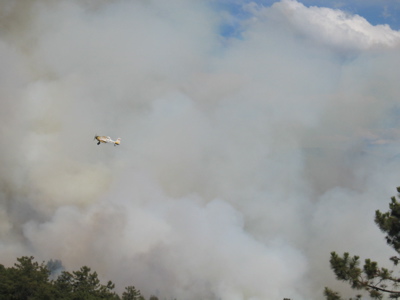
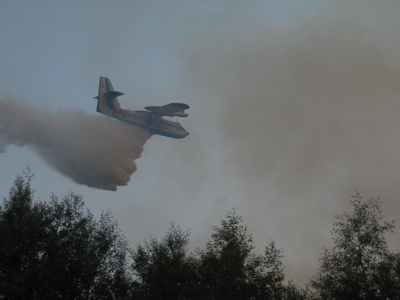
Shortly later, two small planes joined the fire-fighting effort. These had inboard tanks, and presumably had to return to base for refills. Even so, as we watched (for perhaps an hour or so) they made a number of round trips. We imagine they were flying into and out of Coja airfield, judging by the direction they came in from.

Ultimately, two helicopters, two small planes, and two larger float-planes (no photo, I'm afraid) joined the effort. In an hour or so, the fire appeared to be mostly under control, though still burning fiercely in a couple of places.
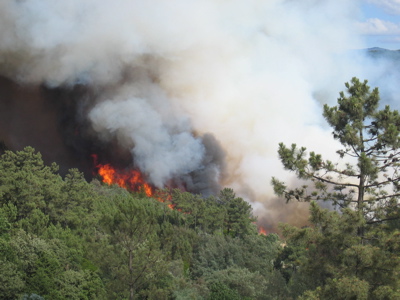
It's very difficult to judge just how big this fire was. My guess is that it burned 2-3km of trees from west to east (the wind direction), while it might have spread up both sides of the huge Alva valley (something difficult to verify from where we were). My map shows a large number of houses in the area; whether any were lost or not I have no idea. However, it seems the fire didn't make the major newspapers, so I have to assume it was a small one. For us, standing a few hundred metres above and to the north, it was quite frightening. At times the flames were invisible; hidden behind thick, billowing smoke. Then sometimes they came closer, and we could see they were towering over the trees -- probably 2-3 times treetop height. In the strong wind, they whipped around unpredictably, and we worried for the fire-fighters whom we could see on the very edge of the conflagration.
After seeing this, I must remind our friends who have large areas of woodland to get on with their fire-protection work -- most importantly clearing flammable undergrowth....
Pothole Doesn't Make It...
Pothole, the bird we picked up last week is dead.
After almost a week in our apartment, suffering the indignity of being fed with a syringe, it suddenly became unwell last night and began to have difficulty breathing. We noticed a lump near its throat; perhaps some kind of growth. Although still breathing with difficulty when we went to bed, by this morning it had, to our great sadness, passed away. Over the past week we have become quite attached to the little miracle. Such a tiny thing... (It turned out to be a swift, not a swallow, probably a Pallid Swift) . It seems incredible that such a tiny creature could fly south to Africa once, let alone every year of its life, which may be up to 20 years. For a while, we were quite hopeful that we'd be able to encourage it to fly off and join its brethren, who flit through the skies of Tabua day in and day out.
All the information we've found indicates that rehabilitating a swift is very difficult. Some people have gone to great lengths over many years to develop methods, but even then the success rate is not brilliant. I suspect that diet was a problem in this case. Swifts are insectivores, yet the feed we bought at the local pet shop was cereal-based. Pothole was never happy eating it, and it may just be that it wasn't providing what it needed. On the other hand, it is just possible that Pothole was never going to make it; there was probably a reason for it ending up out of the nest and on the pavement in the first place -- perhaps it was thrown out as a no-hoper, or maybe (as we suspect) it was unable to see properly.
Anyway, the little thing has gone. At least it had a comfortable final week (apart from those few times a day when a syringe was thrust into its mouth). We buried it in a special spot in our garden, under an olive tree. We trust it will find peace there.
Garden Latest
Since my last report on our vegetable growing, things have come along quite well. It seems we do have green fingers (or perhaps greenish fingers) after all.
For over a month, we've been eating lettuce from the garden, as well as rocket and some other salad leaves. We started off simply plucking a few leaves rather than pulling whole lettuces, in the hope of prolonging the harvest. In this we may have succeeded to some extent, but we've also succeeded in allowing lots of the lettuce to bolt and run to seed...

Just coming ripe now are tomatoes. I originally bought seedlings of some unknown variety at Tabua market. Not knowing much, I planted them far too close together, so now we have a jungle of tomato plants growing up a pyramid of canes. I also grew two varieties from seed -- Roma V and another. At first I thought they wouldn't survive, but after some time in seed modules I planted them out -- also too close together -- and these now are beginning to produce fruit. A couple of days ago, we picked the first tomato from the seedling-grown plants. Today three were ripe. I suspect we'll be inundated within the week...

The bell peppers (piman) have been very slow, and for a long time I doubted that they would do anything. These were also seedlings picked up at Tabua market. Finally, though, they flowered, and we now have some tiny (but growing fast) peppers.

Courgettes (zucchini) are another seedling-grown vegetable. They are going great guns, and we picked the first couple this morning. They were great in salad at lunchtime and also in a pasta sauce for dinner.

Snowpeas (at least that's what I think they are; they are developing more like ordinary green peas...). I sowed a couple of short rows from seed, along with edamame (a great Japanese snack bean).

Aside from the vegetables photographed, the onions are doing fine, we've harvested one beetroot and a couple of Japanese daikon, while we've been enjoying greens from an odd white variety of beet for a month or so. I've also picked some of the root; it tastes like beetroot, but is very odd because the taste of beetroot is so closely associated with the colour red.
Finally, the potatoes are perhaps best not talked about. We've got Colorado beetle, and also failed to water well enought. Fortunately, though, our neighbour Alice has enough potatoes to feed an army, so I doubt if we'll go short....
Post-Carbon Living
One of the reasons we are here in Portugal is that we want to step back from the regular economy. We hope to be less reliant on the exchange of money and on the products of the industrial world. But neither of us particularly want to cut ourselves off completely from modernity. Rather, we hope to live at a sustainable level of consumption, whatever that may be.
I don't know of a good, simple measure of sustainability. It may not be possible to come up with one, aside from a pure permaculture with zero inputs and outputs crossing ones boundaries. So, for the moment, I expect to simply adopt the three Rs (reduce, reuse, recycle) as a basis for judgement. Most important, of course, is the first R: reduce.
This is a choice we are making. But a friend's blog points out that our hand may, in fact, be forced as we go beyond 'peak oil' into the unknown world of scarce energy. How quickly will dwindling oil production affect our lives? What should be do to prepare? Check out The Post-Carbon First Aid Kit as a forum for ideas.
A Closer Call with Wildfire
On Tuesday, Megumi was taking the second day of an African dance workshop at Quinta de Mondego a few kilometres from here in Povoa de Midoes. During the lunch break, we'd been to a restaurant with friends and I dropped her back at the Quinta before heading home and then on to our friends Guido & Mariluz. On the way down the dirt track to their place, I saw smoke on the horizon -- not an unusual occurrence just now, as we see at least one fire almost every day.
I realized the smoke was somewhere in the direction of Quinta de Mondego, but didn't think much more of it. But as we sat around talking on the verandah, it was clear the fire was a big one. Here's a photo I took at 5pm:

That's a pretty big cloud of smoke! (Povoa de Midoes is the community on the horizon just to the left of the large tree in the picture; Quinta de Mondego is in the valley beyond.) I was beginning to wonder whether I should call Megumi to say the fire was nearby and possibly coming closer; I could see it was moving quite rapidly from west to east -- in her direction. But she beat me to it; a few minutes later she called to say the dance workshop location was almost surrounded by fire. Things were beginning to sound quite serious, as they had 15 workshop participants plus teachers, musicians, children and others on the property. Megumi was concerned that the firefighters hadn't shown up, but I said we'd already heard sirens and I thought I'd heard a plane or helicopter already. We hung up while I decided what I could do, and agreed to talk again soon.
Next time I called, it was clear that the only route down to Quinta de Mondego (I say "down" because it is on the south bank of the Mondego River) was blocked by the fire. I had a choice of a long drive around to the other shore, or staying put. At the time, the dance group had decided they could use a kayak to begin evacuating people across the river for safety.
Megumi and I talked over the phone quite regularly over the next couple of hours; she was keeping me up to date with firefighting activities and the progress of the fire towards the house/property. In the end, I decided I needed to do something and drove around to Povoa de Midoes. There I had to get through a road block (which I did by saying my partner was down in the fire!), then talked to fire fighters at the point where the dirt track leaves the paved road. They waved me through and said the road was just fine. Which it was, for their huge vehicles!
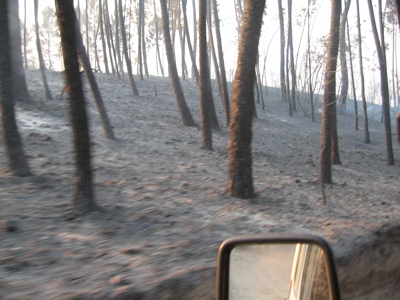

I found it rather hair-raising, with small trees down across the track, fires still burning, and thick smoke in places. I could feel the heat of the fire as I drove, and was happy to be in a 4WD vehicle, albeit our small Suzuki. I engaged four-wheel drive and raced down the track faster than I would normally attempt it -- which may explain a scratch down one side that Megumi found the following morning!

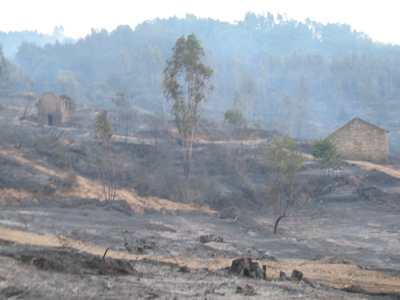
By the time I arrived, just before 8pm, it was reasonably clear that the house and guesthouse had been saved. In fact, in the end, the fire hardly encroached on the quinta at all. Still, there was a smouldering mass of burnt trees and undergrowth no more than 25 meters from the main house. On the riverbank I met a family from another house who had fled to the river, and still didn't know the fate of their own property. When I told them I'd come down the track, they decided to go back and take a look. I learned later that their house was fine. Lucky them; I saw at least two houses that had been burnt out, as well as a couple of abandoned farmhouses and a number of cars.

Elsewhere, the fire was still raging and there was a continuous noise of helcopters, planes, and sirens.
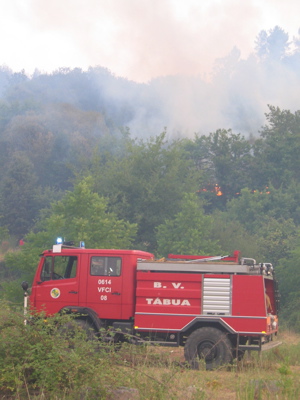
Here's our local volunteer brigade (the Tabua Bombeiros) in action on the Quinta:

Potential Wine on the Vine!
The grapes are coming along. It's amazing really -- the land is dry as a bone, and we haven't watered the vines at all. Yet here are the grapes, filling out and reminding us of their wine potential...

How's the House?
Coming along.... The builders are still coming every working day, and they are getting on with the structure.
Here's the south of the house as it was a few days ago. You can see how the gable has been taken down and replaced with brick/concrete. In fact, the roof ridge is now about a meter higher than the original one.

Here it is from the north (garden) side. The kitchen/dining room is on the left.

Here's the view through the main doors of the kitchen/dining room.

The next step is to pour the reinforced concrete beams around the walls, then put on the roof. I would expect the first stage of closure -- the concrete roofs -- to be in place in a couple of weeks...
Fire and Water
Last week we had the worst fire yet in this area. From the upper floor windows of our apartment here in Tabua, we could see the flames and smoke as the Serra de Acor burnt in the distance.
It was clear from this distance (about 15km) that the fire was a terrible one, and between Tuesday and Thursday it spread over a huge distance. Fortunately, though, the weekend was a little cooler and by Saturday there was no sign of the smoke we'd been seeing for days.
My sister Barbara was here for the weekend with her husband, and we had previously planned to visit the lovely slate village of Piodao high up in the Serra de Acor. In spite of the fire, we decided to go and take a look. It's about an hour from here by car.
As we began climbing into the mountains, we saw evidence of isolated fires. Then suddenly, as we reached one particular ridge, we were in a landscape that was completely blackened and burnt. It continued all the way to the village -- miles and miles of scorched trees and undergrowth. Amazingly, the few villages we saw had been saved in the main; each one a green oasis in the midst of burnt out crops and forest.

It turned out that the fire had passed right by Piodao too, leaving the village unscathed but the surroundings a bleak, smouldering mess. We left by a different route -- to the east -- and stopped at a beautiful swimming hole we discovered previously. This is a picture taken back then:

Now unfortunately everything around it has been burnt to a cinder; although the water still appears crystal clear, swimming here wouldn't be quite the spectacular experience it was before.
Anyway, after a cool weekend, this week has continued cloudy and less warm. In fact, we've even had a little rain -- just a few showers. Not much to speak of, but more than we've seen here for many months! It's a bit depressing to think that had it arrived a few days earlier, a whole mountain range could have been saved....
Latest House Pictures
The house is coming along. Finally we are getting a feel for how it will look when finished.
Here's the SW view with the gables replaced (in brick and concrete) and the roof going on.

This one shows the inside of the attic as the roof is being put on.

Finally, here's the view from the 'back'; the garden side. The round window was Megumi's idea. It really adds a bit of character to this elevation.

番外編 モモのその後
さて、その後である。ネコは家につく、とはよく言う。引越が彼女にとって大きな負担にならなければいいがと心配していた。
レンタカーでリスボン空港から家に着く直前まで、モモはずっと鳴き続けた。終いには疲れ切って眠ってしまったようであった(私も眠ってしまった)。運転しているスティーブだけが何とか眠気を振り払っていた。
午前3時頃、アパートに着いた。キャリーバッグからモモを出すと、ソファの下に逃げ込んだ。最初の2、3日は落ち着かなかったようだ。あちこち匂いを嗅ぎ回り、聞き慣れない音がするとソファの下に逃げ込み、夜は私の足元で寝ていた。
1月半ばに家具や生活用品などを船便で日本から送った。その中にはモモのイスも入っていた。日本のマンションからものがなくなったので、モモは落ち着かない様子だった。ここに来て、これまで身近にあったものがまた「現れた」ので(モモの芽には多分そう映っただろう)、思ったよりも問題なくポルトガルの生活(とは言ってもまだ外に出てはいないので、日本からポルトガルに来たという意識はないかも知れない)に慣れてきた。一週間もすると、今までのように「ここは私のお家」というような顔をして家の中を歩き回るようになった。
知らない間に自分(モモ)の家にいつもいる人間(私達のこと)が外の景色や階段も含めて模様替えしたんだなと思っているのかも知れない。最近ではすっかり安心して、夜は自分が寝床と決めた箱の上で一人で寝ている。
モモの分身
6月末の週末。近くの村で夏祭りがあった。ポルトガルでは夏になると毎週末どこかで地域ぐるみの祭りがある。私達の家がある集落の村人に誘われて、その祭りに行った。広場のステージではバンドがポルトガル音楽からポップまで、演奏している。気に入った音楽が流れると、夫婦や恋人や女性同士が組んで踊り始める。屋外に設置されたテーブルでワインを飲みながら食事をして、音楽に合わせて踊って、夜中の12時近く、アパートに戻ってきた。
車庫に続くランプに入ろうとした時、スティーブが突然、「うっそー!」と言って車を停めた。何かと思ったら、モモが道を歩いているではないか! 留守中にモモが外に出ないように、アパートの窓はすべて締め切って出たはずだ。
東京ではマンションの1階に住んでいた。地元出身のモモはマンションの周辺をよく知っていたので、好きなときに外に出していた。しかしここ、ポルトガルではそうはいかない。東京とは異なりマンションの入口は3階だし、町の広場に面したマンションの近くには交通量の多い目抜き通りがある.モモにはこの辺りの地理感覚は全くないし、ポルトガル語もわからない。数日前にモモは窓の隙間から屋根に出ている。外に出たがっているのはわかっていた。
私は車を降りて、モモを追いかけ始めた。とは言っても、ネコは追いかけると逃げてしまうので、駐車してある車の下に逃げ込んだモモを、道路にしゃがみ込んで呼んだ。モモはこっちを見るばかりで、来ようとしない。新しい遊びだとでも思ったのか、車の下から飛び出すとちょっと走っては止まって振り向いて、追いかけられていることを確認してまた走り出す。
東京でも時々、真夜中になっても帰ってこないモモを探しに行った。いる場所は見当が付いていた。近寄って呼ぶと出てきた。だが、今日は違う。車の下から飛び出すと、道を渡って、人の家の庭に入ってしまった。呼ぶと振り向いて様子を窺い、もっと奥に進んでしまう。見失ったら大変だ。
その家の向こう側にも道路がある。私がいる道と向こう側の道は、通り抜けができる幾つかのビルでつながっている。私はビルの階段を駆け上がって向こう側の道に出た。モモもちょうど庭を通り抜けて、その道に出てきたところだった。
モモ、と呼ぶとモモは振り向いてから、また走り出す。もう少しで手が届くと言うところまで近づいたのに、モモはまた、他人の家に入ってしまった。呼んでも、ガレージにある車の下に入ったきり、出てこない。
スティーブは車を車庫に入れてから、一旦マンションに戻り、モモのおもちゃを持って道路に来ているはずだ。おもちゃを見せれば出てくるだろうが、ここでモモを見失うわけにはいかない。
モモの後を追って、私は他人の家の垣根を飛び越えた。真夜中である。みつかったら不法侵入で捕まるだろう。だが、そんなことは言っていられない。モモが隠れているはずの車の下をのぞき込んだ。モモの姿はどこにもない。
...どうしよう。見失ってしまった。
他人の庭に突っ立っているわけには行かない。どうしようと思いながら、垣根を飛び越えて、ビルを通り抜け、最初にモモを見かけた道路に戻った。
道ばたで待っていたスティーブが笑いをこらえながら「いい知らせがあるよ」と言う。マンションの扉を開けたら、モモが眠そうな顔をして出てきたという。すぐ知らせようとケータイに電話をしたが、私は電話をとらなかった。そうだろう。ケータイは家に置いてある。
それにしても、そのネコはぶちの位置からしましまの尻尾まで、モモにそっくりだった。外に出たい気持ちが高じてモモは、眠っている間に自分の分身を外に送り出したのだろうか。それとも私達は二人揃って幻覚でも見たのだろうか...?
一週間位してから、そのネコ「モモII」を見かけた。モモよりも多少汚れ、よく見ると尻尾の形が多少違うものの、うり二つである。その後、2度ほど見かけたが、そのうちどこかに行ってしまった。
End of Summer
It's over a month since I last posted here, and summer is just about over now. August was hot and dry, with temperatures up to around 40??C and no rain whatsoever. The fires continued to burn, though later in the month there were fewer; we are not sure if that's because the weather was a little cooler, or people had learnt not to be quite so stupid with fire, or all the most vulnerable forest had already burnt. Anyway, we now seem to be through the worst of the fire season, and we've even had a little rain in September.
Mornings and evenings are already surprisingly cool, though it can still get quite hot in the middle of the day. With the cooler weather, we've started doing more in the garden -- though we haven't got much growing at the moment because of the lack of water. It's going to take a lot more rain over many months to restore the water table (and our well). At the moment, with the grape harvest coming up at the weekend, we will be happy if it doesn't rain for a few days. But after that we'll be praying for some more wet days!
One interesting 'find' in the past month is a shiitake producer in the next hamlet to ours. They are the only one in Portugal, and sell mostly to health food shops (in the major cities). Shiitake is definitely not something we expected to find here, so it's a real bonus. We both find we are missing Japanese food. We can of course make certain things, but authentic tastes are not that easy to create. Best we've come up with so far is somen and an avocado donburi (with wasabi, soy sauce, shiso, and nori topping). The shiitake adds one more ingredient to our available list, so the repertoire may broaden in the future!
See Our Weather


Grape Harvest Time!
Well, the time has come for our first grape harvest. The grapes are apparently good this year (who are we to tell), and everyone seems to be expecting fine wine to result.
We are planning to start the picking tomorrow (September 15th). It should only take a few hours, especially if the neighbours come and give a hand as they've promised. We don't yet know what quantity we have; it has been suggested that in a good year, with the vines well looked after, we can produce up to 800 litres of wine (which equates to around 1,000 kg of grapes). We are sure the harvest won't be that much this time, but I suppose it could be around half. Which is plenty to be going on with!
Our neighbour Orlando is allowing us to use his equipment to produce wine. We need to get the work finished before Saturday, when he'll be doing his own.
First, we'll run the grapes through a manual press (a hand-turned thing a bit like an old-fashioned laundry mangle with two large rollers) into a large concrete vat. Lifting 500 kg or more up into the hopper, then churning it through the press, should give us a good bit of physical exercise! The mass of liquid and pulp will then sit in the vat for a day or so -- longer would be better, as it is the fermenting in the vat that brings out the red colouring from the skins -- before the liquid is drained off into a wooden barrel (or more than one, depending on how much we can extract).
Our grapes are a mix of red and white. This year, for simplicity, we are simply going to mix them all together to make a red wine. Perhaps it will turn out more like rose! The wine should be ready to drink in a month or two, so come on over and try it!
Here are some of the ripe grapes, covered in bloom and ready to harvest!

Last of the Veg?
The summer vegetables are just about finished. We're still picking a few tomatoes, courgettes and peppers, but I don't think we'll get many more.
In theory, we should have been able to sow seeds for autumn beans and second crops of other vegetables over the past month or so, but without water that would have been fruitless. So for this year, our vegetables are just about over. We've had lots of tomatoes, some of which have been frozen. We've also frozen some carrots. Onions are stored in our neighbours' 'adega' (cellar) -- about 30kg of them. Beetroot have been pickled and used to make a rather nice chutney; come over here to try it, or I can send the recipe if you are interested. I also made chutney with green peaches (from a branch that came off a tree during strong winds).
There are two types of peach (four trees) in the garden. One is a rare 'red' peach with a greenish inedible skin and amazing blood-red flesh inside. The other is yellow with a slight red tinge; the skin is edible and they are more like standard shop-bought peaches you find everywhere.
We have two apple trees (not counting one grown from a pip that has not yet been grafted). One is old, and the apples are a bit mushy. Not that wonderful. The other is younger and produces deliciously sharp fruit. Unfortunately the insects like it too, and there's hardly an apple that hasn't been bored into by some kind of maggot. Next year I'll see if there's anything to be done about the problem (that does not involve toxic chemicals).
Here'a a basked of vegetables that we picked last month:

Fully Roofed (Almost!)
After a two-week summer holiday (which they didn't tell their boss about), the builders have been working with a vengeance this month.
Since starting back at work a couple of weeks ago, they have knocked out all the holes (in the old stone walls) for new openings, put up the main structure for the new outside steps, built some interior walls, and finished most of the roofing. Within a couple of days, the roof tiling should be done -- at which point tradition seems to insist that we take the men (they are all men) out for lunch or bring them some wine or port. Since we've been providing a regular supply of beer already, the lunch seems an appropriate way to celebrate.
Here's a view of the house from across our little valley (in which flows the mighty Tabua River, currently dried up).

And this is the structure of the outside staircase (the main way into the house from the street) before laying the stone stairs. The ragged hole is for a new door. (It's been sitting like that for a week; I'll be happier when they get a lintel in there to hold the rest of the house up...)

Fire on the Horizon
Here's a photo I took at the height of this summer's fires, towards the end of August.
It's taken from the round window in our porch (as it will be when finished) looking to the north. The fire was just the other side of Santa Comba Dao, a small town about 8 km away. Santa Comba Dao is our transport hub; from there we can get buses and trains all over Portugal (and Europe for that matter; an international train from Paris comes through daily).

Hard-to-Beat Cafe
For a bit of Portuguese ambience, this cafe is hard to beat!
Built into part of the Igreja de Santa Cruz cathedral in Coimbra, it offers standard Portuguese fare (great coffee, pastries, cheese and ham rolls, etc.) in surroundings that are anything but standard. Vaulted stone ceiling, ancient leather-upholstered furniture, and fine people watching in the square. It is a delightful place to while away an hour.

Our "Stone Cathedral"
Pedra de Se (meaning something like 'Cathedral of Stone') is a local landmark, a series of huge rocks forming an overlook above the Mondego River, just where the new road comes across towards Tabua. Unfortunately, the river is blocked with a dam and this point is the upstream end of the huge reservoir that results. Still, it's a spectacular spot. Here's Meg standing up there at sunset one evening.

Grapes into Wine
The grape harvest is now complete and our wine is coming along.
It took us a few hours last Thursday to gather in the grapes from our vines. Altogether, we collected 26 large buckets (of about 25kg each), 18 of white grapes and 7 of black (tinto). The hardest part of the job was carrying the buckets up through the garden to our neighbour's cellar, where we were to make the wine. Once gathered there, they had to be run through a press (a bit like an old-fashioned mangle, with two rollers turned by hand) into the large concrete vat where first fermentation takes place. The neighbour, Orlando, had already decided that the grapes would be mixed this year (unlike last) to simplify the process. As a result, we'll end up with wine something akin to a rose.


After crushing all our grapes into the vat, we hardly seemed to have wet the bottom; someone reckoned perhaps 200 litres. In fact, it might have been more like 300 litres. Still, nothing like the 800 litres of wine (not crushed grapes) that has been mentioned as the productive capacity of our vines. But we are not complaining -- it's a dry year anyway (which reduces the harvest) and anyway there's a limit to how much wine we can drink!

Anyway, over the following two days, we harvested from Orlando's vines as well, completely filling the vat to overflowing. In the end, we had to draw off about 400 litres of the liquid into plastic barrels to accommodate all the crushed grapes. Within a couple of hours, the mass of liquid and crushed grapes was fermenting; a lovely bubbling sound accompanied by foam rising out of the vat. This initial fermentation is allowed to continue for a few days; it is during this time that the colour of the wine develops (from the skins of the black grapes).

During these few days, the barrels are prepared. They have to be washed, then soaked so the wood expands and tightens everything up. The access doors in the ends are sealed up, and airlocks prepared. Today, we filled the first barrel -- a large 500 litre one. Tomorrow the remainder will be filled -- perhaps another three. Filling is another manual process. The wine is drawn out from a tap at the bottom of the vat into 20 litre jugs. These have to be hefted up and into a funnel atop the barrel. It's hard work; 500 litres means lifting up the jug 25 times.... Half a ton of wine lifted up to shoulder height and poured in.
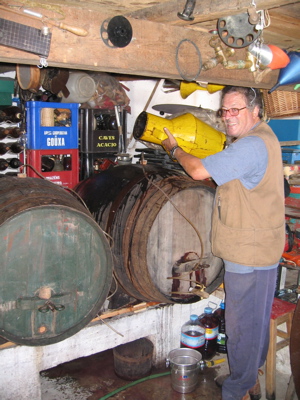
When the barrel was full, Orlando announced that it was 'ours'. Very kind of him, as our contribution was in reality less than 300 litres of liquid. But it does reflect the glut of wine in this area; everyone makes their own. If Orlando doesn't give wine away, what is he going to do with 2,000 litres a year! There's never a shortage in our village, and everyone offers us bottles all the time. So, we chalked the words 'Quinta da Meg' on the end of the barrel, and when the wine is ready we can go in and decant off a bottle (or ten) whenever we want to. Lovely!

アフリカンダンスと山火事
ポルトガルの森林火災が世界中にニュースとして流れ、皆さんにも随分と心配していただきました。実際、ひどい状況でした。夕方、数カ所から煙が立ち上ることも珍しくはなく、7月末には昼夜4日間燃え続ける山をアパートの窓から双眼鏡で見ていました。炎は山の斜面を燃えつくし、燃えながら反対側に下り、さらに隣の山を燃えつくしていきました。
8月半ばから末にかけて、同時に27ヶ所で森林が燃えているという事態も起こっています。都会に住んでいると干ばつや森林火災は他人事ですが、ここに引っ越してから異常気象を身近に感じるようになりました。9月に入って2日間雨が降って森林火災も落ち着いたのですが、ここ一週間ほどほとんど毎日、森林火災が発生しています。
インターネットで天気予報を見ると、「晴れ」や「曇り」の他に「煙」と言う予報があるのに驚きました。
8月末、ポルトガルが燃え続けている間、私はオーストリアで豪雨に遭っていました。土砂降りの雨が二日間途切れることなく降り続け、土砂崩れで道路が寸断され、近くの町が洪水の被害を受けました。アメリカのハリケーン、カタリーナもひどかった。真剣に自然環境のことを考えないと...。まだ遅すぎないと思いたい。
アフリカンダンスと山火事
7月の2週目、一週間のアフリカンダンス・ワークショップに私は参加していた。会場はモンデゴ川に面した森の中にあるドイツ人コニーのモンデゴ農場。ワークショップは屋外で一日5時間、午前10時から午後1時まで、午後3時から5時まで予定されていた。西アフリカ出身でドイツ在住の講師とドラマーがモンデゴ農場に泊まり込んでいた。夏休みなので子ども達も一緒である。生徒は私も含めて8人。5人はポルトからテント持参で参加している。
ポルトガルの田舎では文化的な活動はほとんどないだろうと思っていた。予想に反して、タブアにはコニーが主催するエスコラダ・デ・ムジカ(音楽学校)があった。彼女はアフリカンドラム、ジンベエを教える。他にも、子ども音楽教室やピアノ教室などがある。週2回、ヨガ教室に通うようになってコニーと知り合った。
二日目。ワークショップ終了直前、木が燃える匂いが漂ってきた。この辺りの森林は原生林ではなく、商業用のユーカリ林や松林が多い。ポルトガル人が騒ぎ出してワークショップは中断。木々の間からコニーの家の方角を見ると、家のすぐ裏にもうもうと立ち上る黒煙が見えた。1キロほど離れた農場が燃えているようだ。
「(消火作業の)手伝いに行かなくちゃ」と言うコニーと一緒に、外に出られる格好をしていたクリスティーナとリタと私が車に飛び乗った。暑いさなかのワークショップである。ほとんどの生徒は裸足でビキニに巻きスカートという格好で参加していたため、すぐには動けなかい。
100メートルも進まないうちに木立の間に赤い炎が見えた。折からの強風で飛び火したのである。モンデゴ農場は風下になる。消火に使える道具はない。さらに数十メートル車を走らせると対向車が来た。隣の農場に住むドイツ人だ。「だめよ。もう、火の手が回っているからここから先には行かれないわ」
引き返すと、農場では避難の準備を始めていた。楽器を石造りの家の中に運び込み、プロパンガスと車を川辺に移動させた。馬とイヌを川辺につなぎ、ニワトリを小屋から逃がした。子ども達をカヌーで対岸に避難させた。農場に泊まっていた講師やドラマーの楽器や荷物もカヌーで対岸へ。私も含めて、ワークショップの参加者全員と講師達も対岸に避難した。農場には7人ほどが残った。
スティーブに電話をすると、友人の家のベランダからモンデゴ農場方面の黒煙を眺めながら、ワークショップ会場の近くだなあ、山火事に気づいていないことはないだろうが、一応電話で知らせよう、と考えていたところだという。
強風にあおられて乾燥した下草を燃やしながら火は飛び火し、コニーの家を取り囲むように数カ所から黒煙が立ち上る。家のすぐ後ろには赤い炎が見える。モンデゴ川の下流方面から出火した森林火災は燃え広がりながら上流にあるモンデゴ農場に向かってくる。
10日ほど前に初めて、ポルトガルの悪名高い森林火災を間近に見た。スーパーで買い物をして出てくると、黒煙がもくもくと青空に立ち上っているのが見えた。小型機とヘリコプターが各2機、消火を続けて、1時間ほどで鎮火した。
火災が起きてから随分時間が経ったような気がするが、消防車もヘリコプターも小型機も来ない。もっとも、消防車は燃えさかる森林の中を通り抜けなければならないので、来たくても来られないだろう。対岸の7人は消火作業をしているのだろうが、木々に遮られて見えない。乾燥した木が弾けて燃える音がこちらまで聞こえてくる。灰も降ってくる。晴天なのに空は煙で赤茶色に染まった。それでも、都会の火事とは違って燃えているのは森林と下草なので、有毒ガスの心配はなさそうである。
地元の人が消防署に何度か電話してやっと、ヘリコプターの音が聞こえてきた。峡谷には煙が充満して、視界はひどく悪い。飛んできた3機のヘリコプターのうち一機は目の前のモンデゴ川から水を汲み上げて家の回り放水し始めた。対岸にいる私達のところからは炎がよく見える。ヘリコプターが給水に降りてくるたびに、燃えさかっている炎の場所をパイロットに教えた。
火事が発生して3時間ほど経った。段々と風が弱まってきた。夜の8時はまだまだ明るいのだが、煙のせいで暗くなったように感じる。暗くなると消火作業が危険だからだろう、ヘリコプターは引き上げてしまった。誰かが消防署にまた、電話した。消防車がこちらに向かっていると言う。家の前にはパトカーが到着している。リタと私は消火活動を手伝うためにカヌーで川を渡り、モンデゴ農場に戻った。
農場ではコニー達がバケツやペットボトルにくんだ水や濡らした箒や鍬などで、家の近くまで迫った炎を消して回っていた。近所の人達も消火活動に加わり、いつの間にか人数が増えている。ダンスのワークショップに来て、山火事の消火をすることになるとは思わなかった。
黒こげになった森林が家の20メートル近くまで迫っていた。水の入った重いバケツを持って森に入り、炎やくすぶっている下草に水をかける。消しても消しても、風が吹くと炎が上がる。まるでモグラたたきだ。コニー達はくたびれきっていた。二日間で10時間踊った上での消火活動である。
暗くなりかけた頃、スティーブが来た。彼が林道の入口に到着した時には、なんとか林道が使えるほど鎮火していた。消防車が道を塞いでいたが、「妻(!)が下にいる」と言ったら通してくれた。「どこも黒焦げで、まるで地獄絵。車の中まで熱気が入ってくるから、怖くて真剣に運転しちゃった」とスティーブ。その頃には消防車もモンデゴ農場に到着していた。私達は冷蔵庫にあったビールやジュースやコーラを取り出して、ベランダに座り込んだ。
一緒にワークショップに参加していたヨガの先生ティッタは、この近くの家を買おうと思っていた。銀行から借りられるローンの範囲内の値段で、手入れをしなくてもすぐに住める家だった。その家も燃えてしまった。
ポルトガルの森林火災の50パーセントは不注意(タバコやバーベキューの不始末等)が原因だという。25から30パーセントが放火、残りが自然発火である。恨みや土地の値段を下げるために放火する人もいると聞いた。「これでもっと安くなるかもよ」とスティーブが冗談を言うと、疲れ切ったティッタは「ふん...」と力なく笑った。
コニーの家と農場は奇跡的に助かった。回りはすべて黒こげである。林道の両側も焼けこげた木が林立し、地面からは煙が立ち上り、所々炭火のような残り火が見える。
黒こげの森と、燃えなかった緑鮮やかな森林、そして青い空。翌朝通ったときに見たコントラストは鮮やかだった。火災から3日経っても、所々に煙が立ち上っていた。
***
ポルトガルの森林火災の背景と統計を簡単に説明しましょう。
ポルトガルの年間平均火災焼失面積は1、100平方キロ。最悪だった03年には4、250平方キロが燃えた。環境的な原因として、紙とパルプの原料となるユーカリの植林(よく燃える。因みに森林の4分の3が燃えやすい松、ユーカリ、コルクである)、年々減り続ける雨量、1945年以来最悪の干ばつ、南ヨーロッパの記録的な猛暑等が挙げられる。また、過疎化で森林の所有者が都市にでてしまい、手入れをしないために消火活動が困難になっている。80年から現在までで国土の約3分の一が焼失している。
人為的原因としては火の不始末と放火が上げられる。今夏、放火容疑で35人が逮捕された。但しポルトガル人の友人に言わせると、放火の刑期が1年なので、放火犯は翌年の森林火災シーズンに釈放され、放火を繰り返すということだ。
今年は8月22日現在で1、400平方キロが焼失。8月25日には1、800平方キロに、9月14日現在には2、559.2平方キロ(国土の約3パーセント)に焼失面積は激増した。ポルトガルの国土は92、000平方キロである。
Roof Tiling
Tiling the roof has proved to be one of the most time-consuming tasks so far. But finally it is done -- after about three week's work.
The main reason it took so long is that we insisted on replicating the original ornate tiling. In fact, the result is somewhat different -- the original tiles are no longer available. Still, we are pleased with the results:

Note the ornamental edges, with tiles laid perpendicularly at the gable ends. The roof is just waiting for some finishing touches -- three finials to go over the gables. These also were not original, but somehow got included in the design.
Tile Talk
The builders recovered most of the tiles from the old roof. About half were undamaged, half slightly damaged, and some lost completely. They've been piled in the garden for the past few months, but this week we decided to sort them.
It turns out that various parts of the roof had used slightly different tiles. They came from about five different suppliers, all within this general area. I have no idea how old they are, though they seem to be moulded using some kind of manual process. Dimensionally, all those of one type are identical. In design, they are quite sophisticated with various indentations (for fitting) and grooves (for water runoff). But some have odd squashed sections where they have obviously been less than perfectly handled prior to firing.
They are beautiful things, really. Simple and functional, earthy even. But the colouring is lovely, and the makers' marks pressed on the underside seem almost like hallmarks -- giving away their origin and probably (for those in the know) when they were made.
Sorting them has been hard work, but now we have separate (and stable!) piles of each type -- probably around 3-400 good tiles altogether. We'll probably use them to roof outbuildings and other structures at a later date. As for the damaged ones, at the moment we are planning to edge the beds of our vegetable patches with them to form slightly raised beds. (We are hoping to be able to work with the no-dig raised-bed system for many of our vegetables.)
With the tiles sorted and stored safely, we have to turn our attention to all the recovered timber. There are two huge stacks of it, with pieces ranging in size from kindling to huge logs that were once roof beams. We have to remove all the old nails, as far as possible, then sort into re-usable timber and firewood. The firewood somehow has to be cut to a size suitable for an iron stove (which we plan to install in the dining room/kitchen).
Green Tomatoes
We brought in the last of the tomatoes a few days ago. Quite surprising really -- I thought in this warmer climate we'd keep getting tomatoes longer than in my dad's garden, at least. But in fact the season seems to be shorter here.
The plants are already withering now, along with most of the other summer vegetables. In fact, I wouldn't be surprised if we have the first morning frost in the not too distant future; already (and quite suddenly) we can see our breath in the mornings.
Anyway, the final tomato harvest went to make green tomato chutney. Here are the tomatoes being washed:

Incinerated Cathedral
Don't panic. Not a real cathedral. Rather, the local rock formation I mentioned a while ago. As we returned from our eclipse-viewing trip to Braganca yesterday afternoon, we could see a plume of smoke from miles away -- it was visible from the motorway up north of Viseu....
As we approached home, we realised the fire must be quite near Tabua. But it was only when we came down the long hill from IP3 towards the Mondego River bridge that we understood just how close it was. The whole area above and below Pedra de Se (the rock cathedral) was burning, as were the woods on both sides of the road up to town. What a depressing sight to return to! The fire was huge -- in the strong winds it had travelled kilometres to reach this point -- and according to friends had even crossed the river a couple of times.

Aguadente
Aguadente is the local fire water. It's a form of grappa -- made with the grape skins left after extracting the juice for wine.
Everyone around here makes it, usually in a home still located in the garage or a storeroom. I helped our trusty neighbour Joao make his in mid October.
The mass of grapes skins and pulp left after draining the liquid (for wine) is left to ferment for some time. It becomes a dense, quite dry mass that smells strongly of alcohol. At the apppropriate time. it is loaded in batches into the boiler of a copper still.

This is Joao's still, or 'alembic'. It's set in a brick firebox, and here the main boiler has been crammed full of grapes. To stop them burning, a small quantity of aguadente is added; apart from that it is mostly solid material in there. Joao is putting on the top -- it has a long outlet spout (not visible in the photo) that sends the distillate through a tank of cold water to condense it. As soon as the top is in place, the fire is built up and the precious 60?? alcohol starts dripping from the condenser.

The result is a fiery but surprisingly tasty spirit. Some people age it in wooden barrels, so it gains a little colour like a whiskey. It is often used to steep fruit, producing a kind of fruit liqueur. In our village 'cafe', an order for a cup of coffee usually results in one espresso, a sachet of sugar, and a bottle of local aguadente coming to the table. The aquadente goes in the coffee (along with the sugar) creating what we like to call 'Portuguese Coffee' (a reference to Irish Coffee, which similarlly takes a shot of the national drink...)
Annular Eclipse in Braganca
We headed up north earlier this month, our first real trip within Portugal since arriving here in February. Leaving Momo the Cat in the safe hands of some girls in our apartment building, we drove off into Tras-os-Montes, or "beyond the mountains" (also known as Terra Fria, or the cold lands)!
The main purpose of this little adventure was to see an annular eclipse that crossed northern Portugal, Spain, and then Africa. We had a good few days, taking our time and visiting a few out-of-the-way places on the way.

Here's our projection of the eclipse through binoculars onto a sheet of paper. Our selected viewing spot was Braganca Castelo, high above the town and very medieval in aspect. (People still live in tiny houses that appear almost like lean-to structures around the walls.)

And there's the full eclipse. It got dark, but not that noticably. (We assume our eyes adjusted gradually; there was no sudden change.) It also got cold -- and that was very noticable! From a warm, even hot, morning it turned quite cold.

To prove it, there's Megumi looking very wrapped up!!
Rain Breaks the Drought
It's been raining! The change in weather began just about two weeks ago, and since then we've had mostly cloudy skies and quite a few days of almost solid rain.
Our stream (actually not ours; it's in the valley below our house and runs through our neighbour's land) has begun to flow again, although it hardly warrants the rather grand name Tabua River. What's more, the landscape has gone from being tired and dusty (and burnt!) to lush, green and vibrant. What a change! As a result, we've been busy in the garden again, preparing vegetable beds for autumn and winter sowing.
Unfortunately, I've been too busy taking pictures of all the wiring and piping currently being installed in the house to take pictures of our newly rejuvenated countryside. But I'll try to get some up here as soon as I can.
Donkey Manure?
Megumi would love to have a donkey. She's even threatened to drive a donkey cart around town instead of a car. The old man who comes past our house with his donkey and cart is always a signal for her to mention, once again, that she plans to get one!

Personally, I don't think we have space. And anyway, the only real advantage I can see is the manure -- which would be great for the garden! In the end we might reach a compromise; friends with more land and their own interest in a donkey might let us keep one at their place.
No-dig vegetable beds
It sounded like a good idea to me -- growing vegetables without digging!
In fact, it's the method recommended by the Royal Horticultural Society in their books on organic gardening. Not really having the slightest idea about vegetable growing when we arrived here, we decided it wouldn't harm to try this relatively new idea. We started by simply digging rectangular beds of appropriate size -- we chose 1.2m wide by 4.0m long -- and that's what we grew most of this summer's produce in. But I wanted to build edged or raised beds in the end, as also recommended in our various gardening books.
The large number of tiles taken off our old roof seemed to cry out for a use -- particularly the slightly damaged ones. I thought I'd see if they will work as edging for the beds. The picture shows the prototype.

Conveniently, the tiles are 40cm long. That means I can build a bed with 26 tiles -- 10 along each side and 3 at each end. I set out leveling strings to mark the bed borders, dug into the soil to about half the depth of a tile, and set the tiles on edge (holding them temporarily in place with stones, clods of soil, or anything else I could find around the outside). Our terraces slope slightly, so keeping the beds level means that one end is set deeper into the ground than the other; because the tiles are not that large (20cm in that direction), this type of raised bed will only tolerate a very slight ground gradient.
I didn't want to create anything too permanent -- after all we may want to abandon the beds after the trial period -- but on the other hand I don't want the tiles moving too readily. So to fix them in place, I dry-mixed cement (4 shovels full), sand (4-6 shovels full) and soil (about 6 shovels full) to backfill to a depth of a few centimeters around the outside of the bed. After covering the cement mix with soil to restore ground level, I watered it gently to dampen the cement-soil. After a few days, and a little rain, the tiles seem to be reasonably well fixed in place.
We expect to end up with around 16 beds altogether. That ties in well with the approximately 400 damaged tiles we have, so I may have to go into a kind of mass production! However, with some beds in use all the time, the reality is that I won't be able to build them all at once. But I hope to get them built gradually as time and opportunity permits.
Our Aldeia
Aldeia means village or hamlet in Portuguese. Our aldeia is Oliveira de Fazemao. Here's a new photo that shows the few houses in the hamlet rather nicely.
Our house is the roof you can see on the right. Above ours, other houses rise up to a small high spot in the middle of the aldeia.

Many of the trees in the picture are olives -- the greyish coloured ones. (Actually, I suppose I should describe them as olive-coloured....)
Down in the dip betwen the camera and the hamlet is the grandly named Tabua River, a small stream that has just begun flowing again for the first time since we first saw the house in May 2004.
Views of Porto
I took a couple of photos in Porto last weekend, when we were there to pick up my mum and dad.

This is the Dom Luis I Bridge, taken from the Gaia (south) side. The top deck is now used by a new tram/transit system. A long way down below is the road deck.

Taken from the upper deck of the bridge, this is part of Ribeira, a maze of little lanes and buildings tumbling down to the Douro river at the centre of Porto. It's a UNESCO world heritage site.
ヴィンディーマ(ブドウの収穫)
収穫の秋。9月半ばから10月始めにかけて、この辺りはブドウ摘みの季節である。どこも家族総出でブドウを摘む。アデガ(民家の1階部分。作業場兼貯蔵室になっている)の隅に設置されているタンクに潰して入れられると、ブドウはすぐに発酵を始める。因みに白ワインならば一両日、赤ワインなら4日から1週間くらいタンクで発酵させてから、樽に移す。
家の庭には約200本のブドウの木があるが、一次発酵に使うタンクや樽など必要な設備がないので、隣のオーランドの設備を借りた。タンクは1メートル四方で深さが1.6メートルくらいあるが、私達のブドウとオーランドのブドウを一度に発酵させられるほど大きくはない。最初に私達がタンクを使い、一次発酵が終わった汁を樽(500リットル入り!)に移した後でオーランドがブドウの収穫をするという話だった。私達はオーランドが帰ってくる数日前にブドウを収穫した。
午前中にスティーブと二人で収穫を始め、暑くなる時間帯は休憩し、涼しくなる夕方4時頃から作業を再開。ジョアオンが手伝ってくれた。彼はポルトガル人にしては珍しく(?)几帳面である。時間通りにハサミを持って現れた。84才で耳が少し遠いが、畑仕事に余念がない。特別な行事があると煉瓦のオーブンに火を入れてパンまで焼く。昔はリスボンでパン焼き職人をやっていた。タクシーの運転手をしていたこともあるという。
この日の夜、私達はジョアオンと妻のオデットを夕食に招待していた。6時頃までには作業をすべて終え、食事の準備をする予定だった。が、思ったよりも時間がかかった。6時までには終わりそうもない。
見かねたオデットがハサミを手に手伝いにやってきた。続いてアリス、ローザ、マニュエルもハサミを持ってやって来た。足が悪いイルダはイスに座りながら応援してくれる。
ビンディーマの時には、手伝ってもらった家が昼食を振る舞うという伝統がある。みんなに手伝ってもらってジョアオンとオデットだけ、夕食に招待するのも気が引ける。私は作業を中断してマンションに戻り、ほとんど準備ができていた夕食を持って村に戻ってきた。こうすれば、手伝ってくれた人達も一緒に食事ができる。
村に戻ると、作業は既に終わっていた。オデットとジョアオンのアデガを借りて食事をすることになった。オデットがデザートを、ジョアオンがワインを用意してくれた。
裸電球に照らされた石壁のアデガで思わぬ宴会になった。
***
数日後。オーランドとエレナが帰ってきた。彼らの土地は広いので、手伝いの数も多い。谷の下の方から幾重にも重なった石壁のブドウ棚を一段ずつ、収穫しながら上っていく。ブドウが山盛りに入っているバケツをオーランドがジープでアデガへ運び、潰してタンクに入れる。別々にワインを作るという話だったはずだが、オーランドは私達のブドウの上に自分のブドウを潰して入れた。ホントに入りきるの? と聞いてもウインクしながら大丈夫、と言う。大丈夫ではなかった。発酵が始まるとブドウの皮がタンクの表面に押し上げられる。それがタンクの上にてんこ盛りとなった。オーランドはブドウの皮を押し戻しながら、さらにブドウを潰して入れる。だがいくら何でも限界がある。ブドウ汁があふれ出した。これ以上、どうやったって入らない。50リットル入りの容器2個にブドウ汁を入れ替えた。そうしてやっと、収穫したブドウすべてをタンクに入れることができた。最終的にうまくいくのだが、オーランドの仕事はどうもアバウトである。
ブドウの収穫は何故か必ず昼食までに終わる。収穫が終わると食べきれないほどの昼食とワインが出る。ここではアデガにプラスティックのテーブルとイスが並べられ、手伝いに来た20人がテーブルを囲む賑やかな食事になった。
夕方、みんなが帰って静かになったアデガではタンクに入ったブドウが発酵するプシュプシュという音が聞こえた。
***
一週間後、今度はジョアオンとオデットのビンディーマである。私達も手伝いに行った。彼らの庭はそんなに広くはない(私達の庭と同じくらい)。手伝いに来たのはジョアオンの妹と娘夫妻である。
9時頃に行くと、既に作業が始まっていた。ここの畑は手入れが行き届いている。これまで、ブドウの収穫とはつぶれるブドウですぐに手もハサミもべとべとになるものだと思っていた。そうではなかった。きちんと手入れされているから収穫しやすいし、手も服もそんなに汚れない。
ジョアオンはタンクを二つ持っているので、赤と白のワインを作る。私達のワインは白いブドウも赤いブドウも一緒に入れたのでロゼと赤の中間くらいのワインができるはずだ。
作業はやはり昼には終わった。娘が食事を作ってくれた。アデガで食事をするだろうと思っていたら、きちんとテーブルがセットされたダイニングに通された。作業服で入るのがためらわれるほどだった。ジョアオンが作った去年のワインがクリスタルのデカンタで出てきた。
皆既日食と燃えるポルトガル
10月3日の午前、ポルトガル北部を皆既日食が通る。隣人にモモの世話を頼んで、私達はキャンプをしながら北部の町・ブラガンサに行くことにした。
一泊目9月30日はビラ・フロールの市営キャンプ場。年中無休だが、夏休み後で閑散としている。すぐ隣りにさびれた動物園があった。オリの中のイノシシと鹿は、誰も来ないので飽き飽きしているようだった。2泊目は国境の町ミランダ・デ・ダオン、3泊目はブラガンサの郊外にテントを張った。ミランダ・デ・ダオンはスペインからの買い物客を意識しているのか、古城がきれいに整備されている。この辺りはテラ・フリア(凍てつく大地)と呼ばれるだけあって、風が強く、夜は冷え込んだ。
2日は朝から強風。地図で目星をつけたブラガンサ郊外の丘でキャンプして、そのままそこで皆既日食を見る予定だったが行ってみると、遮る物がない丘の上ではもろに強風に晒されて、寒いし、吹き飛ばされそうだ。もうちょっと居心地の良いキャンプ地を探して丘を下った。道路脇に丁度良さそうな場所があった。車はあまり通らないし、灌木と背の高い雑草のおかげでテントも車も道路からは見えない。
丘を挟んで2ヶ所、遠くに煙が見えた。森林火災である。9月初旬に2日ほど、雨がぱらついた。気温も下がり秋らしくなってきたので、森林火災の季節ももう終わりだろうと思っていた。が、そうではなかった。気温は低くても、極度の乾燥は解消されていない。この強風では燃え広がるだろう。こんな日はあまり外をうろつきたくない。放火する場所を探している不審者と誤解されたらどうしようと心配するのは妄想だろうか。
暗くなるまで時間があったので丘に戻ると、風はさらに強くなっている。2ヶ所の森林火災は風にあおられて広がりながら移動していく。暗くなりかけた頃、丘を下ってキャンプ地へ向かった。灌木と雑草の間にテントを張る。澄み切った星空である。テントの中は暖かくなるが、外は寒い。高空で渦を巻いた空気が落下してくるような強風が吹き荒れた。竜巻が真っ逆様に地上に叩きつけられているようだった。十分離れていたので大丈夫だろうとは思ったが、山火事も少し心配だった。
朝になっても風は収まらない。丘の上でキャンプしなくてよかった。寒かったのでブラガンサに戻って、城壁から日食を見ることにした。城壁の回りは皆既日食を見る人で一杯になるだろうと思っていたが、いるのは数人の外国人だけ。スティーブと私は城壁の見張台に陣取った。日食が始まった。人が集まる様子はまったくない。通りは閑散としているし、空を見上げる人もいない。側で屋根瓦を修理している職人は、日食にまったく無関心で仕事を続けている。屋根に座ったネコだけがナットクできない面持ちで空を見上げていた。
日食は8時半過ぎに始まった。9時50分頃に皆既日食。皆既とは言っても、太陽と月の距離が離れているので太陽の輪郭は隠れない。思ったよりも暗くはならなかったが、空気は冷たくなった。
始めて皆既日食を見たのは80年2月、ケニアであった。この日は快晴で、月が太陽と完全に重なると、太陽は黒い巨大惑星のように見えた。99年8月には皆既日食が通過する英国・コーンウォールにいた。20世紀最後の皆既日食だと、マスコミが何週間も前から騒ぎ、まるで民族大移動のように誰もが南を目指した。当日は雨模様で、厚く垂れこめた雲の上を皆既日食の陰が凄い早さで通過していった。
皆既日食を見てから昼過ぎにブラガンサを出発し、ビゼウを経由してタブアに帰った。この日、そこら中が燃えていると言っても大げさではないくらい、あちこちで山が燃えていた。森林火災の黒煙は活火山が吹き上げる黒煙に似ている。
タブアから50キロほど離れたビゼウを出ると、前方に黒煙が見えた。地平線の3分の1以上が煙で覆われている。...タブアの方向である。近づくにつれて、それがタブア周辺だろうことがはっきりしてきた。スピードの出ない車のアクセルを床まで踏み込んで、スティーブが運転する(それでも90キロがせいぜい)。借りているマンションが燃える心配は先ずない。何しろ、消防署のすぐ裏なのである。家も火が迫れば、大工の3人が何とかするだろう...。大丈夫だと思ってもやはり心配になる。
タブアに近づくと道路脇の森林が焼けこげているのが目についた。黒く焦げた木々の間から白い煙が上がっている。タブアの入口である橋に来ると、数日前に散歩したペドラ・デ・セ(直訳では石の教会、実際には大きな岩)が火に包まれていた。野次馬が橋の上から火事を見物している。私達も、車を停めて写真を撮った。
タブアは燃えてこそいないが、煙に包まれて真っ白、灰が舞っていた。燃えているのはコニーの農場の方向である。運良く焼失は免れたが、コニーはこの夏、3回も森林火災に見舞われた。彼女の住む地域ではこれでもか、というほど何度も森林火災が起きた。燃えるものが残っていることが不思議なほどであった。放火だろうと、誰もが推測した。
後で聞いた話によると、ビゼウ周辺で始まった火災は強風のあおりを受けて数日間燃え続け、何十キロも移動したと言う。ペドラ・デ・セを燃やしてさらに西に移動していった火災は、ビゼウで出火したこの火災であった。ポルトガル全土が炎に包まれているようだった。
では、実際はどうだったのだろうか。パブリコ紙インターネット版から拾ってみた(ポルトガル語はまだおぼつかないので、正確さは不明)。
10月2日。「ビゼウ周辺で午前6時45分頃森林火災発生。火災は4ヶ所に広がった。現場への接近が難しいことと強風で、消火活動は困難」「ビゼウでは消防士149人、消防車38台、消防飛行機とヘリコプター各2機が出動」「昨日発生したポンバルの森林火災は今日午後2時、鎮火に向かう」「フィゲイラ・ダ・フォズでは森林火災のため、キャンプ場から50人のキャンプ客が避難。消防士136人、消防車36台、消防飛行機2機が出動した」 この日、ポルトガル本土全土に森林火災警報危険度5(1から5まであって、5が最も高い)の警報が出されている。
10月3日。「今朝7時22分現在、11ヶ所で森林火災が続いており、ビゼウでは18人が救助された。火災はコレガル・ド・サル(モンデゴ川を挟んで、コニーの農場の向かいに位置する町)まで広がった。全国で消防士1、580人と消防車463台が動員された」「ポルトガル北部及び中部では5ヶ所で消火活動が続いている」「22時50分現在、ポルト及びビラ・レアル両県の3ヶ所で消火活動継続中」
10月4日。「森林火災7件のうち5ヶ所がまだ燃えている。消防士1、070人と消防車292台が出動。ビゼウで出火した火災は消防士422人、消防車111台、消防機3機にもかかわらず、コレガル・ド・サルは燃え続けている」「3地区4件の森林火災で消火活動が行われている」
9月末にスペインでは、シエラ・ネバダ国立公園で遭難した英国人とフランス人が救助隊に自分達の居場所を知らせようとして起こした火が原因で、2、600ヘクタールが焼失した。二人は無事に救助されたが、救助後、即逮捕された。また7月にはスペイン中部でバーベキューから出火したと思われる森林火災で12、000ヘクタールが焼失、消防士11人が死亡した。
9月末にポルトガルで選挙があった。森林火災対策は選挙の争点にはなっていないようだった。選挙活動の一環で、タブアでは候補者がライターを配っていた...。
10月半ばになって本格的に雨が降り出すと、一週間もしないうちに山野は緑に覆われた。ポルトガルでは毎年4月になると焚き火が禁止される。この雨で焚き火は解禁になったのだろう、夏の間燃やせなかった(燃えなかった?)下草などを燃やす煙が曇り空の下で何本も立ちのぼっている。
St Martin's Day
November 11 is the date. My middle name is Martin, and I've just learned from my mother Shirley that my 'expected' birth date was this day. In Portugal, it's traditional to taste the new wine on St Martin's.
The workers on our house knew we have 500 litres of wine in the barrel. They made it quite clear that they expected a chance to taste it. So last Friday they planned bit of a do, with barbecued pork provided by the boss. It was a simple affair -- pork, bread, and new wine -- but it was enough to take a couple of hours out of the work day for them. As for our wine, I suppose I'd describe it as 'green'. Flavour is rather thin, and there's something of a bitter initial taste. Aftertaste is a bit more rounded, but I must admit I was expecting something a bit more sophisticated. Still, I think the flavour will develop over the next couple of months.
Another tradition on St Martin's is chestnuts. Three kilograms from the local supermarket (Ecomarche) cost about 5 euros. One of the workers roasted them by simply mixing them into a pile of pine needles and setting fire to the mix. It took only five minutes, and the result was as good as any chestnuts I've tasted. It's a technique I'll remember!

Some of our workers with the remains of the chestnuts!
Tabua has a large market on the nearest Sunday to St Martin's. It turned out to be little different from our regular monthly markets -- cheap clothes (mostly Chinese), shoes, tools (often hand made locally) and the usual CDs, DVDs, and trinkets. The only thing I wanted was a copy of the local almanac, known as Borda D'agua. Although it is available earlier in some stationers, St Martin's day is when the older people look forward to purchasing their copy for the coming year.

Dry-stone walling
With friend Allan visiting, I wanted to get started on our project to build a new retaining wall in the garden. After a week of effort, both of us have a renewed respect for the wall builders of old!
The garden consists of three main terraces below road level. The upper two are separated by a nice granite retaining wall that probably dates back to when this land was first cultivated. The lower two terraces are simply separated by an earth bank, with a row of vines extending along part of it. We thought it would be nice to add a new retaining wall along the centre section, where there are no grapes. This would allow us to level the lowest terrace, which we plan to leave as natural meadow, while also backfilling the upper terrace by 20cm or so to give deeper topsoil (for some of our Japanese vegetables). Fortunately, there is a large pile of granite resulting from the building work (though I'm not quite sure where so many stones came from...) so we are not short of material.
The first problem to work out was how to move the stones across the top terrace, over the retaining wall, and into position for the new wall. Having decided on a length of about 4m that would comprise the Phase I work, we moved the foundation layer stones down in a wheelbarrow. Some were quite heavy, but by tilting the wheelbarrow on its side and rolling them in, we were able to get them into place.

The foundation layer is complete, and infill material is ready in the wheelbarrow.
We then chose some larger stones for the second layer, and realised they were too large even for the wheelbarrow. We borrowed a low four-wheeled trolley from the neighbour and laid down planks across the terrace. With this arrangement, we were able to move quite large stones -- though getting them onto the trolley required some thought (and some good levers). Keeping the trolley on track was also not easy; the consequencies of going off the boards into soft earth were sometimes messy!
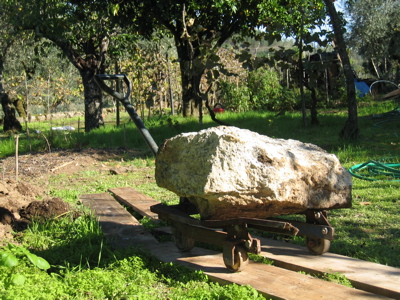
One of the larger stones we've managed to move so far.
We've tried to avoid shaping the stones as much as possible, but occasionally it has seemed expedient to get to grips with the hammer and chisel.
In the photo below, Allan is working to fit the large stone (shown above on the trolley) into place in the second layer.

After a few days, we'd picked up a few good techniques for moving stones. Levers are our friends! But rolling (particularly over planks) also works well. It is surprising how easy it is to rotate a very heavy stone that is lying on a plank. A stone or wood block makes an even easier pivot point.

This stone just about moved itself into position once we reached the edge of the earth bank.

Here's the large stone (seen above on the trolley) in position. The second layer begins to take shape!

We estimated that this one probably weighs 250-300 kg. Here it is sitting on the edge of the retaining wall between the first and second terraces; the wall is about a metre high.
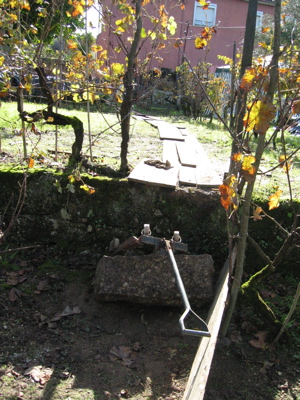
Almost certainly the biggest stone we've moved to date, it didn't go over the wall very cleanly. In fact, it took the trolley with it...

This is where we learnt to respect the wall builders of yesteryear! In this area, there are countless granite walls built to form terraces on steep hillsides. They range from a metre or so high up to monster structures, sometimes 3-4 metres in height. Some of the stones used must weigh several tonnes. Having moved some large stones, we have some ideas about how it might have been done, but the effort involved (just to create a terrace for a row of vines and a few potatoes) still defies imagination.

Here Meg and I take a break on the completed second layer. We now have to put a final capping layer on top. Unfortunately, the stones we like the look of are even heavier than the ones we've moved so far, and we feel that heavier equipment is needed. Tomorrow we are off in search of a suitable winch and pulleys...
Snakes and Ladders
The latest work on the house includes stone cleaning (inside and out), mortaring (between the stones) and putting in pipes and conduits for water, electricity and central heating. What a mess!
The stones are cleaned with high pressure water. This is no real problem outside, but inside it's made everything very wet! Still, the stones come up looking great, and we've decided to leave more stone visible than we originally expected to. Here's the west wall of the house; the workers are up there finishing off the mortar between the stones:

Ladders and scaffolding up the side of the house as the stones are cleaned and mortared
The electrical and pipe conduits are really amazing. It's incredible how many are required. I don't think there's anything particularly special about our house -- we have a couple of sockets in each room, a light or two, one small and one larger bathroom, and a radiator in some rooms -- but the amount of conduiting is almost mind-boggling. I've tried to keep records (photographic and on paper) of where everything runs, but in the end I'm sure I'll miss some details. Drilling holes in walls or floors, or trying to find pipe runs for future repairs, will be a fun task indeed!

Snakes in the first floor bathroom! Note how many of the hot and cold water pipe conduits and drains run under the floor; next step is to set them in solid concrete!

Pipe and electrical conduiting for the kitchen. How am I going to hang wall cabinets on those walls without piercing something?
First Snow
So you thought Portugal was warm? So far, November has been quite cool and autumnal here in Tabua. The evenings, in particular, have often been much like the cold, misty November nights I remember from my schooldays in Rickmansworth. Then last Monday, November 15th, we woke to see snow covering all the nearby mountains.
The previous day, Sunday, had been cold and wet here in Tabua, but I didn't expect to see snow so early. Not only was there a thick blanket on the Serra da Estrela (Portugal's highest range), but all the ridges of the much lower Serra de Acor were also white. (This is the range of mountains that burned so badly last summer.) Not content to simply see the snow from our apartment windows, we decided to go and experience it first-hand.

Up at around 1800 m, it was blowing a gale and still snowing. Very cold indeed!


Not enough snow yet for skiing, but I do have high hopes for some back-country ski trips (if I can get my skis over here from Japan!)
Local people have often said that snow in the Serra da Estrela is key to our water supply. I don't really know how that works -- we and other people who have heard the same tale live on high ground well above the valleys of the large rivers that the snow melt must drain into -- but if it is true, then I'm very happy to see the beginnings of a snow build-up. Last winter, when we arrived in February, the mountains were mostly clear of snow. It was only after a large storm in early March that the mountains looked briefly wintery.
Winches, Wheelbarrows and Rocks
Work has continued on the dry stone wall!
Last Monday, having moved the largest stone we thought possible the previous week, we decided to look for some equipment that might help us move larger ones without killing ourselves. Friend Dave had given some advice, so we went out and bought a hand-operated winch, some steel cable, eyelets, and rope. It proved a struggle to get set up (the winch came with no fittings, and we had to fix the cable to the drum ourselves) and when we finally did get it working we decided it wasn't really necessary for the job. Still, the winch will certainly be needed when we come to move some large 'sitting' stones into place in front of the new wall.
Another new method that we tried was to use rollers, which we cut from old steel pipe using an angle grinder. This worked, but didn't allow us to move any larger stone than by our earlier method (of loading onto a small trolley). Again, though, the rollers will almost certainly prove useful when we come to move the large sitting stones.
In the end, we simply persevered using the tried-and-tested method of hauling stones onto the trolley, running the trolley over planks, and then dropping the stones over the retaining wall. One minor innovation was to roll the stones over and over into final position along two rails -- square section timber rather than planks -- using a long steel bar as a lever. Another novel method was to ask a couple of the builders for help. They loaded enormous stones into a wheelbarrow and literally ran it (for stability) right into position. As a result, we managed to get two of the last large stones into place by sunset yesterday (my birthday).

Two of the cap stones in place

One more large one. We've learned that it's best to use smaller stones at the bottom and larger ones at the top -- contrary to our intuition


It was dusk when we finished work yesterday. Most of the cap stones are in place

In daylight...

The space is taking shape as a sitting area under the orange tree
Exterior Render
With render beginning to go on the exterior, the house is beginning to look more complete. Finally the rough brickwork is disappearing!

A front view. The rendered areas will eventually be painted. We still haven't made a firm decision about colour, but white (just like the original house) seems most likely at the moment. The painter himself disagrees -- he's suggesting a sand-yellow colour.

These are the exposed stones on the west wall. The workers have been displaying their artistic talents -- carefully shaping the mortar and adding small pieces of granite in the larger crevices...
Olives
The time has come to harvest the olives. What to do with them?
Well, Megumi picked about 20kg a few weeks ago. Half were still green and the rest nice and ripe with black flesh. They were destined for pickling -- a somewhat fraught process that has so far involved us in one chemical emergency and lots of salt purchases.
The chemical emergency? Well, most recipes for green olive pickling revolve around lye. What's that? (Don't worry, I had to look it up too!) A solution of caustic soda (sodium hydroxide) or, in older times, potassium hydroxide. The alternative is to soak the green olives in a solution of ash, but unfortunately we haven't got a supply of ash this year. Caustic soda comes in 1kg plastic bags; it seems the main use for it around here is cleaning stainless steel wine making equipment. Simply add it to water, and you get lye. Add too much of it to water, and you get something more like boiling lye -- because the reaction with water is exothermic. So, with a slight error in an imperial to metric conversion somewhere along the line, we ended up with an aluminium saucepan full of a witches brew -- frothing, steaming, and getting hotter by the minute. We quickly slammed the door to the kitchen and made brief forays in to dilute the mix with more water. In the end, no harm was done -- except to our large saucepan, which has suffered some chemical etching!
If it all sounds rather nasty to you, particularly to be treating our olives with, then I tend agree. But in the end, all should be well. The point is that olives, even ripe ones, are completely inedible. Green ones have a bitterness that a few hours in lye solution takes out. After that process, they are placed in water -- which is changed daily -- for some weeks. This washes out the lye, and leaves the olives softer and less bitter. The washing then continues weekly, until finally the olives can be bottled in salt solution (and any herbs desired).
The ripe olives go through a similar process but without the lye. A week or two of daily rinsing, either in water or brine, until they become edible. They are then bottled in the same way with brine, vinegar, and flavourings of choice. We are told both should be edible after a few months...
So that's what we did with the first 20kg of olives. The rest will go for pressing into olive oil. We'll be combining our small harvest (just six trees) with the olives of friends Guido & Mariluz and Richard. Together we should be able to reach the batch size for one of the local olive presses (which open up for a few weeks at this time of year), and so end up with our very own virgin olive oil. We started the harvest this week, and I'll report on progress later...

Mixed green and black olives ready for pickling
Death at our Favourite Restaurant
We went for dinner at one of our favourite restaurants tonight. I can't tell you its name; in fact I'm not sure it has one. There's no sign outside, and no clue at the turn-off from the main road (except a signpost for the village cemetery). In fact, you wouldn't know the place existed if it wasn't for word of mouth. And that is probably as good a recommendation as any.
What we like about the place is that it feels like a restaurant. It still has the wall-mounted TV without which no Portuguese restaurant would dare open its doors. But missing are the flourescent lights, plastic chairs and tables, and complete lack of atmosphere. This is a place someone has thought about, with smart stone walls, lovely woodwork, and arty lighting. Aside from that, the food is good (if limited in range) and the price right (a fixed 7 euros for dinner -- drinks, soup, main course, dessert, and coffee).
Anyway, tonight we turned up ten minutes before the friend we had planned to meet. The waitress presumed (rather than asking) that we would wait for our friend before starting into the wine, olives and bread that usually appear as soon as a customer sits down. And we soon learned why she was determined not to waste time serving us immediately -- there was work to be done in the kitchen. We heard the sqawks a couple of times before we realised that chickens or ducks were being done away with just beyond the drinks bar. When we did catch on, we had to laugh. What a welcome! Some kind of aperitif!
We are such city-dwellers that we couldn't in fact tell if they were ducks or chickens being butchered; I suspect ducks, but only because I had a brief glimpse of legs held tight as the throat was cut. Anyway, as a semi-vegetarian, I was quite surprised at how matter-of-fact the whole business felt. Probably it is the down-to-earth environment of rural Portugal with its smallholder culture; somehow I can't imagine a Tokyo restaurant openly dispatching livestock in the kitchen, nor me putting up with it!
Incidentally, we chose the sardines for dinner, and very good they were too!
Olives II
In the previous post, I mentioned that Megumi had harvested about 20kg of olives for pickling. Now we've finished harvesting from the six trees in our garden and have some olive oil to show for our efforts.
The trees yielded another 52kg (as measured once we got them to the press). It took us a few sessions, of a few hours each, to get them all. This mostly involved placing a ladder into the tree, climbing up, and pulling the knocking or pulling the olives down so they fell into sheeting (plastic in our case) laid around the base of the tree. Sometimes, where they were too high up to reach, I simply cut off a branch; it's good to keep the trees to a sensible height, not least because it makes the picking easier!
All in, we filled two large bins, which we then had to sort (to remove leaves and other foreign matter). We weren't quite sure how to handle them after that, especially after it became clear some friends would not, after all, pool ours with theirs. So last Friday, we decided to head off to one of the local presses to see if we could get them processed. Our neighbour Alice, a very kindly soul, gave us directions so it was easy to find.
We arrived to find a rough-and-ready place, crowded with people obviously waiting for their harvests to be dealt with. We had no idea what the system was, and it took a while to locate the boss. In the end, he came and looked at our measly two bins full and set an assistant -- bit of a dubious looking character -- to the task of rinsing the olives and putting them into sacks. Evidently, sacks are the standard -- as they allow the olives to be weighed easily -- and this was a special service for the ignorant foreigners! Anyway, all seemed to be well, our newly sacked olives were weighed and stacked in the storage area, and we hung around waiting.
We didn't really know what was going on, and with all the noise and hustle-&-bustle of a busy workshop it was difficult to make ourselves understood. We did know that if one has enough olives (perhaps several hundred kg) they would go in a single batch -- so one would get oil from ones own olives. With a smaller amount, they are pooled. But we weren't sure if our pooled sacks would have to wait for other small quantities to make up a batch, or if there was some other system. But whatever the story, lots of people were just hanging around presumably waiting for their batch to be processed. So we waited too. I noticed that some people got little green tickets -- presumably information about their batch, how many kg, etc. I expected we would get a receipt too -- with a record of how much oil we were due. (The basic story is that a percentage of the oil comes back to the grower, while some is retained by the press as payment.)
It was quite interesting just watching what was going on. Olives were being loaded by the ton, one sack at a time, into a hopper. From there they entered a machine for washing beofre disappearing through a pipe into the main press facility next door. Looking through, we could see the machines at work and smell the warm oil. Every few minutes a pickup or lorry would arrive with more. Some were stacked on the floor, while others went straight into the hopper; clearly some people had booked batches the previous day (as a notice on the wall suggested was the rule).
After observing all this for half an hour or more, a kind gent came up to us and suggested we could go anytime and collect our oil. This despite the fact that our olives were still waiting in sacks on the floor. So off we went, into the next room where the main processing was taking place. At the far end was the collection area, with a few tanks and, again, people hanging around. Here, everyone had plastic bottles and barrels in various sizes waiting to be filled. Somehow, we were at the front of the queue; as soon as we walked over (with a number of plastic bottles that, anticipating this situation, we had brought with us) our allotment was decanted off into a five-litre jug and poured into our bottles. We had no receipt and don't know how or when the quantity we were to receive was communicated to the man in charge of decanting. But the five litres tallied with what we had been told -- that the good presses return about 10% (five litres for 50kg) while others take more for themselves

A litre of our oil, after decanting into something a bit prettier than a plastic pop bottle!
Wall Finished?
Well, after some weeks of work, Allan and I have finished the first section of our dry stone wall. It is quite an impressive structure; or at least, it appears quite impressive to us because we know what a task it has been!
In fact, in pictures, it may not look like much. About 80cm high and perhaps 8m or so long, it is not a huge thing. But with the stone weighing around a ton per metre of length, that's a lot of weight we've shifted into place by hand. Here's some of that weight on the move:

Actually, that's not part of the wall, but one of the stones making up the sitting area we constructed in front of it. Like this:

I like to think of it as a miniature cross between Stonehenge and a stone circle like my favourite one at Castlerigg in Cumbria. We look forward to eating out here in the warmer weather...

またしても断水!
10月のある朝、断水になった。予告なしの断水はこの辺りでは珍しくない。水道工事などで突然水が出なくなる。またかと思ったが同時に、もしかするととも思った。2月にここに引っ越してから、アパートで水が使えるようになるまで3週間も待たされた。一度請求書が送られてきたが、それから一度も請求書を受け取っていない。請求書が何ヶ月に一回発行されるのかは知らなかったが、最後に(最初に)支払ってから既に4ヶ月近く経つのでそのうち、水道局に確認に行こうと話してはいた。
村のおばさんに聞くと請求書は2ヶ月に一度送られてくるはずだという。...ふむ。特に水道工事をしているようにも見えないのに、午後、帰宅しても断水はまだ続いていた。夜になっても水は出ない。やはり...?
翌日、朝一番で水道局に行った。窓口の女性に断水のことを話すと、水道料金が滞納されているので元栓を閉めたという。請求書もなく、警告もせずにいきなり元栓を閉めるとは随分乱暴だ。それでも、水道料金を支払えば、今日中に元栓を開けるという。請求書は受け取っていないものの、使った分の水道料金を支払うことに異議はない。請求書をプリントアウトしてもらった。
確認すると、何と新規水道接続手数料として14.88ユーロが加算されている。何だ、これは!? 請求書は受け取っていないし、警告もなかった。使った分を払うのはいいが、手数料は納得できない。彼女はコンピュータの画面を見て、請求書は送付されているわと涼しい顔で答える。水道局と言っても、ここは水道料金支払窓口女性が一人いるだけである。
警告もせずに勝手に閉めた元栓を開けるために手数料を払うつもりはない。水道料金は払うから、今日中に元栓を開けてくれと要求した。手数料は払わないと言うと「じゃあ、水はいらないのね」と言い放つ。私達が抗議している理由がまったく理解できないようである。払え、払わないの押し問答になった。私達の後ろに延びた列が段々長くなる。彼女は私達を無視して、後ろに並んだ人の対応をしようとする。彼女の正面に回り込んで抗議をする。
らちが明かないので、では上司を出せと言うと、ここにはいないから電話で話せと電話番号を紙切れに書いて渡してきた。20キロほど離れた町にある水道局(多分)本局にいる上司と電話で話しても、手数料を払わなければ元栓は開けられない、と言うばかり。「申し訳ないですね」とちっとも申し訳なさそうに繰り返す。こちらもらちが明かない。
謝っている本人が何にもせずに、何故私達が手数料を支払って尻拭いしなければならないのよ! と言って電話を切った。その間、窓口の女性は宛先不明で戻ってきた郵便物の束をチェックしていた。その中から、私達宛の警告が出てきた。最初に受け取った請求書と同じ住所なのに、宛先不明で返送されていた。「郵便局の手違いよ。文句があるなら郵便局へどうぞ」 ほらね、私達のせいじゃないのよとでも言いたそうな顔つきである。水道局が送ったという請求書2通はとうとう出てこなかった。水がなければ生活できない。渋々手数料を支払った。
その足で郵便局に向かい、水道局でのやりとりを説明した。局員は届いた請求書と宛先人不明で送り返された封書を見比べてから、リスボンの苦情係に送る書式を持ってきた。これに苦情を書いて、直接訴えるように、と。
そして夕方。4時前になってもまだ水が出ない。今日水がつながらなければ週末になってしまうので月曜日まで水が使えない。また水道局に足を運んだ。延々と待たされること30分。まだ、水が出ないと言うと、「コンピュータに入力したから他に私がやることはないわ」と肩をすくめる。後ろに並んでいた二人も水が出ないと苦情を言い始めた。どうやら昨日、水道局は料金滞納者の家の水道を片っ端から止めていったらしい。
窓口の女性は受話器を取り上げると業者に電話をかけた。書類を取り出すと1件1件読み上げている様子である。コンピュータに入力したんじゃなかったの?
やっと受話器を置くと私達を追い返したいのが見え見えの態度で「そのうち、つながるわ」 2月の経験があるので簡単に信じるわけには行かない。何時に来るのか聞くと「知らない」 今日来なかったら自分達で接続するわよ、というと「お好きなように」 この態度は何なんだ。夕方6時頃、やっと水が使えるようになった。
数日後、ポルトガル語の先生に手伝ってもらいながら、郵便局苦情受付センター(?)に苦情を書いて送った。ついでに、新規水道接続手数料として14.88ユーロも請求した。返事はまだ来ない。
ポルトガルのボージョレ・ヌーボー?
11月11日は聖マーティンの日。今年のワインを試飲する日である。数日前から大工職人の3人がこの日にはバーベキューをやってワインを飲むのが伝統だから、そうしようと言っていた。ワインはもちろん、家のワインである。
昼前に家に行くと職人達は既に焚き火を焚いていた。買い物も既に済ませたという。見てみるとポークとパンの山。スティーブは風邪で、遊びに来ている(或いは労働しに来ている)友人のアランは連日の石壁作りで疲れて、二人とも家で休んでいる。だがこの様子では延期というわけには行かない。電話すると顔だけでも出すという。
10センチ四方もありそうな豚肉を次々と網(サンマを焼く網を10倍くらい強くしたようなもの)に乗せる。60センチ四方ほどあるその柵が豚肉で埋まった。ドアを使ったテーブルの上にパンを切って乗せる。アリスのアデガからワインを5リットル入りの瓶に入れて持ってくる。スティーブとアランも来て、8人でバーベキューパーティとなった。何の野菜もないのがいかにもポルトガル。パンに焼けた豚肉を乗せてワインで流し込むのである。もっと食べろと進められてもそんなに食べられるものではない。食事の後、職人はそれでもちゃんと仕事に戻った。
仕事の合間に職人は何度も私達に、ポルトガルでは聖マーティンの日には焼き栗を食べてとワインを飲むのが伝統なんだよと言いに来た。最初は「へえ、そうなんだ」と言っていたが、結局スティーブがスーパーまで、栗を買い出しに行った。
職人の一人が松葉の山に栗を入れて、火をつける。それだけである。下火になるとまた、松葉を乗せる。皮が真っ黒に焦げた栗を彼らは手で拾い上げるとテーブルに乗せた。アリスがジュルピガを持ってきた。白ワインとアグアルデンテを混ぜた飲み物である。砂糖も入っているのだろう、甘い。これがまた栗とよく合う。夕方になってやってきた電気工も一緒に栗を食べた。
職人達は栗まで食べてやっと、伝統行事が終わったと安心した様子だった。
オリーブの収穫
11月に2度、オリーブを収穫した。6本ある庭のオリーブから、70キロの実が収穫できた。最初に収穫したオリーブは漬け、2度目に収穫したオリーブは搾油所に持って行った。
オリーブ色、というのは缶詰や瓶詰めで売っている塩水に漬けたオリーブの色。元々の実そのものは黄緑で、それが成熟するに従って深い赤紫色に変わっていく(オイルの含有量も増えていく)。収穫時期は実の色で判断する。
オリーブを漬ける
最初に収穫した20キロほどのオリーブは、熟した実(黒くなったもの)と未熟な実(黄緑のものと赤紫に変わりかけたもの)に分けて漬けた。漬け方が違うのである。(偉そうに言っているがオリーブを漬けるのは初めてで、インターネットで調べた)。
おおざっぱに言うと黒いオリーブはそのまま水または薄い塩水に漬け、10日間毎日水(もしくは塩水)を替える。それから濃い塩水に漬ける。熟していないオリーブは先ず苛性ソーダに15時間から48時間漬けて(もしくは灰にまぶして)灰汁を抜いてから水に漬ける。色が溶け出すので水が透明になるまで毎日替える。それから塩水に漬ける。オリーブの実そのものは口が曲がるほど苦い。漬けはじめてから食べられるようになるまで6週間から3ヶ月ほどかかる。
緑のオリーブは先ず苛性ソーダの溶液に漬けた。1ポンド(約450グラム)の苛性ソーダを5ガロン(約20リットル)の水に溶かすと書いてあった。4リットルもあれば十分なので、計算し直し、鍋に1ガロン(約4.2リットル)の水を入れて苛性ソーダを入れた。溶液の表面がぼこぼこと泡を立て始めた。鍋が熱くなる。突然、私もスティーブもせき込み始めた。悪臭はないがガスが排出されているのである。取りあえず、キッチンの窓を開け放し、ドアを閉めると居間に避難した。「間違えた、5倍も濃い溶液を作ちゃった」 少し考えてからスティーブが言った。1ガロンの水に500グラムの苛性ソーダを入れてしまったのである。このまま流したら排水管が溶けてしまう!?
スティーブが時々息を止めてキッチンに入っては水で溶液を薄めた。そのまま流してももったいないので、薄くした溶液はトイレに流した。ついでにガスコンロも掃除した。どちらもぴかぴかになった。排水管もかなりきれいになっただろう。鍋もきれいになった。
オリーブは苛性ソーダ溶液を必要な濃度に希釈して漬けた。今、緑のオリーブは月桂樹やレモンと一緒にペットボトルに入れ、塩水を入れて密閉して漬けてある。黒いオリーブはクリスマスの頃に密閉容器に詰め替える予定だ。
オリーブオイル
この辺りにはオリーブ収穫の時期だけ稼働する搾油所が何カ所もある。家庭で消費する少量のオリーブオイルの場合、収穫したオリーブを持ち込んで重量に見合ったオリーブオイルをもらう。400キロ以上の量があれば、個別に搾油してくれると聞いた。搾油所によって、渡してくれるオイルは持ち込んだオリーブの重量の5パーセントから10パーセントと幅がある。実際にどのくらいのオイルが絞れるのかは知らないが、渡してくれるオイルと実際に絞ったオイルの差が手数料である。
このところ雨が続いている。数年間続いた干ばつの後なので、雨が降っても文句を言う人は誰もいない。だが、庭仕事ははかどらない。オリーブの収穫もすべて終わらせるのに1週間かかった。収穫した実は水に漬けておけば持つ。
どんよりと曇り、時折強い雨が降る12月始めのある日、搾油所に行った。忙しい時期なのだろう、悪天候(おっと、良天候だった)にも関わらず、搾油所の前の道路には何台も車が止まっている。トラックでオリーブを持ってくる人もいる。オリーブの農家なのだろう。60キロから100キロのオリーブが入る袋をピックアップトラックの荷台から次々に下ろす。持ち込まれたオリーブは2メートル四方ほどある重量計に乗せられる。個別に搾油するものは到着した順番に、木の札を渡される。持ち込んだオリーブの重量が書いてあるのだろう。1軒で1.3トンも持ってきたところもある。少量のものは一ヶ所にまとめて積み上げられる。おばあさんが二人、10キロくらい入った袋を持ってきた。
私達のオリーブもそんなに多くはない。袋に入れて持ってくるとは知らなかったので、収穫に使った大きなバケツ2つに入れたまま、運んできた。搾油所の人が水を切ってそれを袋に入れて重さを量った。52キロ。思ったよりも多かった。渡したのはいいが、これからどうするのだろうか。1時間ほどオリーブの洗浄を見ていた。ぐるぐる回っているので、目が回ってきた。
これまで何度も通ったことがある道だが、こんなところに搾油所があるなんて思いもしなかった。隣ではタイヤを売っている。オリーブの収穫期でなければ、車の修理工場に見える。
係りのおじさんは言葉のわからないガイジンとは関わりたくないと思ったのかも知れない。外国人の顔を見ただけでポルトガル人は言葉が通じないと信じ込むと聞いたことがある。「だったら日本と変わらない」とスティーブは笑っていた。以前、彼が日本で日本人に日本語で道を聞いたら、英語でI don't speak Englishと答えられたことがある。
勝手が分からないガイジンを見かねたのか、オリーブを持ち込んだ客の一人がオリーブオイルを受け取る場所を教えてくれた。洗浄、搾油、精製課程の最後のところでタンクからできたばかりのまだ暖かいオイルを渡している。みんな、木の札を渡してオイルを受け取っているようだ。並ぶと係りの人に手招きされた。行くと何も言わないのに、オイルを計って、持ってきたペットボトルに入れてくれた。5リットルである。受付をやっている係りのおじさんかあら「あのガイジンには5リットル渡すんだよ」と聞いていたに違いない。
渡されたオリーブオイルは店で買えるオリーブオイルと比べると濁っている。洗練されてはいないが、土の匂いがかぎ取れそうなオリーブオイルだった。
Will it leak?
Last Thursday night it rained. "Cats and dogs" as my students used to say in Japan back when I taught English for a living. (Yes, I know it is a perfectly good English expression, but who ever uses it except in jest?)
Anyway, the cats and dogs came down horizontally all night and into the morning. Later on Friday, up at the house, the workers showed us the huge wet patches on the inside of the west wall (which is the 'weather' side of the house). "Problem" they said, and left us to worry about it. As a result, we've spent the weekend thinking up possible solutions. There are three main ones -- as they told us on Friday: render the wall, seal the wall (on the outside), or build a waterproofing wall inside. The only attractive option, we thought, was the second. But do sealants really work? How long will they last? What kind of nasty chemicals are involved? And finally, can we afford that kind of process?
Well, today (Monday) we were up at the house early. Met our builder there -- he was waiting for his monthly payment cheque -- and he was almost put out that we should ask about it. The job included spraying on a penetrating sealant, and that work will be done soon. Evidently quite a common procedure here -- as we'd expect because there are a lot of exposed-stone houses! Depending on who we ask, it seems the seal will be good for anything from five to twenty years, which seems reasonable.
So that's one less thing to worry about. Next? Getting the patterns right for the kitchen and bathroom tiling -- which is supposed to start tomorrow or the next day. So progress is being made -- even though the December 23 handover date is looking a bit unlikely.
Ready or Not?
Today is December 23. Anyone with a good memory might recall that this was our original 'delivery' date for the building work on the house. Is it done?
"No way, Jose!" (Jose is the head worker on site most of the time.)
In fact, we are probably some weeks behind schedule. We've been waiting for the plasterers to come for the past two weeks -- they finally turned up on Wednesday. That's burned a hole in a schedule that was already slipping. So we still have some way to go.
Still, the house is looking good. We've obtained space in what will ultimately be the studio so I can begin work on the kitchen -- which I plan to do early in the new year. We're off to Coimbra to get materials for that immediately after Christmas.

Exterior render almost complete -- it's just waiting for a coat or two of paint now.

The weather has been beautiful for the last few weeks. Here are a couple of our workers (and Megumi) enjoying the sun towards the end of a workday!
Close Encounter with an Aspiring President
In the absence of any big news on the house, here's a little incident that gave us a laugh...
This evening, we headed up to Viseu, a nearby city that we like very much and where Megumi takes a dance class on Mondays. I often go with her -- to save her driving, which she hates, and just to enjoy the change of scenery.
Today, arriving about 6pm, we were walking towards the old medieval lane that winds up to the cathedral. We heard drumming -- a marching band that sounded much like a volunteer fire brigade band. It turned out not to be so; rather it was a group of drummers obviously involved in campaigning for next Sunday's presidential election.
They were blocking our way, so we simply kept out of the way behind other onlookers until they moved off up the lane. We followed discreetly behind. Noisy election campaigns are not our favourite kind of entertainment, but the drums and flags made for an interesting sight. Anyway, the drummers soon turned and started heading back our way. Immediately it was clear that they were accompanying someone; an older man who was shaking hands and waving to people on the street. A walkabout? It certainly seemed so. I guessed he must be a presidential candidate.
We were, as I mentioned, discreet. But not discreet enough. He noticed us behind a couple of other people, nodded at Megumi, and asked if she was Chinese. He appeared to be asking me, so I responded in my best Portuguese that she was Japanese. He asked about me, so I said I was British. We all shook hands. "Living in Portugal?" Yes. And that was about it; I just told him we were living not far away in Tabua. Obviously he was someone important -- a TV crew were recording his every move (and ours) -- but we really didn't have a clue. I did think I recognised his face from TV, but that was about all.
Later, I noted posters with the name Soares in large letters. On getting home a while ago, I discovered that indeed he was Mario Soares, ex-president, ex-Prime Minister, and ex-thorn-in-the-side of the Salazar dictatorship. We are rather pleased to find that we had shaken hands with someone we wouldn't be embarassed to be associated with!!
The Bad News...
...is that (unbelievably) I've lost my digital camera. It was a lovely Canon Ixy 400 (or Ixus outside Japan), a present from Megumi a couple of years ago. Somehow it disappeared after a barbecue we had in our garden last week. I have no idea how it happened; the only logical thing is that it dropped out of a coat pocket while we were at the local supermarket. The immediate result is that there'll be no more photos here until I can afford another one...
Barbarian Food
Nanban-zuke is a marinaded fish dish popular in Japan. Bit of a surprise then to find something almost identical in Vitoria's restaurant just around the corner...
Or perhaps not so surprising. While the Japanese 'zuke' (???) means marinade, 'nanban' (????) literally translates as southern barbarian. The term comes from China, where it refers to peoples lacking culture -- barbarians, in other words, or all non-Chinese peoples. The character for 'ban' includes the element of a snake -- of which you can make what you wish. In Japan, the meaning is somewhat different. Somehow the term came to refer to people from the Iberian peninsular (and who arrived in Japan from the south), or more particularly the Portuguese (the first recorded Europeans to make it to Japan). So, in effect, nanban-zuke means marinade in the Portuguese style.
Here's a photo of Vitoria's nanban-zuke. (Sorry about the picture quality -- see my previous entry for an excuse.)

Anyone in Japan will recognize this. Small fried or deep fried fish (not sure what they are) marinaded together with onion in vinegar, chillies, and oil. In Japan, there'd probably also be soy sauce and mirin, but otherwise we are talking about almost exactly the same dish. I'd say Vitoria's flavour is milder (less vinegar, less salt) than is typical in Japan. But otherwise it is quite remarkable how alike the dishes have remained in the two countries for hundreds of years. In fact, it's almost incredible they haven't diverged further unless, perhaps, there has been some kind of ongoing exchange of information between the two lineages.
There are quite a number of foods that Japan and Portugal have in common. Even bread (pao in Portuguese) was first taken to Japan from here, and the Japanese word (pan) reflects this. But no dishes I have come across so far are quite so similar as nanban-zuke.
Final Harvest of the 2005 Season
Back in the late spring we sowed some seeds of greater burdock (gobo in Japanese) that we brought with us from Japan. We struggled to keep them watered through the summer and watched as the local insects devoured the exotic delicacy.
The foliage didn't grow well, and we'd really given up on them. During the autumn we pulled a couple of roots (quite a task -- they can go down a metre or more) and found them edible. But of the four or six, only one or two were any length at all. Things didn't look too good, but we left them in the ground anyway. Finally, during the first couple of days of January, we decided we had to dig them up. The foliage had been killed by frost (so offsiding our plan to leave them to seed this coming summer) and they were looking very sad.
I had to do some serious digging. A couple of plants that we'd thrown down in some reasonable looking soil near the house had gone down very deep. Getting the roots out was a bit like grave-digging! Anyway, Megumi made up mounds of gobo salad and kimpira-gobo (a wonderful dish of gobo and carrot that can't really be described) which we then took around to a few friends whom we thought would appreciate something a little unusual. I have to say the results were excellent and we look forward to growing more this coming season. In fact, I have plans for a special bed that will allow for easy harvesting (by removing wooden boards at the end). We'll have to see how it goes...
City Life
The draw of the city lights proved too much, so we headed off to Lisbon at the end of January to catch a film festival.
Our friend Miguel invited us to come, stay and see some of the documentaries in the Panorama festival. Since his film Documente Boxe (about Portuguese professional boxers) was being shown, we even got free tickets.

Aside from seeing a handful of documentaries, we had quite a fun-filled weekend. For a start, it snowed on Sunday morning. Not that exciting -- just a few flakes, really. But it turned out to be the first snow in Lisbon for 52 years. So in a way our trip away from Tabua to the supposed warmth of Lisbon turned out to be a wild goose chase. But it was also a food chase; we found a Chinese supermarket that stocked quite a lot of Japanese food items and carried our rucksacks back full! In our area, the most we can find is soy sauce and perhaps, in Coimbra, a few things like tofu and nori.
Finally, we went out on Saturday night for what Miguel told us was the best 'baccalhau com natas' in Portugal. We found this quite a claim, especially as Megumi has become quite an adept at this particular dish, even making it a few times in Tokyo before we came over here. (Baccalhau is Portugal's national ingredient -- salted cod. It's an interesting story in itself, but I'll leave that for another time. Suffice to say that the dish would probably be called something like 'salted cod in cream' in English.) We headed off to a little hole-in-the-wall restaurant in one of the back streets not far from Miguel's place in Anjos. It's the kind of place that we'd be very unlikely to stumble across in the normal course of things, and even if we did we'd probably not go in because it would look so empty. (We were the only customers the whole time we were there and got the impression the place was only open because Miguel had called....)
As with most Portuguese restaurants we've experienced, the place didn't have a huge amount of character. Flourescent lights, TV, plain decor. But it was pleasant enough. And the amazing thing was, the food was excellent. I'd say it's perhaps the best baccalhau com natas in the country.... Certainly it's the best we've had, and we consider ourselves something of experts already.

Tram in a Lisbon street after the snow turned to rain...
Camera
In the UK towards the end of January (to visit mum, who was in hospital for a while) I bought a camera to replace my beloved Canon IXY. It's another Canon, the Powershot A520. Although in some ways a better camera (and certainly a lot cheaper), it is lacking the fabulous quality feel of the IXY. Much more plastic in look and feel. But it will have to do -- I can't afford anything else at this stage.
Incidentally, if anyone is in need of three batteries (brand new and unused), battery charger, manuals, and beautiful aluminium carrying case for an IXY (IXUS) 4oo, I can do you a pretty good deal.

First photo with the new camera -- mum and dad's garden on a frosty morning.
Portugal Time
It seems our builders have gone onto Portugal Time. Work is still going on, and the house is far from finished -- almost two months after the supposed completion date.
We can't say we are happy about the situation, and we desperately want to move into the house -- not least because the gardening season is fast approaching and it is a real pain living away from the land. On the other hand, we are very pleased with the work that's being done. The stonework has been cleaned up inside and out, weatherproofed, and otherwise made ready. Tiling in the kitchen area -- walls and floor -- has been beautifully done. There's now a stone hearth in one corner with our woodburning stove sitting on it. Most of the interior and exterior surfaces have been painted. Most work on the new main (pine) floor is complete. In fact, in some ways there's little left to do. But there seem to be problems getting windows delivered. Same with floorboarding. With those two things in place, we'd be almost there with just a few fittings (and an interior wall) left to do.

Here is the west wall being weatherproofed. It's some nasty chemical they are using; I hope we don't need to do it that often. I guess it's some kind of PVC concoction in water, so in fact it doesn't seem as bad as I feared.

This is the southwest corner of the house. The stonework is looking great, and most exterior paintwork has been done. But as you can see there are no windows...

And this is the rear of the house. Not quite as complete on this side, but getting close. WE JUST NEED THOSE WINDOWS!
My guess is that the problem is simply poor organization. It certainly isn't a problem with the amount of work -- the workers are almost clicking their heels some days, and sometimes there are only one or two of them on site (whereas they have averaged three or four since May). The boss is busy with other jobs, and I feel he just isn't getting around to organizational details soon enough. Basically he is being reactive rather than proactive. On the other hand, he knows he doesn't get the final installment of his money until the work is done; I'd have thought that is good enough incentive (at this stage) to keep things moving...
Circus Act
The circus came to town last weekend!
Megumi, who has long had an interest in the circus, wanted to go along.
Sure enough, a Big Top had been set up on the waste ground usually reserved for Tabua's monthly market. When we got there at around 9pm on Saturday night things were very quiet, but we bought a couple of tickets for the evening's performance due to start at 9:30. Returning just a few minutes early, we found the bench seats at the back reasonably well occupied, but only a couple of people in the slightly more expensive 'seats' (plastic picnic chairs in red, white and blue). With our choice of locations, Meg picked the front row. It seemed a bit close, to me, but she was happy with the position.
There weren't many in the audience. Perhaps 100, mostly children and families. Still, the seating was reasonably full; presumably anticipating a smallish turnout, they had set out only a small area of benches and picnic chairs.
It was soon clear that the circus was very small. In fact, it seems likely there was only one family of performers -- each person coming out under different names for different acts. All in all, it was very low key. A couple of tame high-wire acts, some juggling and plate spinning, one rather impressive sword-balancing act, and a few animal acts involving a pony, a few snakes, doves, and some performing poodles. And then there was the knife-throwing clown... I can't forget that, because I was the one the knives were thrown at! Sitting right at the front, we were prime targets for being dragged into the ring. He caught my eye, and up I went -- to be handcuffed against a wooden panel that had obviously suffered many knife wounds. Protestations about it being dangerous because I don't speak much Portuguese made no impression. After some joking around, I was blindfolded, the clown stepped back the requisite number of paces, turned and threw four knives into the panel around me. A heart-stopping few moments. At least, that's my story...
Triton
I've been lusting after a Triton workbench since I first saw one many years ago on display in Tokyu Hands, Tokyo's first and preeminent hardware/DIY/hobby shop.
The Triton display was backed up with a video in which someone was turning out amazing pieces of woodwork with little apparent effort. I wanted one, even though I was not really much of a woodworker. Unfortunately, a Triton saw bench in my small apartment would have left no room for my futon. And think of the sawdust!
Moving to Portugal, and getting ready to move into a house with a bit more space, I reckoned I had an excuse. Plus, I have lots of work to do in the house (beginning with another kitchen -- following the one I made for our apartment in Tokyo) and anything that makes it easier will be a bonus.... So I sent off an order to the European distributor in Holland.
With the delays on our house, the thing has been sitting in boxes here for several months. But the other day I decided I just had to get it out and begin work on the kitchen.
Setting everything up proved to be more of a chore than I expected. It took best part of a day to put together the kit of parts and then align everything. It was a learning experience, though, and made me very familiar with all the components and their functions. In general, everything went together as in the instructions. Using the Triton brand circular saw helped; I would imagine there may be a bit more work involved in aligning a different manufacturer's saw, even though the workbench is supposed to be universal. Indeed, I actually purchased the triton saw because my existing Skil saw does not fit.
Anyway, by last weekend I was ready to start on some real cutting. I managed to cut boards for all our kitchen base cabinets in a couple of days -- despite torrential rain. Given that I was new to the tool, I found that quite impressive. Work proved particularly quick where there were multiple identical cuts or multiple pieces of the same size. All of the cabinet ends (12 of them) are the same, so those were done very quickly.
(For my previous kitchen project, I had to work on the kitchen floor. I had no saw bench, so every cut was done with a circular saw against a manually clamped fence. Setting the fence was tricky, particularly for narrow pieces. I'd sometimes spend 10-20 minutes setting up for a single cut.)
So far, I'd say my experience with the Triton comes up to all my expectations. I'm looking foward to working with it much more and, in future, getting more sophisticated. I hope in the end to be producing nice pieces of furniture -- as oppposed to the simple boxes that make up a kitchen. Still in boxes, I have other bits of Triton kit: a router table, jigsaw/router top mount, and a proper dust collection system. There's enough to keep me out of trouble for quite some time!

Still Waiting
Three months on, and the house is nearing completion. But we are still waiting for a few important things -- like the windows!
So what's going on? Why is it taking so long?
We are struggling to piece together the story. First, our builder seems to have lost his ability to organise -- if he ever had one. It seems he only starts thinking about something when it is needed; and since arranging deliveries is a fraught business here, this leads to considerable delays. Second, the builder has cash-flow problems. We don't think they are serious enough to jeopardise our work, but enough to give pause to his suppliers. Hence our visit to the window manufacturer last Saturday -- we had to give the builder a cheque as an advance on our final payment, and we made sure he immediately made it over to the window man to ensure he continued work for us!
And to prove that things are moving forward, here is one of our window frames. We've chosen an unusual material for these parts-- a brushed aluminium finish that is more common in Japan. And that pretty much guarantees that these windows are for us. The fact that nearly all windows here are custom made to order means that once the frames are cut, they are really only good for the house they were designed for. Seeing that the work had progressed this far made us fairly confident that this time the builder is right -- the windows are on the way!

We also have attic stairs in place. As expected, this is a very steep ascent -- more like a ladder than a set of stairs. But don't worry, we're arranging for some ropes to ease the way up...

At the end of last week, the interior partition walls were installed. Here's how the first floor of the old stone section looks now:

And the latest schedule? Megumi is the expert on that at the moment. In order to keep things moving forward, she's been preparing a weekly 'agenda' for the builder to make sure he keeps to his side of the most recent bargain -- that the house will be ready at the end of March. We've already slipped a little from that schedule, but both of us are now reasonably confident that the end is in sight. It may take a while to get the small details completed, but it does in fact look as if the windows will be delivered this coming Friday. We can't wait!
Little Fish, Big Fish
There are some fantastic fish dishes here. We often have fish when invited to lunch with our next-door neighbours. And occasionally we find something good at a restaurant. Here are a couple of photos.
One of my favourites is deep-fried carapau -- little mackerel. The best are at one of our most-loved restaurants -- the one I've mentioned before where we enjoyed the murder of some chickens before our meal. But this photo was taken at a place we went to last night in Figueira de Foz, down on the coast:

And here's a part-eaten dish in our neighbours' kitchen. The fish are sea bream, or 'tai' in Japan -- where they are a celebratory dish reserved for weddings and other special occasions. Here they were cooked deliciously in the oven with potatoes and tomatoes:

Out of the Barrel
Our wine had been sitting in a barrel for about six months -- since last September. The time had come to do something about it...
A good sunny day in March is supposed to be ideal for bottling. The wine needs to be out of the barrel before the weather warms up too much. So last week we picked a nice day -- Monday -- and set to work. I managed to fill about 60 wine bottles that we'd collected -- and corked them with this rather wonderful machine:
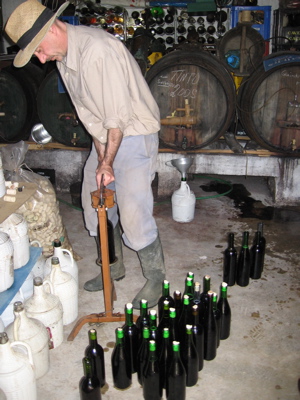
With tons of wine left in the barrel, I took up the neighbour's offer and began cleaning garrafao (5-litre demijohns) from a huge stack he keeps outside. It was quite a lot of work. In the end, we filled 40 of those as well as a few 5-litre plastic water bottles.

The remaining small amount we left in the barrel for a few days and then put it aside in a plastic tub to become vinegar. Unfortunately, there was a little more left than I thought. So we are going to end up with around 20 litres of vinegar in addition to around 300 litres of wine. Quite enough to last us until next November, when the new wine will be ready for tasting...
Kodo
Kodo came to town! These drummers are just incredible, so we just had to go and see them last weekend when they played in Figueira de Foz, down on the coast.
Actually, Kodo mean quite a lot to us. Way back in 1994, a cycling/camping trip to Sado Island (in the Japan Sea) taking in the annual Earth Celebration percussion festival that Kodo organizes was our first major trip together. We had a fantastic time then -- performances, workshops, food, drink and then a good cycle ride around the island -- so we consider Kodo part of our togetherness (our two-ness). Earth Celebration comes highly recommended by the two of us!
In all, seven of us went to the concert. They included Conny, the local djembe guru, Tita (our yoga teacher), and our Portuguese teacher.
I'm not sure how the djembe players found it. For me, the first couple of drum beats raised goose-pimples and sent a shiver down my spine. The Kodo sound is primeval but deeply connected to human existence. It can't be ignored. And although rhythm is a constant in human culture, it is also peculiarly Japanese -- the sound and energy of festival, a time when all Japanese are able to release and let their hair down. I love it, and sat engrossed through the two-hour concert.
No pictures, I'm afraid. And no recordings either. I bought a CD/DVD set (to complement a CD I've had for years), but I'm sure posting tracks here would infringe something. All I can suggest is that you wait for a Kodo concert near you -- they tour every year!
Daikon
Unbelievably, we are into our second cycle of growing vegetables. Already, things are looking very different this year.
I sowed some daikon (Japanese radish) during the winter and kept them under a plastic tunnel through the cold weather. Now they are looking very healthy, and we expect to be eating some in a month or so. Here they are:

We are also well ahead with onions and beetroot, also some lettuce and a few other salad vegetables. Tomatoes are in, peas also. Broad beans have been looking great since they were sown in November. We also have a reasonable selection of herbs in various locations.
Of course, this great head start might have more to do with the weather -- lots of rain so far this year -- than any increased expertise on our part.
Recent Weather
Rain, rain, rain!
When we first saw our house, almost two years ago now, the stream down below (actually the mighty Tabua River!) was in full flow. Everything was green. And I thought we were moving to a sort of England-but-with-good-summers area. Then, when we finally moved here last February, the land was parched. There'd been no significant rain for a year. And nothing much changed until the late autumn, when we began to have a little rain. By Christmas, the land had recovered to a degree, but it was clear we still needed much more water.
Into the new year, and we've had regular rain. Which fell as snow higher up -- sometimes only a little higher than Tabua. Here's a shot of the Serra da Estrela taken around the end of last month:

As a result of all this precipitation, the Tabua River has recovered. Just down below our house, the stream was looking like this a few weeks ago:

Just today, I went down to the stream and saw that ancient irrigation channels -- leading off the stream above the mill weir -- are full and taking water uselessly into nearby fields. Uselessly, because no one around here grows the corn and other crops that used to be nourished by the water down on the small flood plain.
The wet weather has made everything green. Particuarly spectacular are old terraces, now mostly tree covered, that suffered fire last summer. With the trees partially burnt, the terraces are very visible. And with emerald green grass now growing, they are quite a sight:

Take Things Philosophically?
Did I say our windows and doors were coming on Friday? More than a week ago? We're still waiting.
The builder disappeared for a week, as did the contact we have at the window workshop. We thought they'd done a runner, especially when the architect said he had no idea what was going on. Finally today we've had something of an explanation -- not that it's very good or explains everything. But at least we are talking to these people again...
Meantime, the stone exterior steps arrived and have been fitted. They do look nice. We are quite happy with them.

The latest? It's a long story, as most poor excuses are. The window workshop is short of one aluminium profile. The supplier won't deliver it without money upfront. The window man, and our builder also, think this is ridiculous -- but having seen what a bad payer our man is I can quite understand the attitude. (We went into a local shop to order something on his account last week. The word from the accounts department? Don't let him have a thing until you see the colour of his money! As soon as we said we were paying ourselves, everything was OK -- except for the slight black mark we now have for being associated with him...) So our builder's brother calls the brother of the window man. Brother of the window man says he may have to lend the window man some money to get things moving. All of which may be a precursor to us being asked to stump up some more cash -- which is not going to happen. The best we might do is promise some more when the windows and doors are actually fitted. Meanwhile, wife of the window man is in hospital in Coimbra having a baby. Or so we are told. And our builder was off in Lisbon most of last week -- which is why he didn't call us. We suspect he was there rustling up some money in some way or another; we went around a few suppliers with him today (well, we forced him to take us) and his credit rating seems to have improved since last week...
"Take it philosophically" is what my dad used to say. Difficult, but we are trying. And on a lighter, more pleasing note, here's a shot of the house with cherry blossoms looking distinctly like a Japanese castle..... Don't you think?

Eclipse II
Another solar eclipse? Yes, that's right! I'm sure you heard about it -- totality visible from Africa across central Asia on March 29th. We had about 20% or so here. I'm not really sure as it was cloudy and wet at the time... We had a nice (short) picnic, though, despite the rain...
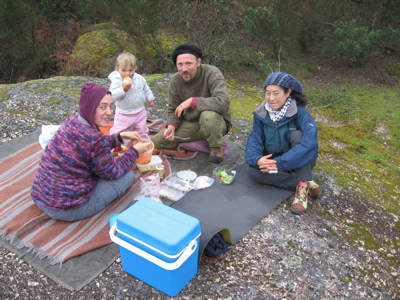
Spring Flowers
Spring flowers -- some might call them weeds -- in a vineyard.
This lovely little view is in the village of Barras, a 30 minute walk from our place. The view happens to be right in front of a new building put up by friends of ours, Francine and Klaas, for their growing shiitake mushroom business...

Note the vine supports -- slate (schist) poles of a type that are quite common around here. Though some of our vine wires are supported like this, others are on a mish-mash of bits of wood, steel pipe and other more pragmatic materials. Over time we hope to replace more of them with these beautiful pieces of slate.
Blue/Purple Flower
Can you identify this? It's a beautiful deep blue/purple colour.
Grows in woods around here, particularly against rocks. It seems to like the sun.

Flower -- Identified!
Thanks to Chris and his botanist sister the flower is identified as Lithodora diffusa or 'Grace Ward'. I suppose this might be interpreted as 'protector of grace'. Interestingly, Megumi means 'grace'. The plant is quite abundant around here.
I can see the light...
...at the end of the tunnel. The house is just about closed, with most windows in place, and we can finally begin to think about living there.
The past six weeks or so have been really crazy. First, some of the windows were delivered and fitted. The rest were due a couple of days later -- but never came. Some time after that, we had a real battle with the builder, Fernando. One day, after the windows had been promised but failed to turn up again, we sat in his car and forced him to drive us to the window manufacturer. There we found that, contrary to what we'd been told, the windows were not complete and ready to go. Rather, they were laying around on floors and benches in various stages of completion. Meg got in his car and said she would stay there until he got something moving. At lunchtime, he got quite violent and started throwing around (and threatening me with) the wheelwrench from his car.

The first windows in place; pretty smart looking but pretty slow coming!
By a fortuitous coincidence, we'd been to a solicitor the day before to discuss the situation and what we could do to get the work finished. He'd agreed to send a letter giving a deadline -- and Fernando must have received this soon after the wheelwrench incident. The letter indicated that we would take further (unspecified) action if the work wasn't finished. It seemed to do the trick -- work sped up, though the windows still didn't come. Until today...

Rear view of the house with most of the windows in place. We are still a couple of panes short; one cracked during installation and the round one is due in a few days.
So things are coming together. It's time for me to get on with building the kitchen. We'll soon forget the trouble we've had getting this far. But perhaps I should write a book on the story -- much of which I haven't posted here for fear of boring everyone.

The terrace with kitchen windows in place. We are also working on the terrace railings; they should be finished this coming weekend.
Food is Global -- Even Japanese Food?
It's easy to miss while living in Japan, but the world seems awash with Japanese food now. At least compared with 20 years ago. Friends of Meg's have just opened a Japanese restaurant in Lisbon -- not the first by any means -- and at Asian supermarkets there we can buy many Japanese ingredients.
Indeed, we've just had some nori (dried laver; used for sushi and the like) with our lunch and were intrigued by the packaging. (We bought it in Lisbon.) The brand name is Sukina, which sounds pretty Japanese. It is labeled in Japanese as ??????? (nori for hand-rolled sushi). There's also English: Roasted Seaweed (Laver), which is about right. The distributor is Wang Globalnet, a company with offices in the US. The European importer is a company in Paris. The original packaging gives the origin as South Korea. Finally, there's a stick-on label added by the Portuguese importer, where the origin is given as China.
How odd! And one wonders why Japanese companies have missed out on the opportunities opened up by a worldwide interest in Japanese food?

Catching up....
An update is in order. Once again, we've had a busy time and only now do I find time to write anything. So what's happened?
Here's a summary -- I may try to fill out some of these points into fuller entries later:
- I had to return to Japan for a couple of weeks to get a new re-entry permit -- without which my Japanese permanent residence would be taken away next time I try to enter the country.
- While I was away, the last windows were installed in the house and Meg began living there. Before leaving, I set up a temporary kitchen, camp style, with a couple of gas rings and a sink.
- The final electrical problems were resolved and we also arranged for an on-demand water heater to be installed in what we have dubbed the 'boiler room'. So we have elecricity and hot water now.
- Delays with the internal telephone wiring and certification (a long story and worthy of an essay in itself) were resolved and Meg obtained the certificate (or perhaps more correctly prised it out of the electrician's hands, because he wanted to hold it to ransom until he was paid by Fernando) that the telephone company (PT) requires before installing a line.
- As soon as I got back from Japan, we moved most of the major appliances and furniture to the house -- washing machine, fridge, sofabed, etc -- and began living there (here, actually!). We were returning to the apartment only for telephone/internet and showers (because we are having problems getting a shower cabinet to fit the base we installed in the small bathroom...)
- The very last contracted work was finished -- some bits of carpentry and door lock adjustments. We told the builder, Fernando, that we considered the work finished and have arranged a date with our lawyer to work out the accounts and make the final payment. That's Tuesday of this coming week, July 4th.
- Last Friday, on their second visit and having put up two new poles, PT connected the new phone line and moved our service from the apartment to the house. Meantime, I had to dig an 11m trench across the garden from the house to one of the new poles to lay in an underground conduit for the line. Then yesterday, Saturday, we finally tested the Internet (ADSL) service, determined it was working, and moved our computers up here to the house. Now, finally, we feel as if everything is settling down and we have everything we need at the house.
- Also on Friday we took delivery of a stone countertop for the kitchen. Pleasingly, my measurements were just about spot on and it fits perfectly. Getting the stone into place was somewhat nerve-wracking (80kg, and with the large hole to take the cooking hob leaving perilously narrow margins of stone). But now it's there, fixed down, hopefully never to move again...
Year of the Cucumber?
Last year it was courgettes (zucchini) that threatened to bury us. This year we have them under control, but we've have a mountain of cucumbers...
Some of the plants we bought as seedlings from the Tabua market; others are grown from Japanese seeds. (Japanese cucumbers are small and quite straight, perhaps 3 cm round and 15 cm long. Portuguese cucumbers are fatter and up to about 30 cm long; pretty much the size of large courgettes.) The strange thing is that the results -- both from Japanese and local plants -- look like the cucumbers we can buy in the market here. I wonder if it is soil or weather that determines the size and shape of a cucumber as much as the variety?

The problem with cucumbers is that they do not keep and nor do they freeze. (Now that we have a larger chest freezer, we are able to deal with the tomato and courgette harvest...) So the focus of bottling this past few weeks has been the cucumbers. I've done some like American-style dill pickles (though with fennel leaves rather than dill, as these are are commonly available around here) using both sliced cucumbers and small, immature ones. I've also done some chopped and some as a kind of green pickle/relish. Now we're running out of ideas. But just in time to save us from a tedious diet someone has asked if we can provide cucumbers for a local Green Gathering event this coming weekend. I expect we'll get paid for any we send over -- but we are hardly going to get rich selling a couple of kg during the peak of the season....
Sun Dried Toms
Lots of tomatoes this year, too. But with a freezer downstairs in the boiler room and intense sun on the terrace, we can handle them! Megumi has been busy with the drying -- and doing it very successfully. We've got bags and bags of the things ready for a winter reminder of summer.

A Symbol of Summer?
Anyone who has lived through a Japanese summer will recognize watermelon (suika) as one of its symbols.
Normally, I am not very keen -- they are messy to eat, watery, and full of annoying pips. But when it's really hot, there's almost nothing better to cool one down, aside from a good dose of air-conditioning. Lacking the air-conditioning here, we were pleased to find that a couple of seedlings we picked up at the market were bearing fruit.


Unfortunately, none of the ones we've harvested so far have been that great. They are pale and a bit flavourless. But still a good thirst-quencher on some of the 40??C days we've had...

Home Centre
The kitchen is the center of the house. At least, it's the place where people always gather wherever we live. So we are pleased to be working on our new kitchen at last...
The space is quite large -- actually it's the biggest room in the house. In the end, about half of it will be taken up by the kitchen itself, with the rest forming a dining/sitting area. The first priority was to get some basic facilities into place -- sinks, cooker, cabinets.

We imported the two sinks from the UK. They are old butler-style sinks that came from a school in Amersham -- where my sister's children were pupils. With a bit of engineering (they are VERY heavy!), they fit in very nicely. One is for washing, the other for draining. At least, that's the current plan.

I've previously mentioned the granite countertop that we ordered. Here it is going into place:

The big hole was filled up with the hob/cooktop, like this:

So now we are beginning to feel quite comfortable in our new workspace, though there's still quite a lot to do...


The rest of the house is beginning to feel like home, too.

And I'm getting on with some work downstairs on the ground floor, such as this tiling in and around the utility room:

Latest Exterior Pictures
Is it a villa? Is it a cottage? Depends on who sees it! Whatever you think, it is certainly the most prominent house in the village at the moment -- by virtue of the fact that it is so newly painted.
This is how it looks from across our small valley:

And this is a view of it from the garden:

Summer Snack
All local ingredients, with salad from the garden. Looked and tasted great!

Some Catching Up To Do
How did that happen? We are in 2007 already and I've not reported on any of the important autumn happenings -- like the grape harvest and wine making, the olive harvest and the very different weather of the past autumn. Once again, it's difficult to know where to begin now that I'm so behind.
Let's see... I'll start with the wine. It wasn't a great year for grapes and in fact many of ours, particularly the tinto (red) were lost to mildew (a result of damp earlier in the season). Many people spray to prevent mildew -- Bordeaux mix, which is I think basically copper sulphate. We didn't and as a result suffered quite badly. We'll have to consider what to do next year -- we would like to get good grape harvests, but on the other hand we really want to minimise spraying, even with (marginally) acceptable chemicals such as copper sulphate.
Anyway, with the help of our neighbour Orlando we managed to fill two 100-litre barrels in our own utility room -- one red and one white. The truth is though we probably had enough red grapes for no more than a few litres, so in reality the wine isn't really ours. Still, it does feel good to have two barrels maturing downstairs.

Nice barrels, huh? Finest chestnut; made by a cooper in Tabua -- perhaps the only one left. (Villagers tell us that there used to be so much demand for barrels that even this little hamlet of a few houses had a cooper.) Amazingly, properly made wooden barrels are not that expensive. These were 45 euros each.
Before the grape harvest was in, it started to rain. And it rained and rained throughout the autumn. What a difference compared with last yeat! A local weather station reported around 75cm of precipitation between September and the end of November -- which is three times more than in south-east England where most of my family live. Here's one of the early thunder clouds that developed toward the end of September.
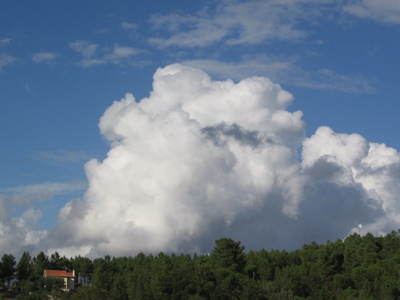
We had some pretty good sunsets too...


In the distance in that second picture, the mountains are the Caramulos. This is what we see from our kitchen windows. The buildings in the foreground are part of Tábua.
The rain kept the garden looking green and healthy till quite late in the year. Here are some of our raised vegetable beds around the end of September.

With that, I feel that this post is getting a bit long. I'll continue elsewhere...
Some Recent Shots
Here are a few of the photos I've taken recently.

During a visit to Lisbon, I took this photo of the wonderful old trams. I was on a tram waiting for the two coming uphill to clear the narrow single-track section. A very nice view that really captures the narrow lanes of Lisbon.

A rainbow seen from our verandah. On a clear day, we'd see Portugal's highest point just about where the pot of gold should be...

One of many villages in the Serra de Açor mountain range -- just south of here -- that was lucky to escape being burnt in 2005. The fire completely surrounded it, as can be seen by the stunted or dead trees nearby. But at least the black colouring of last winter has given way to green.

Night scene (taken on Boxing day or St. Stephen's Day) in Aldeia das Dez, a lovely little village in the Serra de Açor.

Elaborate terracing, now apparently disused, in the Serra da Estrela range. In our area, there is an incredible amount of terracing. Tiny terraced fields have been carved out of rocky hillsides everywhere. But this is the most spectacular and sophisticated example I have seen; it almost looks like part of the garden of a large residence, but there is no house nearby...

Autumn colours as seen across our little valley just a few days ago. The mighty Tábua River (actually flowing now after all the rain we've had) is between us and there.
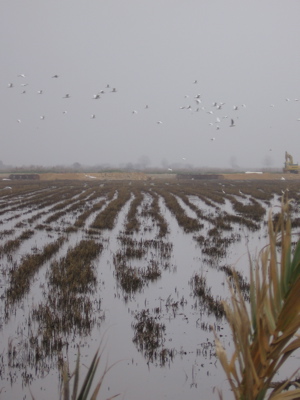
It could almost be Japan. Rice fields on the other side of Coimbra from here, towards the Atlantic coast. In this colder weather, they have a bleak, wintry feel -- emphasized by the white birds, which are presumably a kind of egret.

In recent days we've had a lot of hazy weather, perhaps not helped by smoke from all the wood fires. This sunset is seen between two of our orange trees.
Home Improvements
Progress is slow but steady on the house. Early in the autumn, we had the ground floor walls rendered (with a sand-cement mix rather than the more expensive fine plaster the first floor is finished with). Since then, we've painted most of the walls and also completed the ceiling of our future dance/yoga studio in pine.
The studio is not that large (for a studio), but still much larger than most ordinary rooms. It is also well over 3 metres from floor to ceiling. The almost 40 square meters of pine, plus the battens to support it and a layer of insulation, were quite an effort to fit.

With the studio coming along (we just have to clean a bit more of the stone walling and lay the floor) it was about time I got to work on the stairs leading down there from the main part of the house.


So we are getting there... Slowly....
The studio floor is going to be sprung; a proper dance floor. Getting the special foam pads I need for that was bit of a saga! I sourced the system in the US as a cheap and easy to install sprung floor. Unfortunately, Portuguese customs had other ideas -- and I ended up paying more for shipping and duty as for the parts. The pain was worse because half of the original cost was a kind of intellectual property -- the book of instructions. The total weight was just 3kg; I felt like I paid for this weight in gold!
Anyway, we have the bits we need. Now all I have to do is source the engineered bamboo flooring that we want to finish the studio with. I'm hoping we can get on with this within a few weeks...
Tea Ceremony
Megumi's mother is a high-ranking teacher of the tea ceremony, in the ura-senke tradition. She was here in Portugal over the holidays, so our living room was transformed into a tea house on a few occasions.
We weren't quite sure how our friends here would take it. The tea ceremony isn't something you can get much out of by dabbling in it for a few minutes and, although anyone who has lived in Japan for a while is likely to get a feel for what it's all about, it can be difficult to get any insight at first glance. Still, we decided to try it on a few people who seemed interested, as well as with a few friends with some connection to Japan. Pleasingly, everyone seemed to get something out of it and the people who came have all thanked us for arranging it.

By next time, I hope we'll have somewhere more suitable than a rug on the living room floor. A nice little tea room out in the garden would be nice, but I doubt if we can stretch to that. But perhaps a Japanese-style verandah around the studio might come about and I'd love to plant some bamboo to add a bit of Japanese texture to the garden.
The Olive Harvest
Well, there wasn't much of it really. Although in September and October things were looking very good, by the time we came to harvest in November the weather (heavy rain and continuous dampness) had destroyed them.
And although we learnt later that most Portuguese producers simply harvest anyway and press them for oil, we thought there was little point and picked out only a few kilograms (actually a few tens of kilograms) of the best ones. (Earlier we'd taken some of the better olives -- the larger ones, both ripe and still green -- for pickling.)
Our original aim was to add our olives to those of a Belgian friend and take them quite a distance to an old-fashioned water-wheel powered press. It sounds like a wonderful old place with stone rollers, drive belts and hand presses. The point is that by combining harvests we would have reached the minimum quantity required to run a batch through the press. By doing that, we are sure that the oil we get came from our own olives (in contrast with last time, when we simply took our few olives to a local 'modern' press and were given an appropriate quantity of oil that had already been pressed. Actually, in that case, 'pressed'is not really the correct term, because the process involves crushing, mixing with hot water and then centrifuging to separate the water and oil.
The old presses, like the one we hoped to use, first crush the olives using under huge stone rollers. The resulting pulp is then spread, by hand, onto sheets that are layered into a press. As the press -- a giant screw mechanism -- is tightened down, the oil escapes and is runs into collecting tanks.
Anyway, the small quantity of olives we had made all this impractical. As a result, we just handed the olives over to a neighbour who took them for processing at another local plant. We will have to hope the harvest is better next year so we can try again. I'm looking foward to seeing a real old plant and receiving oil from our own olives.
Orange Season
In contrast to the olives, it's a good year for oranges. Our three trees (actually one orange and two tangerines) look just as they did when we first arrived here in February 2005 -- loaded with fruit heavy enough to break branches. This contrasts with last year, when there was almost no fruit at all.
This time around, we are determined to make the best use of the harvest that we can. Both the oranges and tangerines are of fine quality: large, juicy and sweet. But in fact, at this point in time, I can see we are going to be overwhelmed. Using all of the fruit would require almost industrial-scale equipment!
What actually can we do with it? Well of course drinking fresh orange juice whenever we want it is our favourite way of diminishing the citrus mountain. We really do have an almost endless supply, even considering that some of the fruit will happily stay on the trees until summer or later. In fact, at the present moment, we are picking up 5-10kg of fallers every day -- plenty for our juice needs! (We find it takes about 2kg of either the oranges or tangerines to make a litre of juice.) We've squeezed quite a lot of extra juice for freezing and will continue to do that -- until the freezer is full. I've been making marmalades of various types -- tangerine, orange, thick chunky batches, more refined jelly-like batches. But still we have piles of oranges around and we are fast running out of jam jars to preserve the marmalades in...
So if anyone has other ideas as to how we might use these fruit, do let us know. In particular if anyone knows anything about the manfacture of orange-based cleaners, we'd be very interested....

It Doesn't Get Much More Japanese...
...than devouring a bowl of soba on New Year's Eve!

The soba noodles were from Japan. The dipping sauce Megumi made some time ago; we had frozen some. Negi (Japanese leeks) from the garden. Nori (seaweed) also from Japan, along with the wasabi (from powder). Most of these things, though, we can also get hold of at a Chinese supermarket in Lisbon.
The lone flower is a camomile, fooled by the warmish weather into thinking it must be spring...
Ski Conditions?
I've been waiting for some decent snow up on the Serra da Estrela in the hope of getting my back-country skis back on some snow. Last year, my skis were still back in Japan so I missed the chance. So far this year, there hasn't been much snow at all. This weekend it's been raining. Anyway, for future reference (mine!) I'm putting this forecast here for the area. The site (snow-forecast.com) is quite interesting... You too can find out where it's snowing today!
Managing Those Vines
Grapes have been grown for wine for at least 2000 years (I know that because I've read the bible). So naturally vine management is something that is well developed -- and not to be learnt overnight. For us, the trickiest part is the pruning, which is done after the leaves fall (around November) and before the new shoots appear (March or so). After pruning, we have to tie up the remaining stems to the wires and posts that support the new growth. This is done with 'vime', branches of a type of willow that (helpfully) grows abundantly near streams and rivers here.
There are books and books on pruning grapes. We've read a bit on the subject, but so far it has passed right above our heads; it is a complex, multi-year process that entails understanding how the vines grow and remembering which bit of each vine is which... As a result, our pruning so far has been fairly random, based on a few pointers we've picked up from local people and from the literature. At the end of the day, our pruned vines look vaguely similar to those of our neighbours, which is probably a good thing. At the moment, I haven't got any photos of the pruned grape vines; I'll try to get them and post later.
Our vines are basically supported by two parallel wires. These are stretched between a variety of posts -- the best being slivers of slate about two and a half metres tall. We also have a few concrete posts, some odd bits of steel and some wooden. Between the main posts there are canes, also harvested nearby, to provide extra support.
Around this time of year, after pruning, we have to retie and sometimes replace or move the canes. We also have to tie the pruned branches to the wires or canes. This is done with a kind of willow or osier (a flexible twig of a willow). In Portuguese this is called 'vime' and indeed people talk of 'doing the vime'. It seems that this word probably comes from the latin name of the willow variety: Salix viminalis. Anyway, this willow grows along streams and in valleys here. When the leaves fall, they leave long, spindly yellowish branches and twigs -- which are all cut down leaving the tree as just a stump (from which the next year's grown magically appears). Soaked in water, these twigs become strong, flexible ties that have a number of uses around the garden. (Including building frameworks for the tomatoes, etc.). It's good to be able to use a natural local product -- rather than the plastic ties advocated in some references to vine management.
Here's the vime, cut and soaking in water prior to use

And a rather poor shot of a vine tied to a post using a length of vime
Bread in a Wood-Fired Oven
I've been baking bread regularly for more than 15 years. For the past 12 of those years, I've been using the same yeast culture -- originally taken from a bottle of Tall Ship Pale Ale. (The Tall Ship Ale Company is another story -- way outside the scope of this blog. References to this business that I was involved in can still be found on the web -- the fossilized remains of a great but doomed brewery... Here's one.) But until coming to Portugal one of the things I'd never done, but always wanted to, was bake bread in a wood-fired oven. Well, here, every other house has a bread oven, so...
Actually, I haven't been able to take advantage of all these ovens that much. The weekend before last I had my second real experience with one, at our near-ish neighbours' house. It didn't work out perfectly -- first it was pouring with rain and second we didn't manage to control the heat very well -- but at very least it can be considered a learning experience.
It was a big oven. You could probably bake 20-30 loaves at once with a bit of organization. Of course, we didn't want to do anything like this number -- more like eight -- so they were a bit lost in such a huge structure.

Here's the oven itself. Stone portal. Brick and clay dome. Steel plate door!
Getting such a large oven hot enough requires quite a lot of wood. One of our problems is that we probably did not heat the structure up enough; ovens like this are known as retained-heat ovens because the baking is done after removing the fire; the bread cooks with the heat retained in the walls of the oven, which is radiated back into the dome. In fact, because we wanted to bake pizza after the bread (it would be more normal to do the pizza first, as it likes higher temperatures) we didn't rake out the fire, but left the embers burning around the edge of the oven floor. This caused too much direct heat on one side of the bread, which burnt slightly.
Now one of my books on bread ovens notes that, when the oven is at the right temperature, the inside of the dome turns from sooty black to white. We got this part right; at a certain point, we looked inside and sure enough the roof was white.


That's me, placing bread into the oven. One problem we had was that the floor of the oven has worn so much that bread (and especially pizza) doesn't slide nicely over it. Also, it was impossible to swab the ash out from all the cracks and crannies on the floor -- the result being rather ashy pizza. But somehow that just added to the experience!

Here's the bread baking in the oven. I've turned it once, so you can see the burned crust. This was because of the embers left burning in the back and to the sides of the chamber.
We'll try again sometime. And also, I hope, move forward with plans to build an oven (or two) on our land. I'd like to try a stone/brick oven of this type as well as an earth (clay) one. But that's for the future...
Where in the World?
Somehow the oddities of our 21st century world seem exaggerated here. In Tokyo, we just got used to the idea that people were online and on the go all the time. But even there, I don't remember being quite so surprised as I was by a couple of phone calls last Friday....
First, Meg called her dentist. She just wanted to make an appointment for a regular checkup, for both of us. When he answered, I heard her apologise for calling -- and learnt later that he was on holiday. Reasonable enough; it's a bit unusual anyway for him to have given out his mobile number. What was quite a shock was to learn that he was on holiday in Angola! Hmmm... For all its technology, Japan still hasn't got a decent level of compatibility between its mobile phones and those in the rest of the world. And here we are, calling Angola without even realising it...
A little later our friend Miguel called. He lives in Lisbon. But he was calling to ask me about a second-hand Mac he was looking at in a shop I recommended -- Yodobashi Camera in Shinjuku! Now how did he do that? I don't know if it was with a European phone that he carried with him or from a public phone. When he gets back I'll have to ask him! Either way, it was the second rather surprising call of the day.
Still, all of that is no stranger than what I'm doing as I write this from our house in Tábua. A background window on my Mac display is showing a server somewhere in Tokyo (I don't even know where!) on which my latest database is to run. I'm uploading a new version of the database and preparing it for some testing on Monday morning in Japan using Microsoft Remote Desktop Connection (via a secure VPN). All the data I send is being encrypted for passage through the public internet then decrypted at the other end. This makes it rather slow -- and that's why I've got time to write this post! (I also had time for half an hour of tai chi while the files were uploading...)
Bottling the 2006 Vintage
Another year passes and it was time to bottle the wine again.
This time around I chose March 6th for the job. With much less wine (100 litres of red and 100 litres of white), it was an easier task than last year.

Why did we mix the grapes in 2005 but make separate red and white wines in 2006? Well this was not our decision, since all the processing was done in our neighbour Orlando's adega (wine cellar). Until we get our own space and equipment for producing wine, we will be at his mercy. So far, it has been interesting for us to see (and taste) the difference, but we prefer having separate white and red wines. One problem, though, is that the majority of our vines are white grapes; the only way we got any red to speak of is because Orlando is so generous with his grapes...
Bottling was also easier this time around because I borrowed a different (newer) corking machine. We ended up with around 100 bottles of each and a few of the 5-litre demijohns,

As I mentioned previously, we bought the two barrels in Tabua, where there's one little coopering business still making them in chestnut (and perhaps other woods too). Two 100 litre barrels cost me well under 100 euros. I wonder how much longer they'll be available; most people around here seem to be moving over to stainless steel.
Irrigation System
One of last winter's projects was to put in water points around the garden. Until now, we've been dragging hoses all over the place from a rough-and-ready distribution point that I set up when we first arrived. But with watering a daily task for many months over the summer (in a typical year, anyway), we had tired of doing that. We were spending more time carefully pulling hoses around the beds (to avoid damaging anything) than we did actually watering.
So far, there are six water points, each of a different design. One is simply a column of slate with a tap attached. Another a temporary wooden pillar. Three, though, I went to town with. They might be called follies -- except that they do have a real use.

That's the rather standard one. A simple brick and mortar structure with a couple of old tiles for a roof.

Then there's the 'cairn', built with scraps of granite and boasting two taps and an access door.

Finally, the piece de resistance, a tiled table for potting or whatever, fitted with taps at either side.
Compost
One of the many large strides in knowledge I've made in the couple of years since moving here is in the field of compost. It sounds simple and rather dull, I know, but there's a lot more to compost and composting than meets the eye (or the nose).
Of course, well-managed compost should not assail the nose at all, and most of the time mine doesn't. Occasionally, though, one of my piles might get a little waterlogged and that leads to anaerobic decomposition. This can be a bit smelly, to say the least. But most of the time I have bacteria working away aerobically, turning our food waste, weeds and other garden materials into wonderfully fertile soil. Earlier this year, I started making a set of bins for the compost and for storing materials that I accumulate prior to composting.
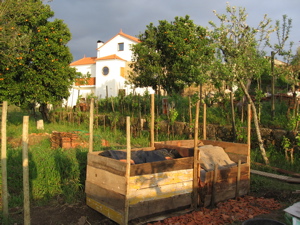
I ran out of old planks, so stopped after two bins -- but in the end I hope to have six. Plenty of capacity for a future in which we may start composting, um, 'humanure'... (Since we don't keep any animals at the moment -- bar a cat -- we have a real shortage of nitrogen-rich materials in the compost. The best source I can see at present is ourselves...)
Oyakodon
A taste of Japan! Coming up with authentic Japanese food is not that easy here, though we can get many non-fresh ingredients during our occasional trips to Lisbon. A relatively easy dish is oyakodon -- chicken in egg on top of a bowl of rice.

The Gum Rockrose
Cistus ladanifer (gum rockrose) grows wild in the woods around here. The mostly white flowers are quite arresting seen among the dark greens of the pine, oak and (unfortunately) eucalyptus.

Kitchen Clutter
It looks as if we've been living here for years -- judging by the clutter!
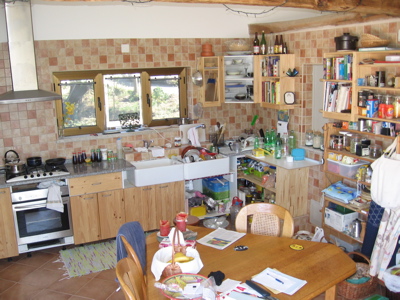
Cider
We've had a break from wine making this year. Our grapes were completely ruined by the weather -- the cool humid spring led to mildew, then there wasn't any really hot weather to ripen any that might have survived the mildew. Other people managed to salvage some, but in our case the harvest was zero. So instead of wine, we thought we'd have a go at cider...
Well, we only have one apple tree. So we pooled our apples and muscles (quite hard work chopping up the apples then pressing them) and ended up with around 100 litres altogether...

That's Megumi hiding behind the esmagadeira (crusher). Friend Glynis is doing the initial cutting with a shovel. The emsagadeira proved almost useless; we ended up cutting the apples with the shovel until the pieces were small enough to put into the press (which is the round unit below the esmagadeira).
The results of all this effort are now sitting in a barrel and a couple of plastic containers. Fermentation seems to have stopped. There should be a secondary fermentation next year, I suppose when the weather warms a little. And the cider should be ready for drinking in the spring. Until then, it's a waiting (and worrying) game. Will we have cider or vinegar when we crack the barrel?
Completing the Studio
We finally got the studio finished! Here's how the all-important floor was done.
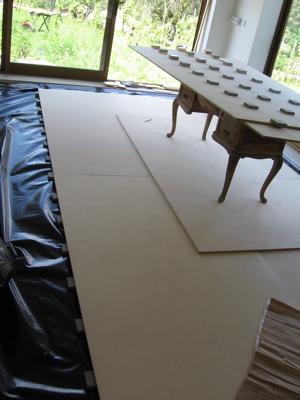
We began by laying down a sheet of black plastic material as a moisture barrier. Then a layer of ply with special foam pads glued underneath in a predetermined pattern -- to give the required spring.

Then another layer of ply glued and screwed on top of that... Our friend Dave is spreading the glue here. By this point, we've got a pretty solid floor -- but lacking the nice surface finish.

Finally the bamboo arrived. There's a bit of a story here. In the end, we were unable to find a Portuguese supplier -- even though we were in contact with a firm that brings bamboo flooring into Lisbon from China. They would only sell wholesale -- and have no distributors at all within Portugal! Minimum sale was a container load -- enough flooring for about 6000 square metres. Our studio is only about 33 square metres! In the end, we bought from a London company and had it brought over specially to Portugal...
Note the planed down area on the far side of the floor -- where somehow I got the levels wrong. (There was lots of adjustment to do, what with an uneven floor and two door sills at different heights...)

There it is done. One happy cat (she loves the space) and one happy Megumi.


Now it's 99% finished and fitted out with a sound system and storage for Meg's sheet music, yoga mats, etc.
Salad Noodles for Summer
All from the garden -- except the noodles.

This Year's Pics
A selection of pictures I've taken over the past 10 months.

Looking out of Coimbra station on a wet evening in September.

Colourful fishing boats on a large tidal bay north of Aveiro.

Yellow gorse dots hillsides near Linhares on the edge of the Serra da Estrela mountain range.
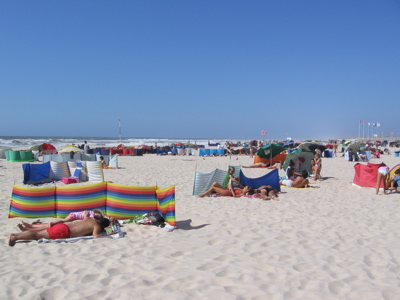
The beach on a windy August day -- Atlantic coast at Torreira, north of Aveiro.

Two children climb the modern steel steps to enter the keep at Linhares castle.

Another stunning sunset from our terrace.

Watch out! Would you want to drive out past that every day?

Stones in an old ruin, Caramulo mountain range.

Lucky shot of a lightning strike during an August thunderstorm.
Labor Omnia Vincit
That's the text on an old factory wall in nearby Santa Comba Dão. I suppose it would translate from latin as "Work conquers all".
The building happens to be across the road from the birthplace of António de Oliveira Salazar, who led the authoritarian regime here from 1933 to 1974. I have no idea if there is a connection -- but I'd guess that people in his home area were broadly supportive of the dictator and showed it in this and other ways.

The old dictator still stirs up passions around here. A few months back we heard there'd been quite a confrontation between a group who are pursuing plans to set up a museum to Salazar and others totally opposed to the idea of celebrating his life. Of course, there are always two sides (at least) to a story... It seems pretty clear to me that, for most people, Salazar was a nasty piece of work. At worst he used the usual violent techniques of authoritarian regimes to keep down dissent. At best, he was a Mao-like figure who kept the peasantry in glorious poverty while enriching close comrades. But a quote from a 1958 travel guide to Portugal (by one Iris Merle) is interesting: "It is now almost a quarter of a century since the quiet but brilliant economist, Dr. Oliveira Salazar, a professor at Coimbra University, was called to put Portugal in order and on her feet again. While remaining always the quiet, austere-living professor, Dr. Salazar has achieved the almost impossible task which his country set him and ahas already become somewhat of a legend." People I've met who lived through the revolution in 1974 (26 years after this quote was written) would not put his achievements into the same words...
Most remarkable to me is that the coat of arms and text still remain. I wonder how much longer it will stay? The factory, whatever it produces, still seems to be operating but in these days of EU membership I'd say its days are numbered...
In a similar vein is the following picture. It's the entrance to the Communist Party offices in Aveiro, a coastal town north of here on the way to Porto. The wonderful tile work is typically Portuguese (and called azulejo). The depiction of a labourer hard at work digging a hole (at the top of the stairs) seems to owe more to the Soviet Union.

Most towns of any size in Portugal seem to have a prominent Communist Party office. Posters are also quite common ("Health is for All" and the like...). It's good to see really; I don't know if it's a sign of real political debate but certainly it must be causing the major parties to think a bit.
Time to Catch Up
Once again, time has passed. I'm just about to upload a slew of entries that really should have dates throughout this year. In fact, I think I will re-date them to reflect approximately when the various events happened. So most of them will, in the blog, predate this one... Sorry for any confusion...
Two Great Seasons in the Garden
Weather wise, it's been a great year (for me, anyway). The spring was long and cool with quite a lot of rain -- quite different from the other two years we've experienced here. Then summer came -- in a sense. It never got very hot, at least not for weeks at a time, and we had occasional rain to keep the garden in good order.
April, May and June were great months, with flowers everywhere (wild ones -- we haven't had much time for anything ornamental so far!) and a mix of sun and showers.

The sea of yellow flowers is our 'meadow', an area of rough grass and weeds that we cut with the lawnmower. Later in the year it becomes a bit scrubby, but in the spring there's a series of wild flowers of different colours.

A misty morning in early summer.

Set up for a party... We put the tent up for Meg's birthday bash in July and it's been there ever since. The days are still warm enough to enjoy a lunch of wine and cheese out there...
Viseu
I've mentioned Viseu a couple of times in my various posts here. One day I'd like to find time to write more and perhaps put up some photos that hint at its character. But that will take time that I don't seem to have -- so for the moment be satisfied with this shot of friends Greg and Liz, with son Max, posing with Megumi in a medieval setting right in the centre of the old town. I took this one last summer, as you can tell by the clothes... By mid autumn, Viseu can get pretty chilly at night...

Getting the hang of gardening?
I'd like to think that after a couple of years at it we are finally getting to grips with growing our own veggies. The reality, though, is that there's much to learn and we remain mere beginners. Still, the photos perhaps do more than justice to our efforts.
First some lettuce. So far we've grown most of our plain lettuces from seedlings. (We have a good, cheap supply of seedlings for all the standard things at the local Sunday market.) Also in the picture, but not quite so easy to pick out, are other leafy salad things -- some mustard varieties (courtesy of friend Roger), rocket, and right at the back the tomatoes at an early stage of development. To the right of the front-most bed you might even see some onions. These things are all relatively simple to grow, it seems, and they give us no major problems (if you ignore slugs, snails, lack of water and the like).

In this second photo of beds on a different terrace, there are beans at the back. They also provided for us well this year -- we had some tens of kg of the various types we planted. In front is a mixed bed -- carrots, chillies, cucumbers (usually reasonably successful) and even bitter gourd (tried for the first time and easier than expected).

By the end of this year's growing season, we had a freezer full of tomatoes and french/runner beans. Just about everything else got eaten as it ripened, aside from some vegetables that store well -- the kabocha and beetroot.
Entrance Improvements
We've been improving the entrance to the house a little. Up till now, it's looked pretty much like a building site. Now it looks like a building site with some pretty touches...
First we laid a large quadrant of granite at the bottom of the steps. Cut granite is relatively easy (and cheap) to come by here. Then we put down a concrete slab in front of the ground floor door -- first digging down deep and putting in a waterproof membrane against the house to prevent water seeping into what will eventually be our bedroom. The gravel top layer is temporary; in the end we'll probably lay some nice Portuguese-style paving stone over the whole area.

Mixing concrete; not Meg's favourite job (nor mine), but satisfying in its own way!

While we had some men in to extend the chimney upwards (don't ask; I might write about chimney design sometime...), I built a small porch roof. Sounds easy -- but it took me a while to get my tiling methods down, so this was quite a few weeks in the making. I'll post a 'finished' photo later...

Momo
It's a year and a half or more since we -- and the cat Momo -- moved into the house. Momo has made herself quite at home, and struts around as if she owns the garden.
Here she is playing tiger. Or snow leopard, perhaps...

And here following us out on a walk. The house is behind. Unfortunately this beautiful little path was murdered in the autumn when some local forestry organization decided the fire department might need access in the case of a forest fire -- and rampaged through with a bulldozer.

(Almost) Carbon Neutral Central Heating
For many people, Portugal conjures up images of sun, sand and sea. But the reality of this central region of the country is that winters are cold, very cold. We often get frost between October and March, with temperatures sometimes as low as minus 6-8??C at night. Thick stone walls help to keep the cold at bay, but once winter really sets in the stones cool down and it feels as if they are sucking heat out of the rooms after dark. So a good heating system is essential for there to be any kind of comfort during the colder months. But what kind of heating?
Well, we started off with a wood burning stove in the kitchen. Despite its failings (it's a rather inefficient local design with a very poor flue), it got us through our first winter. But by autumn of 2007 we were hoping to get some kind of central heating. The pipework was already in place, so really it was simply a question of paying for radiators and choosing a boiler. But what kind of boiler? Was there any way we could reduce our carbon dioxide emissions?
Gas is a simple, low maintenance choice. But we would be contributing to global warming and also at the mercy of future price rises. Wood is logistically awkward for us because (a) we don't have our own supply and (b) we didn't design the house to have a conveniently located wood-fired boiler. So we'd have to purchase wood. And firing the boiler would probably entail running downstairs and out to the 'boiler room' every hour or so. Not ideal
In the end we decided on a wood-pellet boiler. Wood pellets are a form of biomass derived from forest waste, sawdust or cut wood. They are formed under pressure, using the natural oils in the wood as a binder. They are reasonably convenient to handle, and boilers offer the advantage of having auto-ignition (using an electric igniter) and regulated pellet feed, so they can be run on a timer and controlled with a thermostat. Here's the boiler we chose in action:

We have to fill the unit with pellets and clean out the ash (once a day or every couple of days), but aside from that there's almost nothing to do. After more than one season of use, I can say we are pretty happy with it.
Does it make our heating carbon neutral? Well no, not quite. The pellets cost energy to produce ?Eprobably electricity. Then they have to be transported here, though fortunately we have now found a local producer so they only have to come about 10km. Then, most importantly, the boiler requires electricity. When running, it consumes something under 100W to run the hot water pump, the draft fan, and the electronic circuitry. With an output of 25kW, this is a fairly small amount of electricity in comparison. But it is certainly not negligible. It would feel good to have a solar system capable of supplying this power in the future...
We use, currently, about 15kg (one sack) of pellets per day (and that amount will rise when we start operating the Japanese bath from this heat source). That means we have to store quite a lot of pellets. So, I had to build a store for them...
Here we go... "Sakuragi-an" under construction:

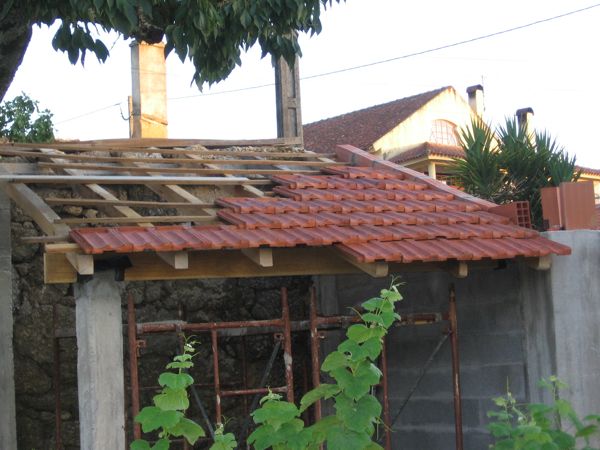

Quite a lot of firsts in there (for me). I've never really built any kind of structure before; previously the closest I got was the wood store. Certainly I've never made a tiled roof. (We used tiles removed from the old roof of the house.) Nor fitted doors and windows (also re-used from the original house). Rendering the interior was also fun :). Yet to do is the exterior rendering; I'll probably get around to that once the bath is finished.
Our next heating question is what to do about the wood burner. It's good looking, but has some serious problems. Currently we are considering ?\ with the help of friends ?\ the possibility of designing and building some kind of tile/masonry stove. Our ideal would be something that burns super-efficiently (which means fast-burning, hot fires), provides immediate heat (such as when we come in later in the evening), stores some heat (so it doesn't have to be fired continually) and offers the possibility of heating water or food while burning. This could be a tall order and some compromise is going to be needed. But we should be able to come up with something better than what we have now. More news in future ?\ perhaps in time for next winter.
Terrace Tiling
We really wanted to make the terrace more usable before the summer. So I finally got to work laying the tiles that have been piled up on it for more than two years.
Here's how it was:

(This picture was taken before we moved in ?Eso in mid-2006.)
Then with the tiling work underway:

(Naturally, a simple square or diagonal pattern would not do; I like to test myself by keeping things complicated!)
And finally with tiling mostly finished:

Stories of Three Doors
Three new doors. One too short. One warped. All good in the end...
Two custom made by a local carpenter to match the existing ones. These are for the ground floor -- one leads into the ground floor 'bedroom' and the other from there into the JAPANESE BATH, which is finally coming to fruition.

The one at right rear leads into this ground-floor space from the stone stairs. Custom-made to fit the narrow entryway, it in fact didn't at first attempt ?Eit was about 10cm too short. Bit of a blow. In the end, they managed to salvage it and gave us bit of a discount because it doesn't look quite perfect.
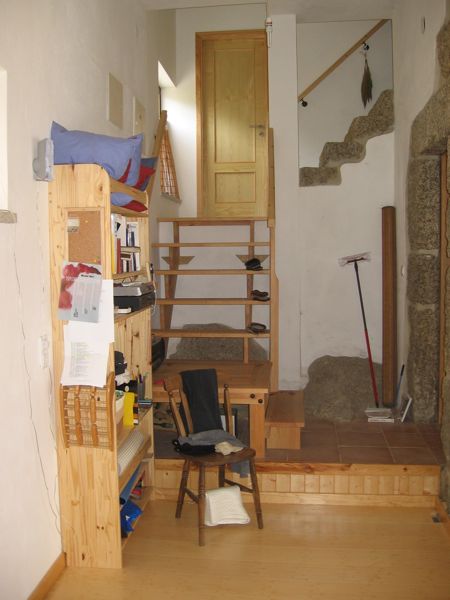
Here it is from the other side.

And this is the third one ?Ewhich finally closes the utility/storage space off from the studio. Note the cat door; this is Momo's route out into the garden. I made this one from tongue-and-groove, and unfortunately it warped by about 2-3cm. I haven't managed to get it quite straight yet...

And here's what's behind the bathroom door... This outer area of the bathroom is pretty much ready. Progress on the bath area itself will come in a separate post.
Drip Watering
Water.... It's only since coming here to Portugal that we've realised quite how important water is. Of course, intellectually, we've always known that without water there is no life. But having lived most of my life in the UK and Japan, there's never been any question that was plentiful. But here in central Portugal things are different. Sometimes we have water aplenty. But summers can range from somewhat dry to completely arid. This year, for example, we probably had a handful of hours of good rain between June and the middle of November. Our well ran close to dry -- low enough that the pump couldn't be used. And we struggled to keep the plants watered.
Fortunately, we decided on a drip irrigation system earlier in the year and had set it up on most of our vegetable beds. This really saved the day ?Eespecially during a period when the pump failed and we had to rely on (expensive) piped water to keep the vegetables alive.
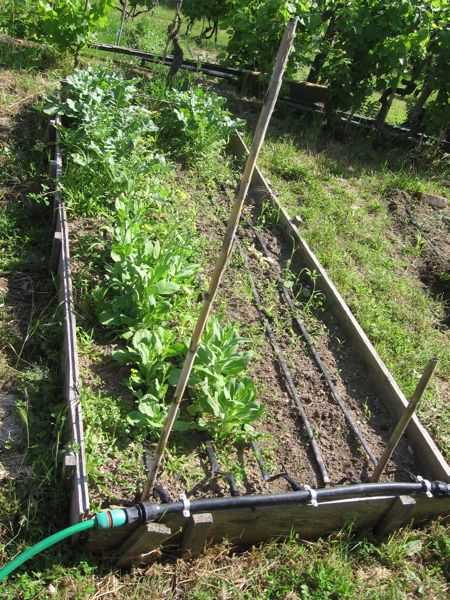


Incidentally, with the well very low, I was able to take photos of the water 'mine' ?Ea tunnel cut out from the side of the well that brings in water from a source some distance away. It's a beautiful bit of construction work that's rarely seen:

The well is a couple of metres in diameter. There's a ladder down to a platform at a depth of about 7 metres. The mine is below that.
Ruin Rebuild
One of the first things we did after arriving here was to remove a wall of piled up rocks that closed off the land to the left of the house. (You can see it in this picture.) Since then, that small area has served as construction site and car park and had the aesthetic appeal of a sand pit. But we've finally got around to starting what we originally planned, which is to rebuild a proper stone wall across the opening and build a garage behind.

In the past, there was actually another small house on the land and two of the walls were still partially standing. We've had them built back up to first floor level, added a wall across the front, and created an opening for the garage and another as a foot entrance.

Here we go ?Ethe first stones go into place for the front wall. Note how simple it is to build a wall from a rough pile of stones...

A tractor with a simple lift is useful after reaching a certain height. Not that the people who originally built our house ?Ewith walls up to about 8 metres ?Ehad such a luxury. How
- did
they do it? I don't know...

"The garage and pedestrian entrance would look great with antique wood as lintels," said one of the builders. And how to get large enough pieces of antique wood? Well, there's the ruin of a rather nice house across the road from us and there happened to be a few enormous chestnut beams in reasonably good shape. By asking around I found someone related to the owners and, a couple of days later, gained permission to take them out....

Nice pieces of timber! Cutting them down (without bringing down the walls) was quite precarious, as was dragging them out between some neighbours' cars. But then, with a little judicious chain sawing, they went into place beautifully.

And this is as far as we've got. No further progress since this picture was taken in April or May...
Finished Porch
OK, so finally here's the finished porch picture:

A Few Photos
Here are just a few photos from the many taken over the past few months...
First, beautiful golden vines in the November mist. This vineyard is near Bobadela and Oliveira do Hospital, perhaps 10km away from home. We'd stopped here to check out an ancient burial mound by the road and the vines just happened to be over the fence...

Back in September we went on a guided eco-walk around the village of Chão Sobral, in the hills between the Serra da Estrela and Açores mountain ranges. It was an early start and we had a couple of downpours during the drive over there. But when the sun poked through the clouds as we descended into the valley of the Alva River, I had to stop for this shot. The village across the other side is Aldeia das Dez, a lovely place with a rather fantastic hotel/restaurant overlooking the mountains.

Snow has come early this year. This photo of the Caramulo range (with Tabua in the foreground) was taken from our terrace a week or so ago. Since moving here we've seen snow up on those hills only a couple of times.

2008 Olive Harvest
Our olive trees were looking fairly healthy this year; a reasonable amount of fruit. But with only five or six trees, we have no hope of reaching the minimum batch size required at any of the local presses. So when our friend Dave suggested working together to harvest his and ours, we readily agreed. (He was on his own this year and, with about 40 trees, was keen for some help.)
So, we spent the first couple of weeks of November working together in beautiful weather, mostly on his land but also picking our olives.

We had additional help sometimes, as people dropped by for a half day or whatever they could spare to help out.

Friend Yumi was visiting for a few days and helped out with our trees:

Here's the harvest from our few trees, a handsome 150-170kg:

Because Dave was leaving towards the end of November, we got the harvest in reasonably quickly and managed to get to the oil press in Tojais quite early. As a result, we were able to have the olives processed in just a few hours. (Friends who went a week later had to wait four or five days for their turn...) Here are the olives making their way through the initial batching/cleaning/weighing process:

The hot water used in the press comes from this boiler – which is fired with the waste olive mash left after extracting the oil:

After crushing and then mixing with hot (warm?) water to extract the oil, centrifuges are used to separate oil and water. Here the beautiful yellow-green oil is running out for delivery into tanks – one for each batch:

This is a pretty high-tech press. There are some advantages to that. First, the temperature at which the oil is extracted is said to be lower – less heat means less damage to the flavour. And the modern machinery gives a higher yield too; this time we got about 1.4 litres of oil for every 10kg of olives.
Here's Dave filling our sundry plastic bottles, glass flagons and other containers from the final holding tank:

The whole process – from dumping the olives into a hopper to receiving the oil – took about four hours. Plenty of time to poke around the facility, get a cup of coffee and a cake at a local cafe, and simply sit around enjoying the sun. Had the opportunity to take a good look at the still; making bagasu (grappa) is a sideline at many olive oil presses during the wine making season:

Finally – A Japanese Bath?
This is something we've been talking about forever – getting a Japanese-style bath built. Finally we can see the light at the end of the tunnel!
Our plan has always been for a large stone tub with a recirculating hot water system. It's to go in the ground floor bathroom, which until a few months ago was just an empty shell of a space. Here's an account of progress so far.
First, I worked on the outer 'dry' area earlier this year – tiling, installing WC and washbasin, etc. No great difficulties there. This is what it looks like (from within the 'wet' bath area):
Then, the first thing to do in the 'wet' area was the drains. Here's the plan:

The large stainless drain unit is from Japan; I couldn't find anything equivalent here or in the UK. The left-hand branch of this drain will be for the bath. You can see it in this photo, where I'm building the formwork for part of the concrete tub structure:

I didn't feel comfortable attempting to pour the whole of the complex tub shape in one go, hence the formwork and concrete pouring was done bit at a time over a period of a few weeks. The concrete is reinforced with a mixture of steel bars and chicken wire. Here's that same section (hollow, to allow the drain out and also to take the recirculation pipes) after pouring:

Next the seat section at the other end of the bath; this was a little more tricky because of the sloping seat back:
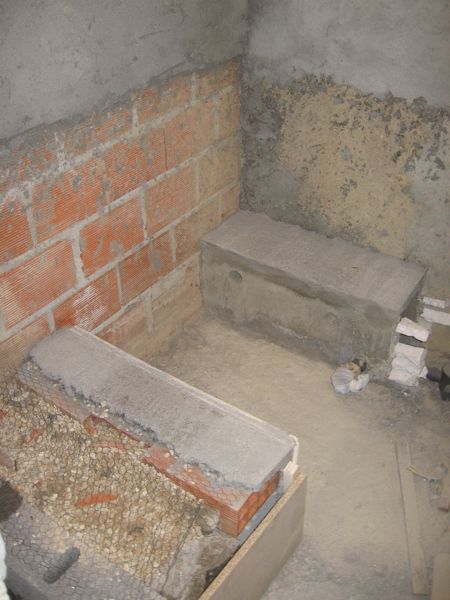
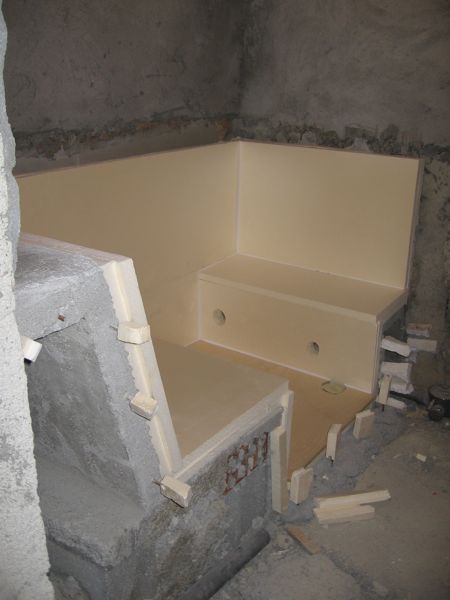
Note the double thickness of foam insulation that lines the inside of the tub. We hope to retain most of the heat in the bath water from one day to the next. The final concrete pour was the whole front wall of the tub. (I tied the various poured sections together by extending the reinforcing bars out beyond the poured concrete and tying bars together with wire.)

Here it is with the formwork removed and most of the insulation in place:

I've already installed the pipework for recirculation and have just been working on underfloor heating for the area outside the bath (the shower area). Taps and shower head units have been ordered from Japan, so we are getting close. We are hoping to have the whole thing finished by the end of the year.
What's left to do? Well, I have to seal the inside of the tub. The plan is to use a thin layer of epoxy resin and glass fibre matting. By including some fine sand in the resin, this will leave a key for later fixing slate tiles in place using tile cement. In the shower area, the mortar for the heated floor is almost done, so the next step will be to tile it – and that will be it. The only possible holdup so far is the slate; we haven't sourced slate tiles yet.
Cafe Brasil
Arrive to visit us by train and we'll probably have a coffee or something stronger at Cafe Brasil, which is just in front of Santa Comba Dão station (which is actually in the village of Vimieiro, across the river Dão from Santa Comba).  In fact, getting here by train is a pretty sensible option. From Paris, it's an overnight (sleeper) journey with just one change. London of course is just a Eurostar further away. And from the airport in Lisbon, train is the best option -- the station is a short bus or taxi ride away from the airport and there are a couple of direct intercity trains a day.
Roman Bridge
The Roman bridge over the river Dão at Ferreiros do Dão.

What a mess!
I apologise for the sorry appearance of our blog. We were attacked by malware – as were all the other sundry websites that I host – and it's taken a while to get things under control again. This blog will not return to the way it was before; the software was too old and in fact that's what allowed the bad people in. But I hope to make it look a little better sometime in the near future. For Japanese readers, in particular, things are difficult. All the Japanese text on the blog is completely destroyed and will have to be replaced... I'm working on that now