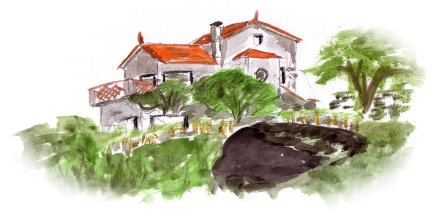
Vindima
As the summer draws to a close, we feel the grape harvest and wine-making (vindima) coming on. We live in an area of tiny smallholdings, where almost everyone has vines enough to keep them in wine for the year. Although it's rare to see anyone out on the land checking their grapes, we know they must keep an eye on them, checking ripeness and counting forward to estimate when the harvest should take place – taking due consideration of the weather forecasts, too.
In our village, a weekend is usually chosen for the main harvest, allowing distant family to get away from their city commitments and come to help. Somewhere around September 20th is the norm, a little earlier or later depending on the year. Unfortunately, we can't any more take our cue from our immediate neighbours – who we have previously relied on to give us a hint as to the appropriate timing. Dona Alice's legs won't allow he to climb up and down the steep terraces and her sister Rosa is not really interested. The two of them are old enough to sit back and let a younger generation take over. But it's not the domain of daughter Helena; and her husband is so unwell after an accident last year that he seems unlikely to ever take part again. Further down the line, the only grandchild is living the modern city life; it's not his thing at all. The land and vines are becoming overgrown and perhaps the grapes will go to waste this year….
It's been a hot summer, so Megumi and I decided to begin early this year. We'd been tasting the grapes and they certainly seemed sweet enough. So we were harvesting our white grapes before the middle of the month, gathering them into large buckets, treading them a few buckets at a time, and pouring the mash into a large 300-litre plastic tub. Some traditional wineries still have beautiful granite tanks for this process, while most smallholdings have a brick-and-cement one. The modern plastic alternative suits us better.
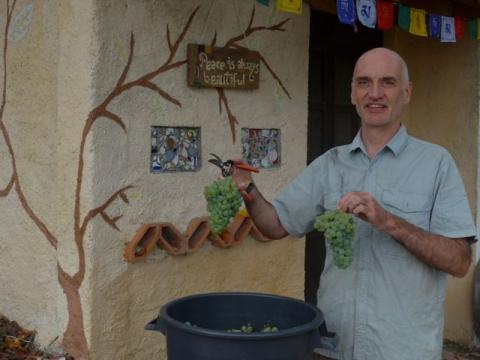
A couple of perfect bunches...

We tread small quantities at a time in a bucket. Traditionally there were big open tanks, often of granite, where dozens of people would tread the grapes together while singing and dancing.
By the time we've got the last of the grapes off the vines, mashed underfoot and into the tub, the mass of grape juice and skins is already fermenting. (It's amazing how quickly the natural yeast on the grapes gets to work.) It's not good in this case – because the aim is to turn the white grapes into juice. We are not really partial to the white wine we get from them. So… quick, quick – drain the juice out of the tub (leaving behind the skin and stalks) and get it up to pasteurisation temperature as soon as possible! We use a couple of large (30-litre) stainless pots. 80°C for 20 minutes is supposed to do it. Then into sterilised wine bottles. Quickly cork them to stop any bacteria getting in!
Unfortunately, something went wrong – the juice started to ferment. That meant going through the whole pasteurisation process again. Oh well, all is well now and we have about 70 litres of sweet grape juice to see us through the year.
I did keep back about 25 litres of the juice to turn into wine. A glutton for punishment, I'll try once again to get a decent white wine out of these grapes! We'll see if a commercial wine yeast makes any difference – along with a more careful separation of the wine from the lees (sediment) after a week or two.
Next, out with the skins, called bagaço. They are a valuable resource because they still contain a lot of juice – which by now is quickly turning into alcohol. Later we'll put them through the alembique (still) to extract a spirit that in Italy is known as grappa; here it is also called 'bagaço' or, more properly, 'aguadente bagaçeira'. For the moment, though, this heady mash needs to be stored, which we do in large plastic bags.
Visitors Gwen and John arrived in time for the next stage a week later – the red grapes. Many hands make light work, and by mid-afternoon we were finished – about 150 litres of must in the big red tub. Again, next morning it was fermenting well when I went out to mash up the mix. (Much of the colour of red wine comes from the skins, so the juice and skins are mashed together for a few days to extract as much colour as possible.)


A fine bunch of red grapes.

More treading...
This year I've decided to experiment a bit. We haven't really been happy with our wine over the years. Our grape varieties are not particularly good, so we can't expect too much, but I'm hoping to find a way to get the best out of them. So instead of going into a wooden barrel, I split the 80 litres or so of liquid I drained from the tub a week later into three plastic fermenters – the kind I usually use for my beer-making. To two of them, I added different varieties of commercial dry yeast for wine making. I don't know if it will make much difference at this stage – when the wild yeast already has such a good foothold and has half-fermented the juice. We'll find out later!

Fermenters in front, buckets of bagaço behind on the right, crates of juice behind on the left, and the large tub (covered in a white cloth to keep the flies out) at the back.
And that was the harvest, or so I thought… sixty or seventy litres of grape juice and seventy or so litres of red wine. Plenty!
Megumi then had to leave – for a stint of peace work in the Middle East. I had a chat with the neighbours and noted that it would be a pity to waste all the grapes… And that's how I found myself offering to make their wine for them. So I got back into it – harvesting about 20 large 25-litre buckets of grapes and then hauling them up from their lower terraces to my work area. Treading them, a few kg at a time, into a pulp. Pouring them into the tub. Until, after a day and a half, I had another 200 litres of must.

The skins give a lot of colour to the wine. This is day one of a four or five day mashing process.
I've just started getting a 100-litre barrel ready to transfer it into at the weekend. (Barrels dry out and, to ensure they don't leak, need to be filled with water to expand the wood again before filling.) So in a few days, I'll have a lovely traditional wooden barrel bubbling away in our utility/store room with more wine. That's below the main house, so everywhere will be smelling wonderful for a few weeks!

Within a day or two, the oak will fill out as the water soaks in and the leaking will stop. Only then is the barrel ready to take the wine-to-be.
- Log in to post comments